Special edition of the Poetry Aotearoa Yearbook to giveaway
Thanks to Massey University Press (MUP), Landscape Architecture Aotearoa has a single copy of the 2026 Poetry Aotearoa Yearbook - doubling as a 75th Anniversary edition and 60th volume - to gift. Just in time to mark this year’s National Poetry Day on Friday 28 August. DETAILS BELOW.
In her 2026 publisher’s foreword to this year’s Poetry Aotearoa Yearbook, MUP’s Nicola Legat refers back to the words of its first editor Louis Johnson, who in 1954 commented that a great number of people “want to grapple with their situation, and the truth of it, in a way that only poetry and the dedication to it can make concrete”.
He held the role for 13 years, and in 1963 expressed confidence that, along with painting, poetry was up to the challenge of being “least affected” by the nation’s recent encroachment of regular TV screenings. Leggat suggests that Johnson would be astounded at the yearbook’s sustained growth as its “net continues to go fishing”.
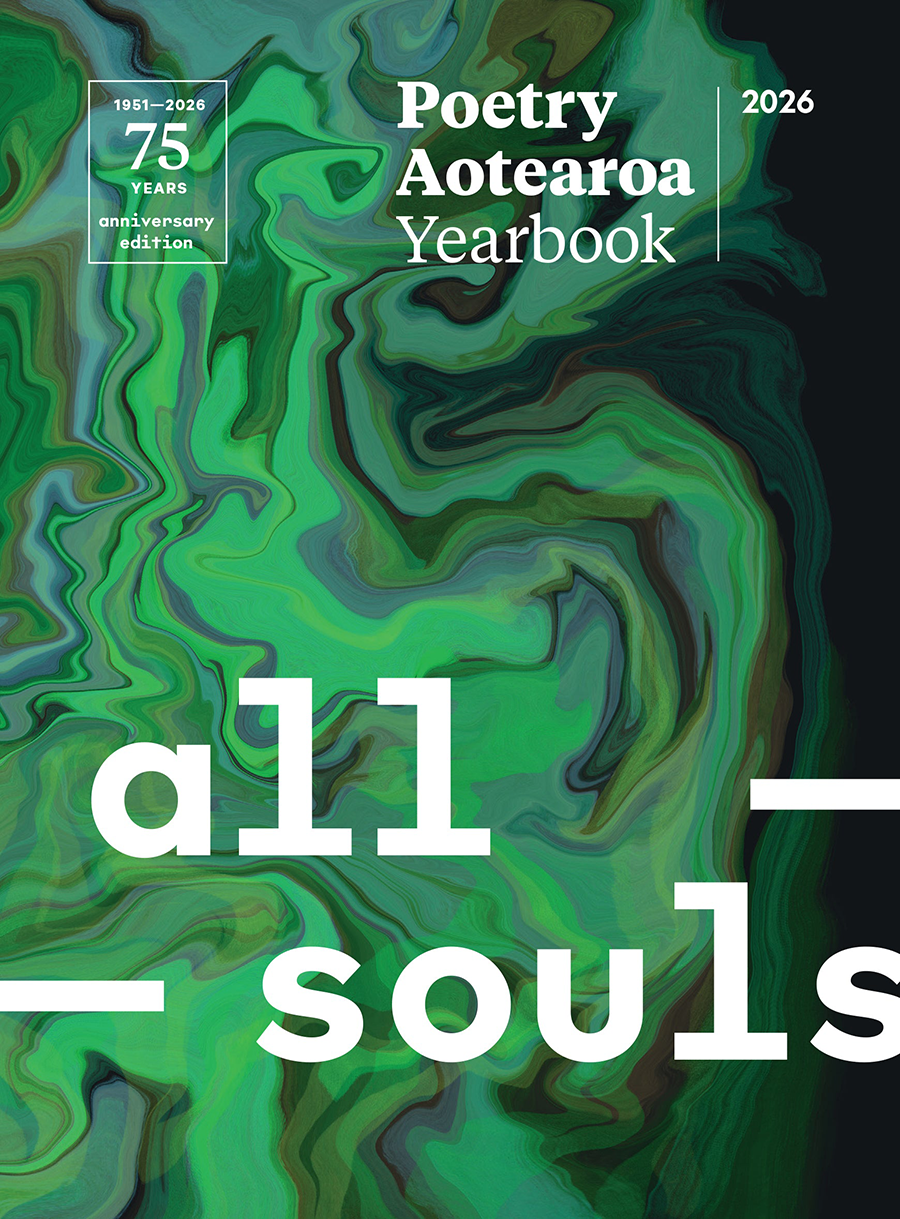
How to be in the running for a gift copy of the Poetry Aotearoa Yearbook
To enter the draw for a copy of the 2026 Poetry Aotearoa Yearbook, all you need to do is to identify the final, single word at the end of the three lines below, directly after AND _ _ _ _ _
.
To make a prairie it takes a clover and one bee.
One clover, and a bee,
And ________.
Send your answer to laaotearoa@nzila.co.nz by this FRIDAY 21 AUGUST.
(This is extended date. We will publicise the ‘winner’ in our next e-bulletin on Tuesday 25 August).
_______
.
An added note: Unless you have one handy, no you don’t have to submit a poem of your own. If you’re not a poetry writer, please feel free though to include any pointers to a favourite poem if you have one, or any reasons why poetry is a ‘go to’ for you!)
For inspiration we recommend these two poems:
Brian Turner’s Place - Scottish Poetry Library
Bernadette Hall’s The landscape of longing - Poetry Shelf
Connecting back to Notions of Poetry and Landscape

It’s well accepted how prevalently interwoven arcadian visions and pastoral influences related to poetry, painting and landscape can be.
But what of more modern times?
Publications like Craig Potton Publishing’s Here On Earth (1999) are a relatively rare testament to how infused the literary history of Aotearoa New Zealand is by expressions of human feelings, understandings, and experiences of landscape.
Well out-of-date now, it delivers a non-sequential, male-dominated legacy of poems from C K Stead, James K Baxter, Basil Dowling, Ruth Dallas, Hone Tuwhare, Denis Glover, John Newton, A R D Fairburn, Allen Curnow, Alistair Te Ariki Campbell, Sam Hunt, Chris Orsman, Lauris Edmond, Keri Hulme, M K Joseph, and Brian Turner - alongside 23 other influential writers such as Witi Ihimaera Smiler, who recently joined the living circle of Aotearoa New Zealand's most significant artists through being honoured at the Arts Foundation’s Icon Awards Whakamana Hiranga.
Rather than poetry it seems that essayists have gained an increased prominence in the sense of communicating important critical writing within the ‘landscape space’; be that the enduring work of Geoff Park through to all the authors who contributed to the Landscape Foundation’s Kia Whakanuia Te Whenua | People Place Landscape in 2021.
It’s a stretch to say things like poetry reading lists for landscape architects are a missing resource, although there is at least one for architects that could be first resort, and looking more widely LAA managed to surface a set of learning resources dedicated to poetry, art and landscape from the UK.
One of the few findable antecedents connecting poetry directly with the world of landscape design/ architecture is located in a 1998 edition of Lincoln University’s journal Landscape Review under the title: Teaching landscape/ language: poetry and landscape in the design studio The edition, edited by Jacky Bowring, was widely themed around uses of 'language' in landscape architecture.
Co-authors Patricia McGirr (University of Massachusetts Amherst) and Joni Palmer (Iowa State University; now University of New Mexico) began their contribution by writing that
In the past, landscape design was an art closely allied with poetry [but that] the 'poetic approach' to landscape design has been replaced by the demands of professional standards.
Their paper argued for re-establishing a place for poetry in landscape design and landscape education, beginning with the introductory-level studio. In one such seven-week long studio they were able to show how the expressive language of poetry could be used to understand the emotive or poetic qualities of a landscape .
Through a series of projects, students discovered a number of languages related to reading, writing, representation, poetry and landscape design. McGirr and Palmer: “By languages of design we mean: drafting; sketching; verbal and written representation; reading a site; using one's body to measure and respond to a site; expressing one's ideas creatively; craftsmanship; thinking creatively; communicating with visual and written material; landscape history and historical precedents for design; design principles; emotional and intellectual meaning in the landscape. All these we see as languages in which a student must become proficient in order to become a good designer. Although there are other languages a student must learn, this studio was only seven weeks long and so it was necessarily limited in its scope”.
Graduate students were tasked with choosing a poem from a selected Massachusetts poet, to become part of an assigned site design based on their explorations of poetry and through one of three scenarios: a written text to be read in the landscape; a bas-relief sculpture displayed in the landscape; or the use of the bas-relief design as a landscape-scale armature upon which to construct the overall space. McGirr and Palmer found that “most projects had begun to successfully create landscapes for poetry but not necessarily landscapes that were poetic”, adding “the most difficult aspect of this exercise was getting students to think non-literally. Although their interpretations often veered toward realistic representation, we continued to push them into thinking abstractly and metaphorically”.
At the time McGirr and Palmer ended their paper by stating they had “no intention of abandoning metaphor, poetry or meaning, as these are important languages with which students should be familiar. These students will soon become designers, writing their own landscape texts. Their language should be rich and multi-layered, and full of emotional and intellectual significance. Teaching them the language of poetry in the landscape can contribute to their understanding, and broaden their approach to the language of landscape design”.
For last year’s mention of National Poetry Day on LAA see:
An ode to magnificent Mosses - in data (and poetry!) - Landscape Architecture Aotearoa, 22/8/25