The New Planning System and Urban Design
by Anthony Vile, Urban Futures Research Lab
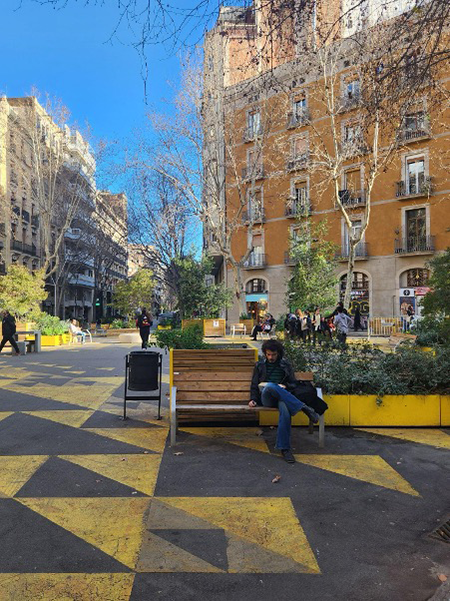
Barcelona, 2024. Photo: Anthony Vile
So here we are, facing the imminent demise of the persistent Resource Management Act, and its replacement with a planning system built around greater freedom to use and develop land.
As many have commented the arrival of the Planning Act leaves the value of landscape architecture and urban design exposed.
The Act directs decision-makers to disregard the character, appearance and aesthetic qualities of a use, development or building. In other words, a design panel saying "We don't like the design character of this "is no longer simply a weak proposition. That judgement is largely out of scope.
But an urban design framework saying:
"This is the agreed spatial structure for the precinct: movement network, density distribution, public-space network, landscape and ecological structure, interfaces and built-form relationships."
is much harder to dismiss.
That's the difference between design control and spatial strategy.
This is where the experience of New South Wales (NSW) is relevant to New Zealand architects, landscape architects and urban designers.
NSW's reforms don't abandon planning nor the value of design. They move it upstream into state, regional and strategic planning, then speed up assessment where the strategic questions have already been resolved.
NSW is also retaining codified design quality mechanisms. The principle is essentially: establish the framework for good outcomes upstream, then provide greater certainty downstream.
New Zealand's emerging system has a similar opportunity. Its statutory framework puts greater emphasis on enabling landowners while establishing national direction, regional spatial plans and land-use plans. Whether that produces genuine spatial strategy rather than simply fewer constraints will depend heavily on implementation.
The risk for New Zealand
The system could go one of two ways.
Version A — "liberated property rights"
Property rights
→ fewer controls
→ fewer consents
→ developers largely determine outcomes
→ planning intervenes mainly for effects.
That produces a very permissive system.
Version B — "strategic freedom"
Strong spatial planning
→ clear growth areas
→ coordinated infrastructure
→ mapped ecological constraints
→ established public-realm networks
→ predictable development rights within that framework.
Under this version once the strategic work is done, individual owners get much greater freedom.
That's much closer to the logic of the NSW reforms — and, in my view, the more interesting question for New Zealand is whether we can make Version B work.
A fundamental question
It gets to a more fundamental question: How do we create a collective city when most of the land within it is privately owned?
The city isn't a collection of individually owned parcels. Infrastructure, ecological systems, streets, landscapes and the public realm run across property boundaries. They don't recognise the lines drawn on the whenua through a colonial system of land ownership — particularly where those boundaries can enable short-term value extraction at the expense of longer-term collective outcomes.
If the new system reduces discretionary, project-by-project regulation, the work doesn't disappear.
It moves upstream. Into spatial planning. Into infrastructure coordination. Into landscape and ecological systems. Into urban structure. Into public realm networks.
And into defining what good urban outcomes actually look like.
That requires a different skillset from much of the practice that has developed under decades of RMA implementation.
Planners and urban designers accustomed to assessing individual proposals against detailed rules and matters of discretion may need to rethink their role.
This could also be an opportunity for design to become, again, a lead enabler of healthy urban environments — not by becoming entangled in things like the appearance of individual buildings, but by shaping the spatial conditions in which development occurs through multidisciplinary collaboration.
As I see it the question is whether the professions are equipped to do that work and whether New Zealand can build the strategic spatial capability necessary to replace case-by-case design and effects assessment.
The first regional spatial plans will be the test. Not only the product, but the processes and procurement strategies that are put in place to deliver them.
See also the Urban Futures Research Lab substack.