New president for the Asia Pacific Region of IFLA
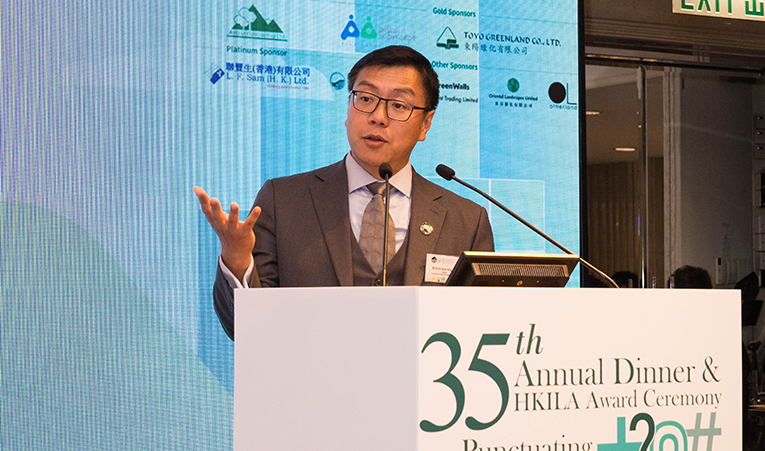
Paul Chan, current president of the Hong Kong Institute of Landscape Architects, is now also taking up the reins of president of IFLA APR - the Asia-Pacific regional chapter of the International Federation of Landscape Architects. (The other regions are Africa, the Americas, Europe, and the Middle East).
Paul is replacing Chris Tidswell who served as IFLA APR president since November 2023 and is a director of the Australian landscape architecture firm Arcadia.
Paul Chan’s tenure will run until 2027, overlapping neatly with the next IFLA World Congress from 28-30 October in Hong Kong next year. He brings a diverse background in architecture, landscape architecture, law and construction project management to the role, was the founding head of landscape architecture at the Technological and Higher Education Institute of Hong Kong (THEi) and in 2015 co-founded Otherland Limited.
Wide ranging endorsement for 2025 IFLA APR Congress
Ahead of the IFLA APR Regional Congress held last month in Mumbai, India, a media release published in The Tribune collected together a strong set of compelling endorsements from municipal and industry leaders for the professional practice of landscape architecture:
Jeetendra Pardeshi, Superintendent of Gardens and Tree Officer, Gardens Department, Brihanmumbai Municipal Corporation (BMC):
Mumbai's density leaves little scope for conventional open spaces, but it also pushes us to innovate - through vertical gardens, podium greens, and terrace landscapes. The contribution of landscape architects is essential to improving our city's environmental health and quality of life. They must be an integral part of every development project.
Keval Valambhia, COO of developer CREDAI-MCHI:
We often mistake growth for development. Growth is natural - but development must be intentional, balanced, and humane. The challenge before us is to ensure that our cities don't just expand, but evolve with purpose. Landscape architecture plays a crucial role in making that possible - it connects built spaces with human emotion and the natural world.
Mala Singh, Chairperson, Mumba chapter of the Indian Green Building Council:
Landscape architecture gives life and heart to our built environment -- it's the foundation of any truly green building. As cities like Mumbai face the realities of climate change, it's essential to make landscape architects integral to every stage of the development process."
Indian Institute of Architects
Darshana Dubhashi, VP, Mumbai chapter of the Indian Institute of Architects:
Growth is collective and collaborative - and when pursued with shared intent, it leads to holistic results. We are proud to partner with the Indian Society of Landscape Architects (ISOLA) in reimagining urban and landscape futures that align with sustainability and innovation.
Landscape Architect Manifesto adopted
An interesting feature of the 2025 IFLA APR Regional Congress was the adoption of a ten-point Landscape Architect Manifesto.
The Manifesto was presented by ISOLA President Urmila Rajadhyaksha and shared with the IFLA-APR executive committee, chairs and official delegates.
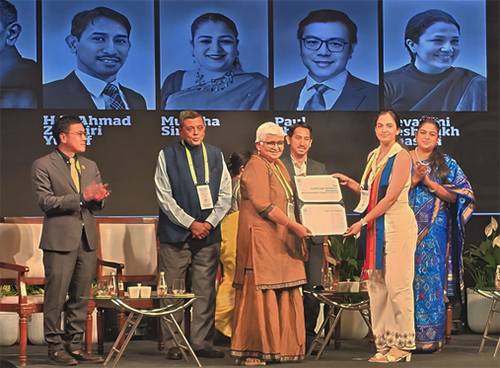
ISOLA President Urmila Rajadhyaksha (left at front) and youth representative Sanjanaa Khemani hold a copy of the Landscape Architect Manifesto.
As outlined on the IFLA APR website, this manifesto is intended as a “statement of identity and purpose, a road map for the discipline and a tool to challenge existing paradigms in which it operates” and has been written “through the lens of critical self-reflection of the landscape architecture discipline targeted primarily at landscape architects operating in the Asia Pacific Region”.
A caveat is given that “only when the landscape architects – both academic and professional - act upon the intent of (the) manifesto will it translate into a public declaration that would collectively communicate the rigour, vision and the aptitude of the discipline of landscape architecture for the coming years”.
At the individual level “it is intended to provide direction, motivation and a critical outlook to the evolving times. A guidance to help maintain focus and serve as a reminder of one’s professional values during periods of self-doubt, challenges and disquietude”.
Key drivers for the manifesto are assertions that the relevance of landscape architecture as a discipline has never been more important to environmental and human well-being, and that the challenges and opportunities for furthering the discipline of landscape architecture is perhaps nowhere as immense as in the APR Region.
The introduction and preamble to the Manifesto put forward various points, including these statements:
… To a certain extent, Landscape Architecture has transcended its traditional identity tied closely to the architectural object and experience, to one that proactively engages with environmental, urban, social, and cultural frameworks on its own merits…
… The pace and type of development, degrees of urbanisation and Climate Change together offer a great challenge in the coming decades; challenges that will indubitably shape the profession as well as enhance and expand its scopes of engagement …
… By adopting new methodologies, tools and technologies, the landscape architect should strive to create liveable cities and spaces rooted in a resilient environment …

[As below the final draft text of the 2025 IFLA-APR Manifesto covers 10 points: Identity, Mandate, Expertise, Inclusive, Climate Change, Economics and Markets, Scales of Engagement, Indigenous Knowledge Systems, People and Culture, Discipline and Advocacy].
01. IDENTITY
The conception of a landscape architect was not with the intent of creating an independent entity to helm a given project or initiative, but one that is ably positioned to navigate between disciplines towards a state of equitable development; one that effectively balances the demands of the natural and built environments as well as people and cultures. Given the overlapping interests and diffused boundaries of in contemporary engagement, Landscape Architects need to redefine themselves as effective stewards of multiple disciplines in fostering a holistic and sustainable outcome.
02. MANDATE
In recent decades, the mandate imposed by Society on a Landscape Architect and one that is self-imposed by the professional are fast evolving and has undergone sea change. Given the imbalances between environment risks, cultural homogeneity and the current development paradigm, it is incumbent upon the Landscape Architect to define their mandate; one that is more responsive to context of their engagement and to further the multidisciplinary nature of the discipline. Going beyond the defined limits of a given project, such a responsible mandate is critical in shaping the profession and its pedagogy in the coming decades.
03. EXPERTISE
Landscape architecture operates as a multidisciplinary field ranging from environmental history, natural sciences, geography, cultural studies, fine arts and even wildlife. However, landscape architects are not expected to and by training are not field experts in any of the fields. The expertise of the Landscape Architect lies to simultaneously straddle and balance these lenses through scales of design and planning towards creating effective outcome to ensure a responsive and inclusive perspective.
04. INCLUSIVE
As a Landscape Architect, one is confronted by complex and often conflicting demands, with the need to balance environmental, spatial and user needs. It should be the profession’s self-defined goal to go beyond the stated program in curating a safe and healthy environment not only for its immediate users but also for the land and the biodiversity that are integral to the larger landscape.
05. CLIMATE CHANGE
Climate change and its implications for the planet and society is no longer in the realm of speculative sciences; its impact is both immediate and every day, especially in the more sensitive and vulnerable geographies of the APR. Given the intrinsically multidisciplinary nature of the profession, Landscape Architects are well positioned to foreground Climate Change as a critical and creative challenge rather than a problem that needs to be solved in the short term. As Landscape Architects, several aspects of adaptation and mitigation may well be beyond our mandate; building in resilient methodologies and tools through design thinking remains well within our expertise. The profession should respond to this crisis as an embedded design language in fostering a more positive and transformative process of engagement with environment at society across scales.
06. ECONOMICS AND MARKETS
Market pressures that dictate the growth and quality of built environment have never been as rapid and demanding as in present times. Global market forces continue to shape built fabric that are increasingly anonymous and homogenous across geographies, with the idea of a landscape subsumed within generic solutions. For the landscape architect, this flux is an opportune moment, to be a differentiator not by responding to the market, but through wilful engagement of critical disciplinary tools; one that translates in creation of meaningful, safe and healthy spaces balancing immediate needs with long-term resilience. Each engagement across scales is a valuable opportunity in co-creation of systems and spaces anchored in the lived experiences of the end user.
07. SCALES OF ENGAGEMENT
The inherent nature of the profession allows a landscape architect to traverse different scales of engagement - from design to planning to strategic thinking. Popular misconceptions lead one to believe that the true potential of the profession is best leveraged only at larger scales, thereby undervaluing the professional’s engagement across scales and contexts. The fact remains that irrespective of scale, the landscape architect’s values rooted in nature, culture and society can contribute significantly towards long-term impact; impacts that may not be immediate but evolve and grow with time. Landscape architects should leverage this inherent value and strive to act as stewards to lead ,any and every process of engagement, towards achieving a more holistic outcome - that lies in the inherently - in the capacity of a landscape architect.
08. INDIGENOUS KNOWLEDGE SYSTEMS
Landscape architects, from the APR, must recognize that every land and context they engage with already has embedded patterns and systems evolved over centuries if not millennia; patterns deeply rooted in the ecological, social and spiritual milieu. Responses to environmental and resource challenges evolved and been honed by traditional societies effectively addressing frameworks of sufficiency and not merely for purposes of ceremonial design. At this juncture in human history where environmental challenges are being addressed through technological interventions, perspectives from the global south offer an enormous repository of indigenous practices of managing the land and its systems towards environmental and social sustenance. Landscape Architects operating in the global south marked by vulnerabilities that impact the environment and livelihoods should extend their mandate to acknowledge and recognise this practice as learnings to inform and make their engagement richer. Richer by layering it with knowledge that one can essay to adapt for newer creative opportunities and simultaneously extending depth of the discipline where elements nature is not seen in isolation of its larger practices.
09. PEOPLE AND CULTURE
The role of a landscape architect has evolved substantially over time and gained traction to impact spaces through nature and design. In the growth however, sub consciously landscape architects have unburdened themselves to discuss culture and people, often leaving them to other disciplinary professionals operating in the same realm – thereby devaluing the role of nature with culture, social practices and people. Landscape architects in the stress of a demanding market, unpredictability, risks and vulnerabilities due to Climate Change, must endeavour to root themselves in the cultural expressions, social practices and people’s needs – from the marginalized to the powerful – ensuring commissioned spaces are not just ‘used’ by people to foster new relationships but a becomes spaces for cultural continuity that ‘reflect’ the necessities , impressions and materiality of the context to which caters to.
10. DISCIPLINE AND ADVOCACY
The idea of designed landscapes has held a connotation of luxury and exclusivity in the past. At this critical juncture in our environmental and social transformation, the profession’s focus should be a wilful shift away from this imagery to actively integrate concepts of equity, justice and resilience. While the visible outcome will continue to be dominated by large-scale private developments, it is imperative that active advocacy pushes the profession’s concerns and contributions in public conversations. Active engagement with contemporary challenges fostered by partnerships with institutional actors, reaching out non-traditional geographies and through forging collaborations to engage with the marginalized are some strategies critical in foregrounding the relevance of the landscape Architect in contemporary society.
IFLA APR information
Member national associations of IFLA APR are:
Australian Institute of Landscape Architects
Chinese Institute of Landscape Architects
Hong Kong Institute of Landscape Architects
Indian Society of Landscape Architects
Indonesian Society of Landscape Architects
Japan Landscape Architect Union
Korean Institute of Landscape Architecture
Institute of Landscape Architecture Malaysia
New Zealand Institute of Landscape Architects
Philippines Association of Landscape Architects
Singapore Institute of Landscape Architects
Sri Lanka Institute of Landscape Architects
Chinese Taiwan Institute of Landscape Architects
Thai Association of Landscape Architects
Bangladesh is not yet a full member of IFLA but its membership is well underway through the IFLA-APR & Bangladesh Landscape Architecture Initiative.