RMA replacement legislation enters the select committee phase
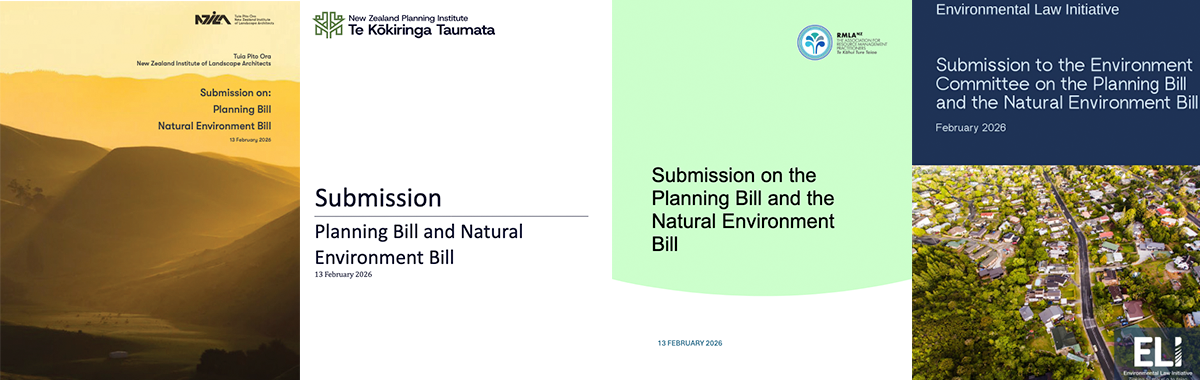
Submissions are now in on the Planning Bill (PB) and Natural Environment Bill (NEB) - about 900 from individuals and approximately 438 from organisations such as businesses, incorporated societies and runanga, as made available on Parliament.nz in the last week.
For readers interested in the organisations who made publicly available written submissions, LAA has compiled an A-to-Z list in a PDF here.
Of chief interest amongst the submissions of course was the one from Tuia Pito Ora New Zealand Institute of Landscape Architects that LAA has been progressively reporting on; followed by many, many other like-minded submissions - some of which include:
Boffa Miskell Ltd (links to a PDF; 13 pages)
Isthmus Group Ltd (.. 4 pages)
Local Landscape Architecture Collective Ltd (.. 7 pages)
RMM Landscape Architects (.. 19 pages) - supplemented by Case studies and exemplars (.. 11 pages)
Wayfinder Landscape Planning and Strategy Ltd (.. 10 pages)
Te Papa Tu Whirinaki - The Landscape Foundation (.. 2 pages)
ICOMOS Aotearoa New Zealand (.. 19 pages)
Resource Management Law Association (RMLA) (.. 125 pages)
Environmental Law Initiative (.. 16 pages)
Te Kokiringa Taumata, New Zealand Planning Institute (.. 143 pages)
Papa Pounamu – Special Interest Group associated with Te Kōkiringa Taumata | NZPI (.. 20 pages)
Tourism Industry Aotearoa (.. 6 pages)
Urban Designers Institute Aotearoa (UDIA) (.. 9 pages)
Urban Design Forum (UDF) (.. 10 pages)
Salient points For the Select Committee
The lead author for the NZILA submission was Shannon Bray, an NZILA Fellow, Registered Landscape Architect and Past President. In behind Shannon were a crew of peer reviewers and contributors, consisting of Alan Titchener, Ben Ormsby, Brad Coombs, Bridget Gilbert, Clive Anstey, Dennis Scott, Di Lucas, Grant Edge, Helen Mellsop, Julia Wick, Nigel Parker, Peter Kensington, Rachael Annan, Ralf Kruger, Rebecca Ryder, Rhys Girvan, Simon Button and Stephen Quin.
Spread across six parts the submission sequentially covers:
Te Tangi a te Manu
Why landscape matters to Aotearoa New Zealand
Well-functioning environments
The importance of clear expectations
Process, participation and place-based understanding
What NZILA supports
Internal contradictions between goals and methods
Where the Bills misalign
Six recommended principles headed up as: Enable Place-based Decisions; One Evidence Base; Shared Definitions; Track Change; Functional Scales; and Implementation Integrity
Outcomes sought for the Planning Bill: Definitions; Goals; Procedural Principles; Effects Outside Scope; Place-based Evidence; Nature-based Systems; and Regulatory Relief
Outcomes sought for the Natural Environment Bill: Goals; Alignment between the Natural Environment Bill and the Planning Bill; Environmental Limits — Management Units and Methods; Indicators, Monitoring and System Performance; and the content and implementation of Natural Environment Plans.
The submission succeeds in addressing issues upon which a planning system with a clear line of sight from evidence to spatial strategy to plan provisions and decision making can be built “directly and proportionately”.
The conclusion states that the PB and NEB move in “positive directions”, with the promise of stronger national direction, regional spatial planning and clearer pathways for tāngata whenua involvement creating the basis for a more coherent and efficient system.
The “however” is that the presence of several structural issues limit the bills’ ability to achieve the outcomes intended. These relate to the absence of a required region-wide evidence base, inconsistencies in environmental framing, the removal of essential information from decision making, and the lack of alignment between the two Bills.
Most importantly, [the NZILA’s recommended changes] seek to protect the landscapes and enhance the landscapes that underpin New Zealand’s identity, wellbeing and economic performance. They [seek to] ensure that development contributes positively to the long-term health and character of the places where people live, work and gather. These refinements represent the most practical and durable way to deliver the intent of both Acts and to support current and future generations through a planning system that is coherent, predictable and aligned with how environments actually function.
Equally importantly the conclusion also includes these two salient points:
Landscape architects work daily with the relationships between landforms, water, cultural connections, built form and lived experience. This practical, place-based understanding shows that environments operate as integrated systems across natural, rural, urban and coastal settings. A planning framework grounded in this reality will be better able to deliver the long-term environmental, social and economic outcomes communities rely on.
The value of getting this right is substantial: by our reckoning, the landscape of Aotearoa New Zealand is a $100 billion driver of national performance, underpinning primary production, tourism, the screen sector and our international reputation.
On top of the substantive content noted above two appendices round out the NZILA submission: one covering definitions of well-functioning environments and one offering the ‘visual amenity’ of a comprehensive set of case studies and illustrative examples with these compelling headings:
The Value of Landscape to Aotearoa New Zealand
Landscape as Framework for Development
Regard for Landscape Supports Growth
Well-functioning Urban Environments
Well-functioning Urban Environments - Residential
Poor Outcomes: Dysfunctional Urban Environments
Well-Functioning Rural Environments
Efficiency through Participation and Place-Based Design
Landscape Mitigation Enables Urban Infrastructure
Landscape Mitigation Enables Rural Infrastructure
Predictable Decision-Making: Rejected Infrastructure
Essential reading for all Government Ministers, Opposition spokespersons and select committee members. (LAA also gets the feeling that if there was an Award Programme category for Submissions this would be a front-runner!)
The next step
The next step will be for the Environment Committee to call for selected submitters to speak to their submissions at upcoming meetings over the coming weeks with clear signals that this will start occurring sooner than later.
At the same time, it’s also worth noting that legislation has been introduced to the New Zealand Parliament to establish the new Ministry for Cities, Environment, Regions and Transport (MCERT), a key step in delivering the Coalition Government’s current reform agenda across housing, transport, urban development and the environment.
The Environment (Disestablishment of the Ministry for the Environment) Amendment Bill is now moving at speed to integrate the Ministry for the Environment into MCERT alongside the Ministry of Housing and Urban Development, the Ministry of Transport, and the local government functions of the Department of Internal Affairs. The timetable for this has set down that MCERT be established from 1 April 2026 and become operational from 1 July 2026 with the chief executive of MCERT fulfilling the role of Secretary for the Environment.
Other submissions of interest on the PB and NEB
Recreation Aotearoa - PDF link here
Forest & Bird - PDF link here
Urban Auckland - PDF link here
Urban Development Institute of New Zealand (UDINZ) - PDF link here
Beca - PDF link here
Engineering New Zealand - PDF link here