Looking Back On The Landscape (2)
by Alicia Keating, guest curator
From programmable calculators to CAD, GIS, and now artificial intelligence, landscape architects have repeatedly encountered technologies that promised to transform practice.
Reading back through The Landscape reveals a profession continually adapting — cautiously, enthusiastically, and sometimes anxiously — while negotiating enduring questions around creativity, expertise, efficiency, dealing with change and valuing innovation.
Current anxieties surrounding the introduction of artificial intelligence seem to demand hardline opinions on how and when it can and should be used. Do visualisation tools flatten creativity and overpromise on the finalised design? At what point in the design phase is it ethical to use AI, if ever? Is hand drawing dying? Will we all be replaced?
Ever-present is this sense of urgency, that the challenges we’re facing today are bigger and less manageable than the ones we’ve faced before. Reading back through our professional legacy, however, tells a different story.
The pages of The Landscape reveal a profession encountering digital technology not as a sudden disruption, but as a gradual and unfolding reality. Contributors were trying to make sense of a technological future that was morphing every few years.
Graeme Robertson’s 1980s description of a CAD workstation, using terms and names like “a video screen similar to a television,” an “electronically sensitized draughting board,” floppy disks, plotters, and a handheld “puck” used to assemble drawings digitally, may land differently in 2026.
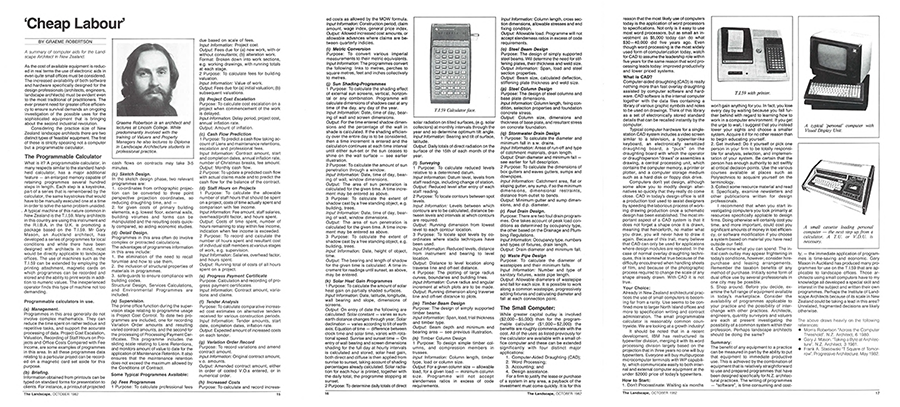
Graeme Robertson’s 1982 article appeared in The Landscape No. 15
But much of the article he wrote back in 1982 feels surprisingly prescient. Robertson describes offices confronting pressure to modernise in order to remain economically competitive, writing that “the ever present need for greater office efficiency to ensure survival demands an on-going investigation” into emerging electronic technologies.
The pressure he describes is not driven by curiosity alone. New technologies rarely remain optional for long. Once adopted by part of the profession they begin to reshape expectations for everyone else.
In contrast to current discussions surrounding artificial intelligence, early conversations about computing were not framed as a direct challenge to the role of the designer.
Robertson reassures readers that “computers don’t yet design,” presenting CAD as a production tool that could accelerate documentation after the major design decisions had already been made. That he needed to include this disclaimer is telling. Even at these early stages, landscape architects had concerns about the boundary between technological assistance and human touch in design.
Artificial intelligence has revived that question in a new form. While CAD altered representation and documentation, AI seems to be edging beyond being a digital aid and into creative labour itself. Whether that distinction proves as significant as it currently seems remains to be seen. What is clear is that the profession is once again debating the relationship between technology and judgement.
If Robertson's article focused on how computers might change the way landscape architects worked, Tony Jackman was more interested in how they might change the level of analysis possible within a project timeline.
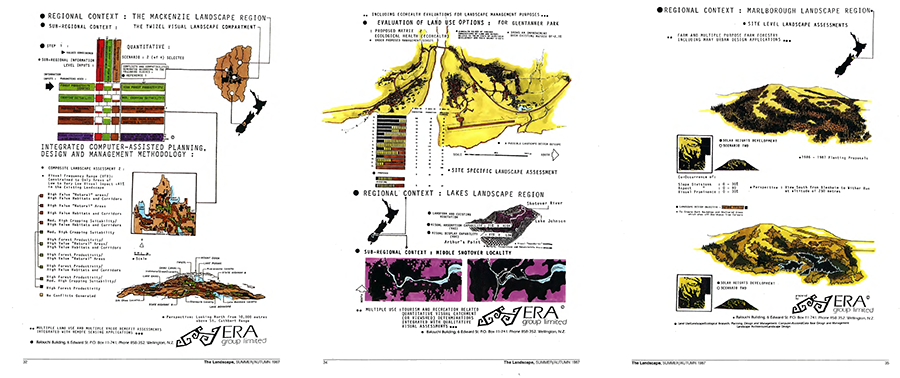
Tony Jackson’s 1987 article appeared in The Landscape No. 32/33
In his 1987 article ‘Top Down and Bottom Up’, he argued that “there is no better tool than the computer” for demonstrating the breadth of landscape planning as a discipline. He also described it as “the only tool capable of assembling and evaluating the many resource use options available.”
Jackman saw the computer as a means of extending the profession's capacity to engage with complex systems. While his article focused on the use of early forms of GIS in landscape planning, he frames its utility as a tool to synthesize an ever growing amount of information. His argument was framed as a matter of responsibility.
“We can hardly afford not to use the computer as an aid in resource decision making,” he wrote, warning that failing to do so meant knowingly allowing wastage to continue. Elsewhere, he argued that effective planning depended on having “‘real time’ information, and a great deal of it, immediately available.”
Much of the enthusiasm surrounding artificial intelligence rests on a similar premise that emerging technologies can help practitioners work with more information than they could reasonably process alone. Every task that becomes easier creates space for another form of work.
Supporting a larger professional purpose
The articles in The Landscape suggest that technological capability has never been the central question. Robertson was interested in efficiency. Jackman was interested in better decision-making. In both cases, technology was valuable because it supported a larger professional purpose.
Injecting a current-day perspective, it’s becoming pointless not to acknowledge that artificial intelligence is proving effective at reducing time spent on routine work. If so, its greatest contribution isn’t replacing professional expertise, but creating more space for the parts of practice that depend upon it.
The qualities that define landscape architecture are not simply products of information processing. Understanding cultural meaning requires empathy and connection with other people. Designing for accessibility requires theory of mind, and doing it well goes beyond understanding the building codes.
The value of revisiting articles in The Landscape is not that they provide answers to contemporary debates. Rather, they remind us that uncertainty surrounding topics like new technology is not new. The challenge now, as then, is ensuring that technological change serves the human need at the heart of landscape architecture.
Alicia Keating is a recent Te Herenga Waka - Victoria University graduate who has also contributed to campus life as a research and teaching assistant. You can read more about Alicia here: Finding connection through landscape architecture