Heading into 2026 with eyes wide open
Hard to believe, but by this time next year Auckland’s long-awaited City Rail Link will have, on current projections, been operating for six months - imagine that! - and results from the 2026 General Election will have determined what combination of political decision-makers will run Central Government through to the end of the 2020s.
Not surprisingly the pace of reforms and policy directions being announced from the Beehive in this last quarter of 2025 has accelerated, with Minister Chris Bishop (responsible for RMA Reform, Infrastructure, Transport and Housing) putting his foot down on the pedal.
Alongside some shock-and-awe moves to radically restructure the governance of regional councils, a long-awaited announcement on 9 December has now seen the introduction of the Planning Bill and Natural Environment Bill to Parliament as a replacement for the Resource Management Act.
Members of the Environmental Legislation Working Group of the NZ Institute of Landscape Architects Tuia Pito Ora (NZILA) have already lined up participation in two post-announcement webinars with the Resource Management Law Association and Te Kōkiringa Taumata | New Zealand Planning Institute (NZPI) on the implications of likely changes - the second, on the Natural Environment Bill, is on at noon on Thursday 18 December. The implications are significant and the working group will be convening an NZILA hui in January.
Naturally the state of both the economy and the environment weigh heavily on landscape architecture practitioners and their workplaces.
Efforts taken at the NZILA this year pointed towards an anticipated need for a stronger evidence-base of the work that landscape architects are engaged on for future strategic thinking and positioning. A call was put out for case studies related to spatial planning - a prime feature of the new planning legislation - and also around projects that relate to connections with tourism, Aotearoa New Zealand’s second largest export earner.
Project news: Studio Pacific Architecture
Along with other firms, Studio Pacific Architecture has been keeping LAA supplied with a flow of relevant project news during 2025.
Three Studio Pacific project sites of recent note are the planning done for the revival of the Waiwera Thermal Springs set on the Hibiscus Coast north of Auckland, an updated masterplan for Auckland Surf Park at Dairy Flat, and work on the Peka Peka to Ōtaki Expressway (PP2Ō).
Supplied image
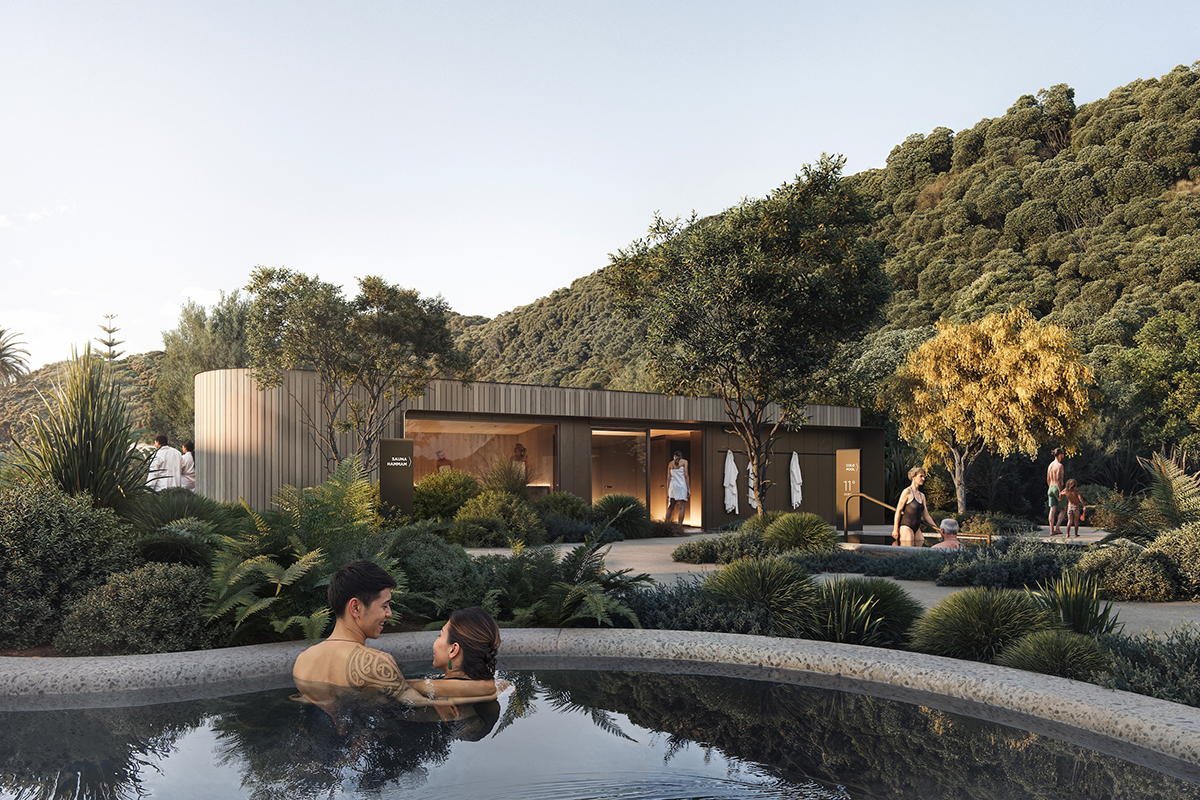
A concept design for the Waiwera site was unveiled on 28 November. Once a popular destination the facilities aged, the former operation closed in 2018 and was then demolished in 2023 leaving the site as a vacant piece of land.
As stated in a recent media release its design will weave pools, saunas, reflexology walks, gardens, and pavilions into a series of outdoor ‘rooms.’ Brandon Batagol, director of Waiwera Thermal Springs, acknowledged the deep ancestral and cultural significance of Waiwera for Ngāti Manuhiri who will be involved as development partners.
An Economic Impact Assessment commissioned from BDO found that a revived Waiwera Thermal Springs has the potential to attract more than 300,000 annual visitors over its first five years and to contribute a Gross Regional Product (GRP) of $300.3 million based on two years construction and five years of operation.
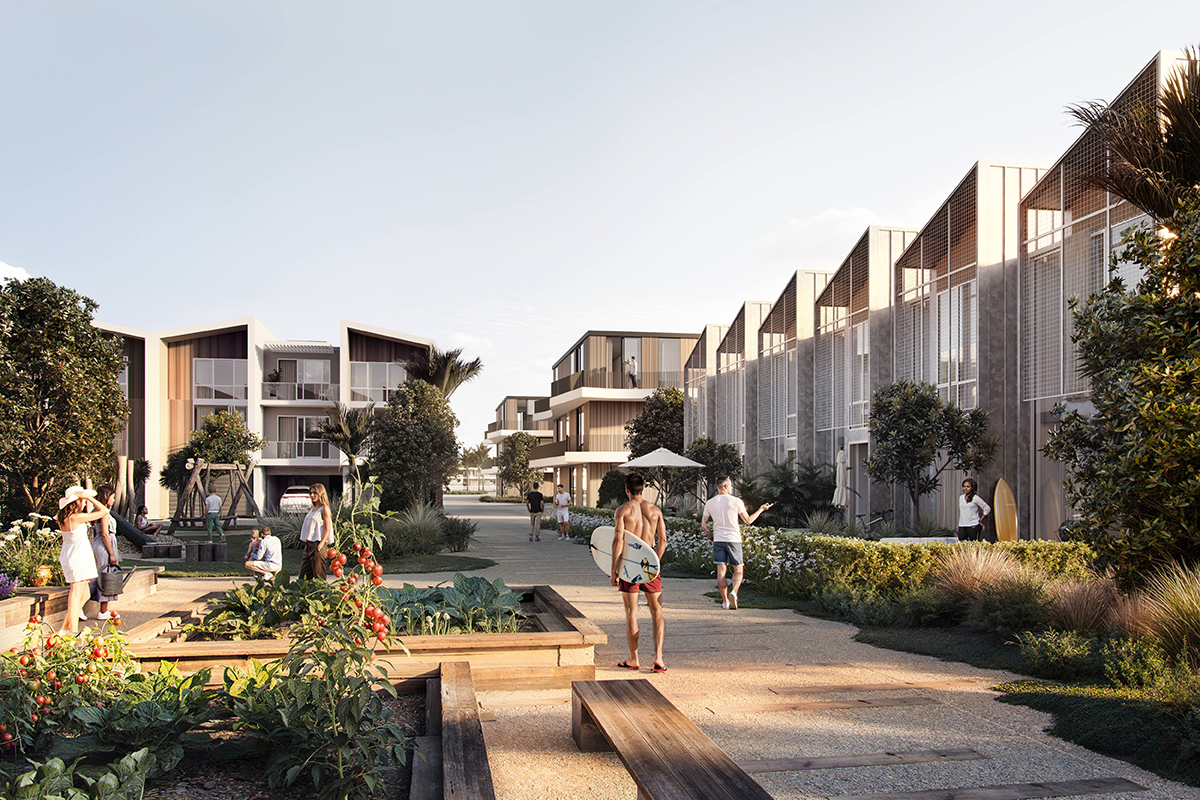
In a not dissimilar fashion, Studio Pacific has been engaged by Aventuur to add broader community outcomes to the Auckland Surf Park project. Studio Pacific’s Stuart Dun, the recipient of an NZILA President’s Award earlier this year, commented in July that the already ambitious project was about more than just surfing, adding “it’s about creating a neighbourhood with lasting value”.
Supplied image
The expanded plan has extended into housing typologies from apartments and terrace houses to duplexes and larger lots, complemented by enhanced walkability, cycle connections, green space and water-sensitive landscape strategies.
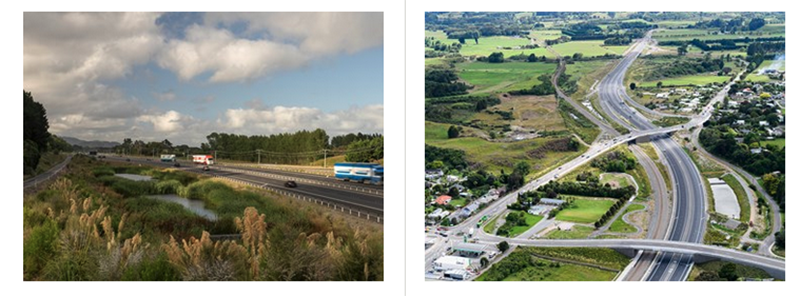
By contrast the sizeable transport infrastructure project that is the Peka Peka to Ōtaki Expressway incorporated regenerative landscape design, public artwork and stories of place, and was shaped as much by its cultural and ecological context as by its engineering.
Worked on with Studio Pacific colleagues by Matt Bangs, a Senior Associate and registered Landscape Architect, the result was a 13-kilometre ‘green corridor’ that combined more than 50 hectares of native planting to connect fragmented habitats and enrich the wider ecological network.
Matt: “At Makahuri for example, a former swamp forest remnant was expanded through targeted planting with areas designated for the restoration of raupō marsh habitat. All plants were eco-sourced, including rare and threatened species, and selected in consultation with Ngā Hapū o Ōtaki. Plantings for rongoā and mahinga kai support cultural harvest, ensuring long-term ecological and cultural benefit. No imported topsoil was used, and local materials were prioritised”.
Developed in close collaboration with Ngā Hapū o Ōtaki the expressway design draws directly from kōrero tuku iho (stories handed down). Bridge markers and sculptural forms reference the Tararua Ranges, ancestral connections, and the region’s three rivers. A ‘family of bridges’ approach unified crossings, while cultural motifs and planting strategies were applied consistently to tie together distinct areas.
A shared path runs the full length of the expressway, linking into local trail networks and providing access to key community destinations such as the Ōtaki River, Smíšek Kilns, and Pare-o-Matangi Reserve. Matt noted that the reserve design was informed by the Keep Ōtaki Beautiful group and local whānau, resulting in a public space that supports both passive and active recreation and reflects community aspirations.
Supplied image
From the infrastructure angle the bridges and underpasses support safe east–west movement for vehicles, pedestrians, and cyclists, reconnecting neighbourhoods previously divided by transport corridors. In the bridge structures, fly ash replaced 334 tonnes of cement, significantly reducing embodied carbon. Advanced design methodologies also minimised the use of concrete and steel. These practical, low-impact choices demonstrate how major infrastructure can adopt sustainable approaches without compromising on performance or durability.
Infrastructure projects loom large
Infrastructure projects across the built environment sector, discounting the retrenchment of Kāinga Ora, have been a constant theme of the current Government, notably through the continued boosting of Fast Track legislation, and at a Crown entity level through the longer-term lens adopted separately by the Infrastructure Commission, Te Waihanga.
A Fast Track hub is located at www.fasttrack.govt.nz where the declamatory descriptor calls it the “permanent Fast-track approvals regime for a range of infrastructure, housing and development projects with significant regional or national benefits”.
The progression of projects - there are more than 140 on the list as a whole - has seen seven approvals, with another 20+ currently in the referral pipeline. The successful approvals to date have been:
Bledisloe North Wharf and Fergusson North Berth Extension | New and extended wharf facilities at Port of Auckland. | Auckland | Infrastructure
Drury Metropolitan Centre – Consolidated Stages 1 and 2 | Residential and commercial land development within the Drury Centre Precinct, Drury. | Auckland | Housing / land
Drury Quarry Expansion – Sutton Block | In stages, develop a quarry with a maximum pit depth of 60 metres over a 50-year period, to be serviced using existing infrastructure and facilities. | Auckland | Mining / quarrying
Maitahi Village | Develop residential dwellings (including Ngāti Koata iwi-led housing), a commercial centre, and a retirement village (including townhouses, in-care facility units, a clubhouse, and a pavilion). | Nelson/Tasman | Housing / land
Milldale – Stages 4C and 10 to 13 | Earthworks and site work for approximately 1,100 residential allotments. | Auckland | Housing / land
Rangitoopuni | Subdivide land and develop approximately 210 residential allotments and an approximately 350-unit retirement village. | Auckland | Housing / land
Tekapo Power Scheme – Applications for Replacement Resource Consents | Continue to use, operate, and maintain the power scheme of Tekapo A and B power stations and substations and the canal system, and connect to the national grid. | Canterbury | Renewable energy
You can download a ready reference listing of projects here - compiled by LAA.
For anyone interested in gauging the big picture of development in Aotearoa New Zealand it’s also worth noting the separate activity undertaken by the Infrastructure Commission, Te Waihanga on its National Infrastructure Plan, its Pipeline dataset and the Infrastructure Priorities Programme.
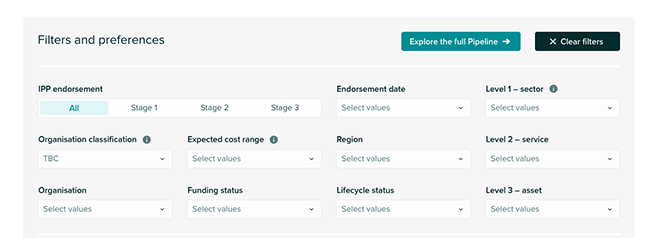
The search screen for the Pipeline dataset.
Te Waihanga’s September Pipeline snapshot included information on almost 12,000 infrastructure initiatives at various stages for 139 infrastructure providers.
More than 2,500 initiatives with a total expected cost of $61 billion were reported as under construction in September. Modelling indicated that work to progress the delivery of these initiatives would result in $2.7 billion spend from 1 October until the end of 2025, and lead to a further $11.5 billion of spend in 2026 as delivery of the initiatives continues.
LAA took its own snapshot of 180 projects that appeared under construction on Te Waihanga’s accessible Insights Platform for six asset categories of interest: Flood protection; Mixed use development; Park, reserve or garden; Separated cycleway; Social housing; and Wetland. This snapshot, in the form a very short video recording can be viewed here.
Since its formation, under a Labour-led government, in 2019, Te Waihanga has become a ‘brain’s trust’ for infrastructure planning.
As explained on its About page the Infrastructure Priorities Programme (IPP) is open to anyone to submit a project or proposal to, including solutions to avoid the need for building new infrastructure, like a congestion charge, as has occurred with a proposal from Auckland Council.
The rationale or intention for this aspect of Te Waihanga’s kaupapa is to “enable an independent approach to identifying and building consensus around the top infrastructure priorities”.
In the last year, up until this month, Te Waihanga has released endorsements for 42 potential initiatives that have been assessed by an independent panel. The major proportion of these have emerged from Local Government (15 transport-related proposals, and 8 for Water/ Waste) and 15 are from Central Government. Curiously though only the details of successfully endorsed proposals are released.
A third call for proposal submissions closed this week. A webinar video has been produced on what a successful application looks like. All proposals are considered against three key criteria:
Strategic alignment. Does a proposal support future infrastructure priorities and/or improve existing infrastructure systems and networks that New Zealanders need?
Value for money. Does a proposal provide value to New Zealand above the costs required to deliver, operate, and maintain it?
Deliverability. Can a proposal be successfully implemented and operated over its life?
IPP proposals can be submitted at different stages, be that an initial idea, on to options assessment or at the stage at which they are ready to be built.
For more on the helicopter overview taken by Te Waihanga see also Building New Zealand’s future: 150 years of infrastructure investment.