Stepping up for landscape architects at ArchEngBuild!
As early career markers go, being the first-ever concurrent landscape architecture student on a winning team at BRANZ’s ArchEngBuild challenge event should stand Konstantinos Antonopoulos - seen speaking at the lectern below - in good stead.
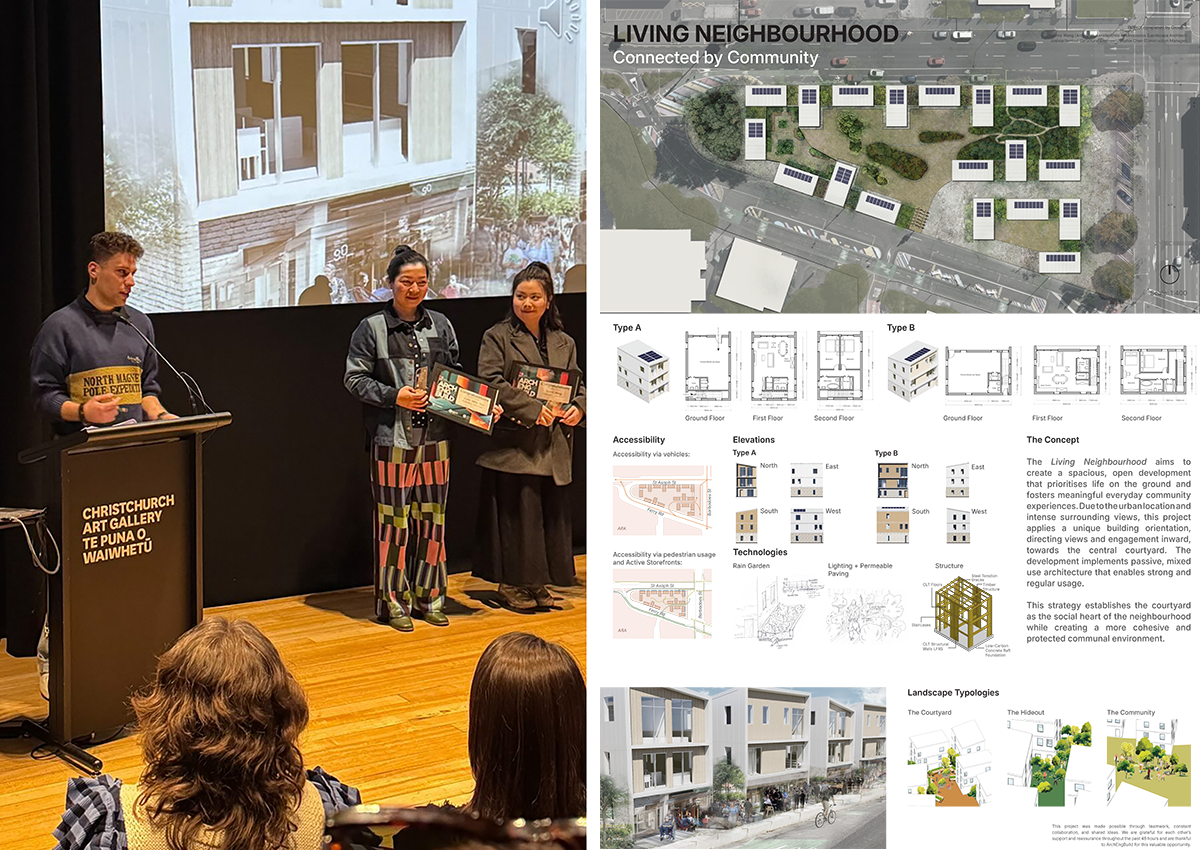
Hosted this year from 30 June to 2 July by the Ara Institute of Canterbury in Ōtautahi Christchurch, the ‘sprint design’ challenge was to come up with a repeatable prototype that could be adapted as part of a wider pattern book of housing solutions across Aotearoa. Not a one-off design, but a solution that could be adopted, reused and delivered at scale.
The teams of students from around the motu - see also the list at the bottom of this article - were shown a 3300m² site, just off the Ara campus and currently used for carparking, that they would be testing their designs within, knowing that each solution would be judged on affordability, quality, sustainability and resilience as well as criteria such as suitability for mixed-use.
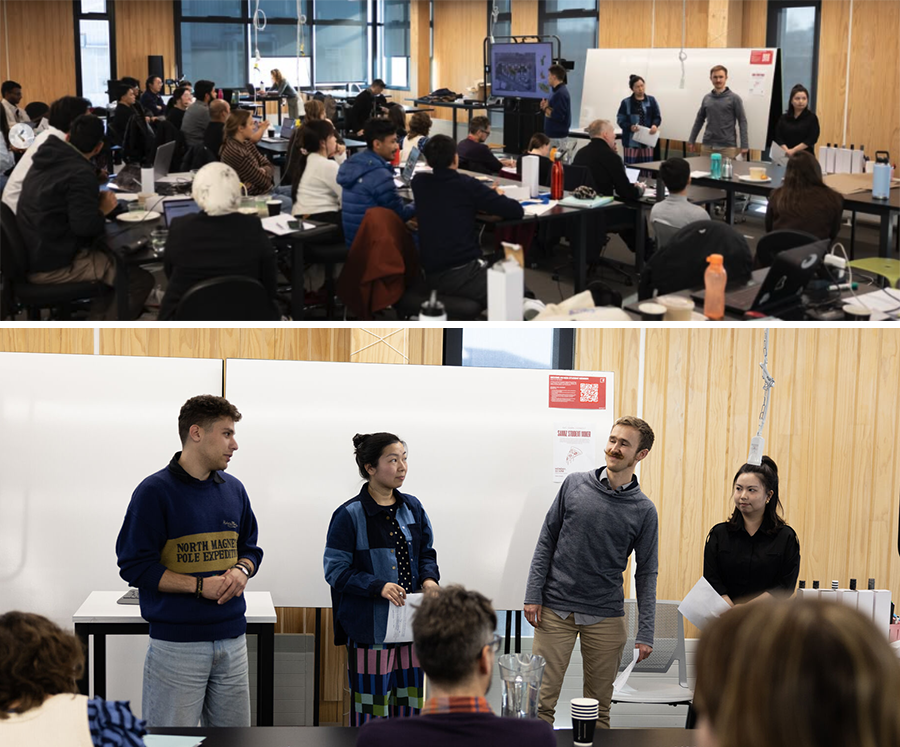
The winning team at the 2026 ArchEngBuild: From left to right: Konstantinos Antonopoulos (landscape architecture - Te Herenga Waka Victoria University of Wellington); Sophie Chen (construction management – ARA Institute); Joshua Rentoul (engineering – University of Canterbury); and Yvonne Wang (architecture – University of Auckland).
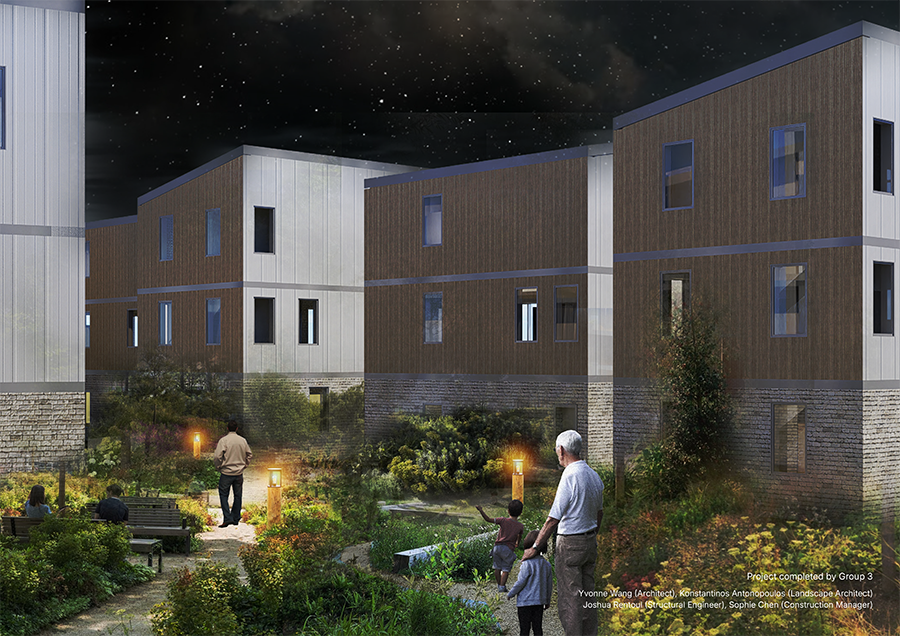
When LAA met Konstantinos after the big win, which saw a $15,000 cash prize shared between Konstantinos, Yvonne (Yuetong) Wang, Joshua Rentoul and Jinxia (Sophie) Chen, we talked about points of difference that helped set the team - self-named ‘Living Neighbourhood - Connected by Community’ - apart.
A former student of Burnside High School, Konstantinos grew up in the Christchurch suburb of Bishopdale, but says that didn’t provide him any “home court advantage”. While dealing with site conditions was an obvious factor, students were asked to think beyond the location.
He believes a prime advantage was paying close attention to the details of the criteria set for the challenge, particularly in regard to mixed-use, as well as team members placing high levels of trust in each other, and, without false modesty, he also credited his natural ease in fronting presentations as a positive contribution he could make on the last day.
With barely three hours sleep on the final night this remained a demanding challenge, so not something that Konstantinos might realistically want to replicate again. “If I did it again I’d suggest teams enter into more engagement across all of their respective ideas early on, and to position those within a contextual, collaborative framework,” he says.
An exciting aspect of the AEB challenge for him was the opportunity for shouldering some responsibility for raising awareness of the role that landscape architecture plays, at least when its given its due level of scope and when the value it adds isn’t disregarded or co-opted.
One hope he has for future ArchEngBuild events is that the influence of introducing landscape architecture into the mix might be made more obvious. (Better ideas needed, but one wildcard was ABLE for ArchBuildLandEng)
He sees a need for greater calibration of the respective inputs of disciplines - perhaps by landing on updated ‘branding’ for the event. Without knowing what that might be he hopes it could convey that design of the ‘built environment’ is as much about the shaping of the entirety of the spaces we live and work in, as it is about single-purpose developments.
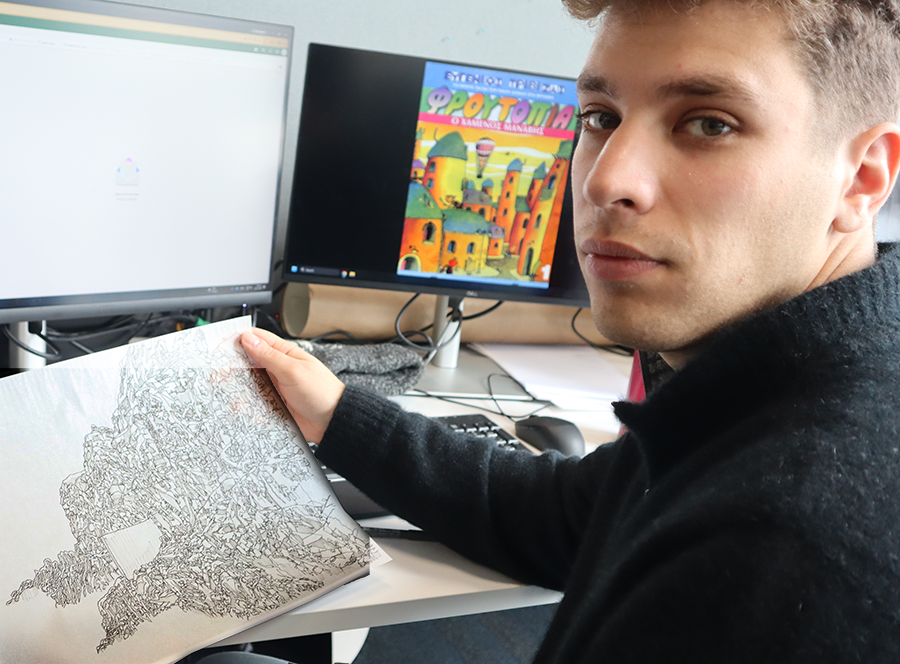
Konstantinos back at work on his studies at the Te Aro campus of Te Herenga Waka Victoria University of Wellington on Monday 6 July. Photo: Stephen Olsen.
Konstantinos arrived in Aotearoa New Zealand from Athens, Greece, in 2012. Both his parents, Ioannis and Tonia, have backgrounds in science and his father had used LinkedIn to source a job in geotechnical engineering on the other side of the world - starting at Opus in Dunedin and now with Stantec in Christchurch.
As parents do, Ioannis showed immense pride in his son’s achievement last week, in a post on LinkedIn where he commented: “His experience - working under pressure, collaborating across disciplines, and transforming constraints into creativity - captures exactly what the future of our built environment needs: thoughtful, resilient, and collaborative designers. Konstantinos, your gratitude toward your teammates and mentors shows your character as clearly as the quality of your work”.
Interestingly when Konstantinos chose to specialise in landscape architecture above architecture, he admits it wasn’t off the back of a stellar grade (in his first module he started with a C+). His decision to pursue the direction he has taken was motivated by an intuitive attraction to the collegiality and expansive thinking of the peers he was meeting, coupled with an attraction to the natural environment and love of drawing.
What does the future hold for Konstantinos?
His portion of the challenge’s prize money - representing, by the way, less than 4% of his Student Loan - might be earmarked for a sought-after new laptop.
However the first call of business had him immediately back in front of his MLA thesis, which, under the supervision of Carles Martinez-Almoyna Gual, takes a fine-grain magnifying glass to the terrain and trails located on the cliff-line on the Seatoun side of the mouth of the harbour of Te Whanganui a Tara. It has the working title of ‘Geomorphology as a way of wayfinding’ and will consume his focus for at least another six months.
Hearing how much he enjoys tutoring students on topics like communications, LAA is sure that Konstantinos will have no trouble finding his way in the profession and making a positive difference.
The AEB Challenge: It’s a team Pursuit
The nine other teams in the 2026 ArchEngBuild challenge were:
Living Patterns - Anyone, Anywhere: Chelsea Qiu (Xiaoxi Qui) – architecture, Unitec; Samir Kumar Chaudhary – engineering, University of Auckland; Robin James Berganio - construction management, Weltec; Vicky Thevenard – building science, Victoria University
Mō Tātou Katoa For All of Us: Anthony Shen – architecture, University of Auckland; Ke Ke – engineering, Ara Institute; Jiayue Ma – construction management, Massey; Ekai Chiu – landscape architecture, Lincoln
Ōtākaro: Erica Lim – architecture, Unitec; Bethany Cardozo – engineering, University of Auckland; Manjot Singh Khalsa – construction management, Otago QT
Quality Storeys: Emily Young – architecture, Unitec; Zhennan Bao (Bruce) – engineering, University of Auckland; (Ngata) Puna Arere – construction management, Unitec; Hai Ninh Nguyen – building science, Victoria University
Side by side pattern: Angelica Morton – architecture, University of Auckland; Wooseok Jang – engineering, University of Canterbury; Chieh-Yu Lee – construction management, ARA Institute; Michael Head – landscape architecture, Unitec
The Grid: Ashley Kroon – architecture, AUT; Huzef Vohra (Firoz) – engineering, University of Auckland; Joanne Sii Yie Lim – construction management, Ara Institute; Yash Sharma – landscape architecture, Lincoln.
The Lifecycle home: Jade Fon – architecture, University of Auckland; Senith Gayal – engineering, University of Auckland; James Persson – construction management, AUT; Richie Green – landscape architecture, Victoria University
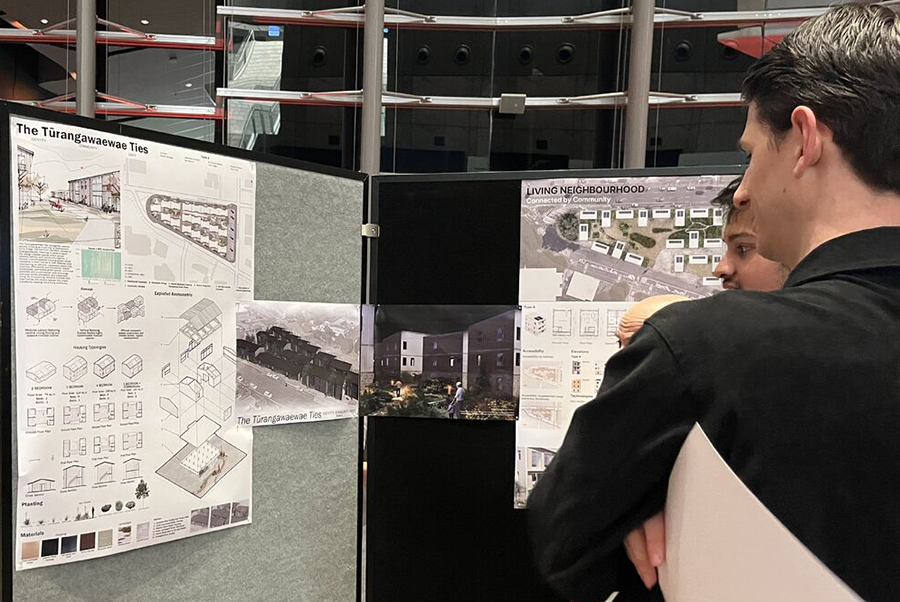
The Tūrangawaewae Ties: Rishab Tainwala – architecture, University of Auckland; Liam Wright – engineering, University of Auckland; Anna Pham - construction management, AUT; Isla Hawkins – landscape architecture, Victoria University; Isla Hawkins
TIAKINA: Rasha Elgammal – architecture, University of Canterbury; Aramuthan Sivapalan – engineering, University of Auckland; Harsh Khurana – construction management, Otago QT; Ananda Acharya – landscape architecture, Victoria University
Editor’s note:
To read our companion story see: Reflections on an "eye-opening" ArchEngBuild.
For last year’s LAA story on the 2025 ArchEngBuild challenge see here.