Reflections on an "eye-opening" ArchEngBuild
Ten teams, forty students, seventy-two hours.
The running of the 13th ArchEngBuild (AEB) challenge this year - only the second to feature landscape architecture students - certainly delivered a "design sprint" for everyone involved.
The purpose of this nationally recognised, multidisciplinary competition organised by BRANZ and funded through the Building Research Levy, is to unite final‑year university students across architecture, landscape architecture, engineering, building science and construction management to tackle real‑world building and construction issues.
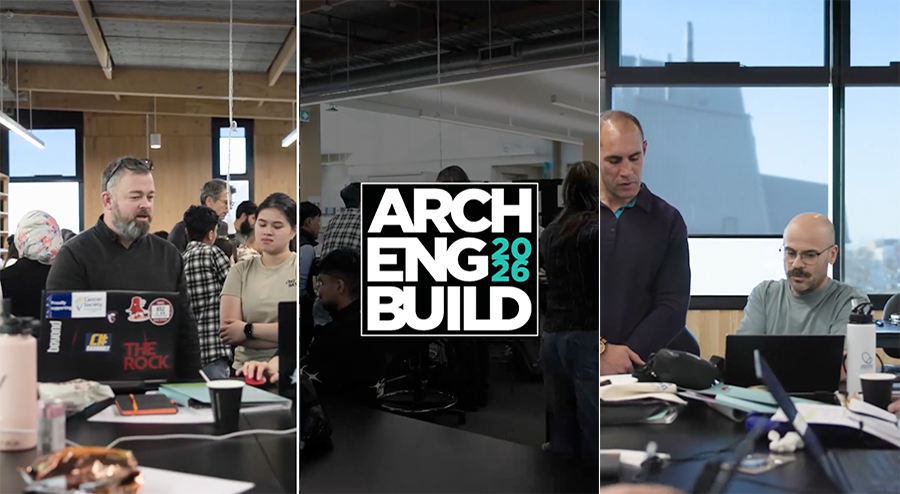
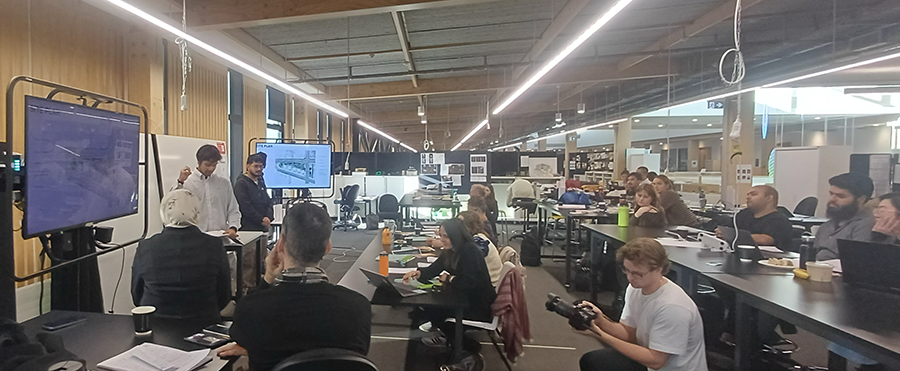
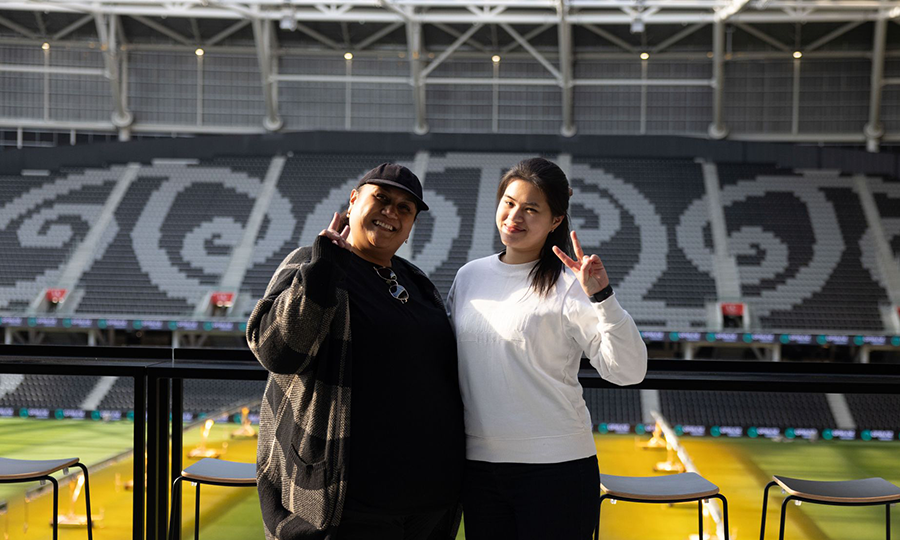
Lincoln University landscape architecture lecturer Don Royds (pictured at left above) was a roving mentor at this year’s challenge from 30 June to 2 July, alongside Dave McGuigan (ConcreteNZ), Sam Polson (Engineering Design Consultants), Tane Tawere (a Community Living Business Manager from Naylor Love) and Chris Lyons (a construction tutor at Ara Institute of Canterbury).
Don says that students he spoke with found it to be "an eye-opening experience".
"Many commented on how it helped them to improve their communication skills in the collaborative environment, as well as pushing them to dig deeper in conversations with colleagues from other disciplines".
"Sharing and discussing their thoughts and concepts with each other saw the opportunities or constraints of each idea being pushed further. They found being in a team much more creative than when they are working on a project by themselves".
"This way of working, which reflects how practice functions, will hopefully mean that they can come prepared to the profession with the skills they need to progress projects towards positive design outcomes for not only their clients, but also the wider community".
Emily-Rose Dunn of RMM Landscape Architects was brought into a judging panel that included architect Bernadette Muir (Ara Institute), engineer Cass Goodwin (Batchelar McDougall Consulting), senior building scientist Victoria Threadwell (MBIE) and Craig Hopkins (CEO of Generation Homes).
Emily-Rose described the amount of work that was achieved in 72 hours as "seriously impressive".
"No two projects were the same. Each team responded to the brief in its own way, resulting in a diverse range of ideas, design approaches and priorities. There was plenty of robust discussion around the judges’ table, and rightly so. Selecting an overall winner wasn’t easy".
A highlight for both Don and Emily-Rose was seeing the landscape architecture students from Unitec (Michael Head), SOLA at Lincoln University (Ekai Chiu and Yash Sharma) and Victoria University (Isla Hawkins, Richie Green, Ananda Acharya and Konstantinos Antonopoulos) in action.
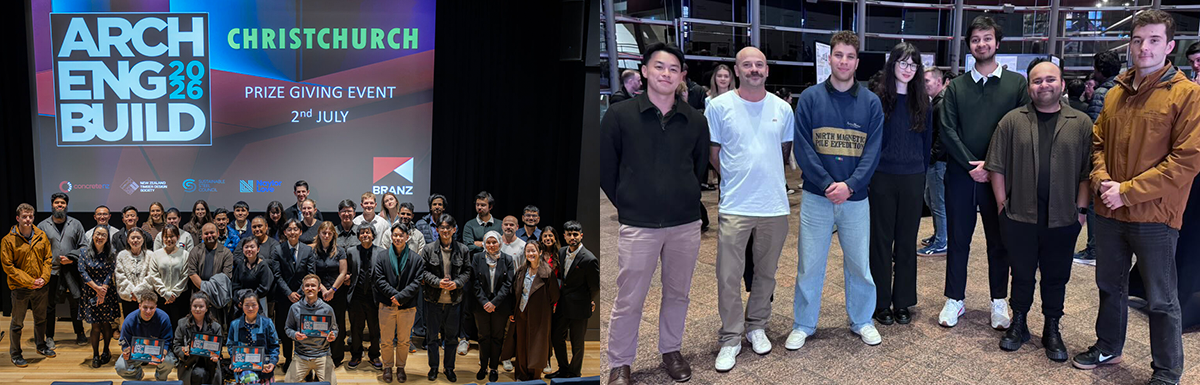
The photo at right shows this year’s seven landscape architecture participants: Ekai Chiu, Richie Green, Konstantinos Antonopoulos, Isla Hawkins, Ananda Acharya, Yash Sharma and Michael Head.
These students featured across seven of the 10 teams and as Emily-Rose puts it there was a strong sense of pride in observing landscape architecture students taking the lead in presenting their team’s work, "all the while making a genuine effort to acknowledge the contributions of their teammates".
Don: "The inclusion of landscape architecture students provided a strong addition of knowledge and enthusiasm into each of the teams, with these students often (in my view) being more passionate about their area and also helping to lead the design process".
Emily-Rose: "It was a great reminder that successful projects aren’t just about good ideas, they’re about collaboration and recognising the value each discipline brings. Landscape architecture often sits at the intersection of architecture, engineering and the environment, so it was encouraging to see students embracing that collaborative role with confidence".
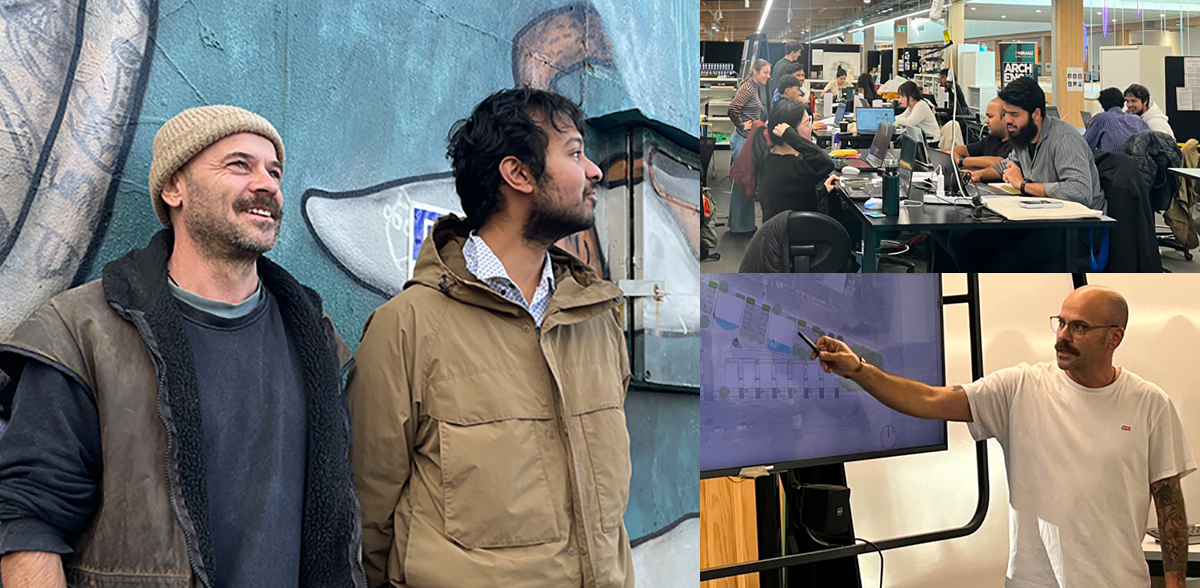
At left: Richie Green and Ananda Acharya looking south before departing for the 2026 ArchEngBuild.
LAA is very grateful to two MLA students from Te Herenga Waka Victoria University of Wellington - Richie Green and Ananda Acharya - for agreeing to bring back their takes on how the ArchEngBuild challenge played out and what it signified for them.
Taken together their two distinct and compelling points of view are a ‘long read’, but well worth the reading.
Ananda Acharya - “Every competiton Has Two Clocks”
Every competition has two clocks: The first counts down the hours. The second begins the moment you realise you don’t have enough of them.
At the beginning, no one believes in the second clock. There is still a sense that time can be managed, that ideas can be explored, that direction will appear through discussion.
AEB began like that. Names on a screen. Chairs dragged into place. Strangers forming teams through proximity rather than choice. The brief opened and immediately the familiar response followed, divide the work, assign roles, begin. We treated it like a design problem. It wasn’t. It was a decision problem.
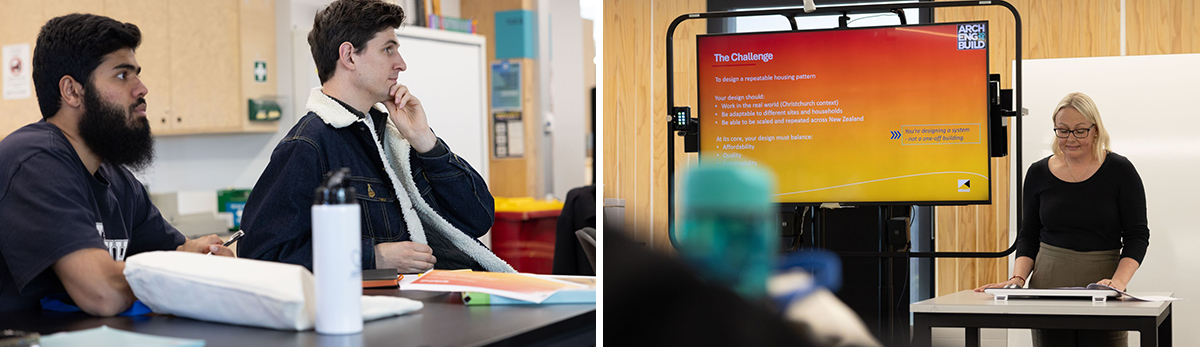
Clearing the noise
When I found my group, I started with simple things; names, programmes, where we were from. Small anchors before anything real had formed. I suggested we read the brief together. I was already looking for something specific: the landscape requirements. I expected them early in the document. They were buried near the end.
That delay mattered more than it should have. It shifted how I understood the role. Not absent. Repositioned. Not an add-on, but something that could sit between architecture, structure, and site, less output, more connector of decisions.
Still, we moved quickly. Too quickly. Roles were assigned before direction existed. Architect, engineer, landscape architect-labels attached before there was agreement on what they were attached to.
What are we building with? Timber? CLT? How many units? What’s the narrative?
Each question produced another. We believed this was progress. It was only activity. There was a constant pull between disciplines. Architects, engineers and landscape architects all saw a different starting point.
For a while, each of us tried to pull the project towards our own. That's when I realised collaboration isn't about everyone having a seat at the table. It's about knowing whose perspective should shape the next decision.
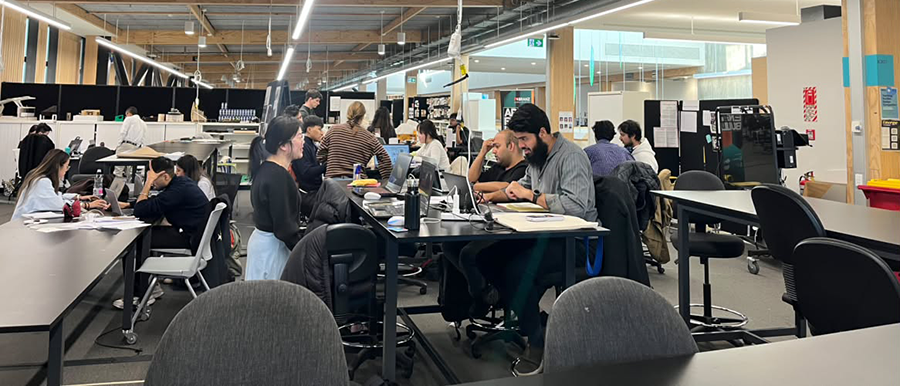
By mid-morning, the room had filled with movement that wasn’t yet aligned. Desktop analysis replaced clarity—heritage layers, flood maps, seismic data, circulation patterns. Everything expanded. Nothing resolved. We still hadn’t decided what mattered.
Facing the Friction: Embracing the Difficulty
By late afternoon, we left for the site. Most teams had already been. That fact lingered without needing to be said. On site, nothing became clearer. Rather, if anything it became more specific in its difficulty.
The scale of what we were trying to do didn’t simplify under observation. It resisted it. We returned with less certainty than we left with. Day one ended without a design. Only possibilities still competing for attention.
Taking Control
Day two began differently. Not with more time, but with less illusion about it. The room moved faster, but not because the work was easier. Because the second clock had started to show. Certainty had quietly begun to disappear.
I worked on the site plan while the rest of the group split into parallel directions—structure, cost, spatial layout. Separate lines of effort, not yet a single direction. Then Don Royds arrived. He looked at the work briefly and asked a simple question. What was the landscape doing? Not framing. Not supporting. Driving.
It wasn’t a technical question. It was about authority in decision-making.
If landscape was central, what remained necessary in everything else? What could be removed? What only existed because it had always existed? Nothing resolved in that moment, but something shifted in how the work was read. Less accumulation. More selection.
For the first time, I realised landscape wasn’t something you drew after the architecture. It was something that could influence the architecture before it existed. The project stopped being about what could be added. It started becoming about what could hold.
Somewhere that evening, a sheet of tracing paper stopped moving. It had been layered, redrawn, shifted so many times it had lost its edges. Eventually someone held it still. Not because it was finished. Because nothing more needed to be added for it to remain coherent. We didn’t notice the change at first. But the room did.
The night shift began early. After dinner, conversation faded. Decisions hardened. Keyboards replaced discussion. Every team now worked under the same condition: time no longer as possibility, but as limit. The second clock had fully taken over.
Brutal Executions: The Hardest Choices
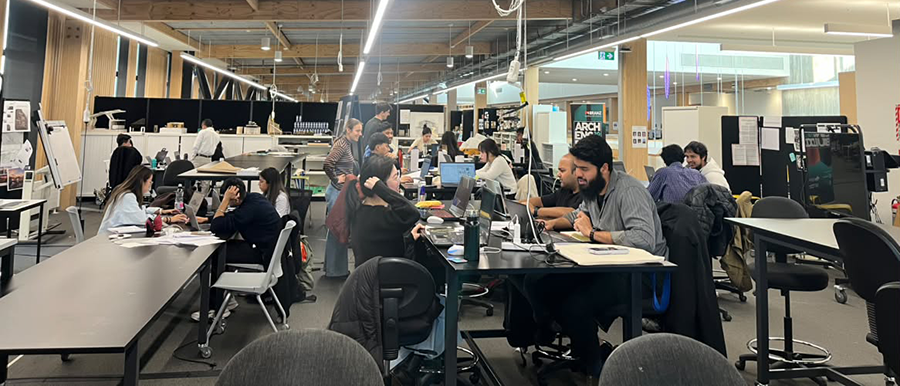
By the third and final morning, the studio looked exactly how forty-eight hours of continuous decision-making should look. Drawings spilled across desks. Chargers disappeared beneath laptops. Empty coffee cups sat beside rolls of tracing paper and half-eaten meals. No one bothered to tidy the mess. What had once felt like an abundance of time now felt impossibly short. Forty-eight hours, which on Tuesday seemed generous, had collapsed into a few frantic hours before noon.
The questions had changed again.
No longer What should this become? No longer Can we make this work? Now it was simply Does everything make sense? Does the site plan support the floor plan? Does the structure reinforce the narrative? More importantly Are we improving the project—or are we adding more because we’re afraid to stop? That was the hardest decision. Not what to include. What to leave alone.
Master the Craft
Watching the other teams, it became clear they weren’t separated by talent alone. They were separated by how quickly they could settle on a direction without constantly reopening it.
That was evident in the winning team, with Victoria University’s Konstantinos Antonopoulos leading the charge. What stood out wasn’t the volume of work they produced, but how little they interrupted themselves. They trusted their direction early, then refined it rather than restarting it. Decisions, once made, stayed long enough to become something real.
I had arrived believing competitions were won through polished visuals and strong storytelling. AEB changed that. Great ideas matter, but under pressure they only survive when a team believes in them, and in each other—long enough to keep moving forward. What stood out, in retrospect, from watching the winning team, wasn’t confidence, but discipline.
They didn’t treat every new thought as correction. They treated it as refinement. Preparation earns confidence. Confidence earns trust. And trust allows a team to make the next decision without reopening the last.
Own Your Value: Ask the Right Questions
For the next group of landscape architects stepping into AEB, don’t spend forty-eight hours trying to prove your value. Spend it helping your team decide what matters quickly enough that the work can actually begin.
After the competition, an architect from another team asked me: What exactly does a Landscape Architect do? At the time, I answered by describing the discipline. Looking back, I think the competition answered it better than I did.
Landscape architecture wasn’t the discipline that arrived with all the answers. It was often the discipline that helped everyone ask the right questions before the answers mattered.
Not something added to the project. Something that shaped what the project was allowed to become.
Richie Green - “Landscape architecture … is an integral part”
When it came to the winning of this challenge, one thing became abundantly clear: landscape architecture isn't just the finishing touch, it’s an integral part of delivering successful projects and framing the architecture and engineering within a broader, more meaningful context.
Yet if I'm honest, when we first read the brief, many of us wondered whether the organisers had forgotten about landscape architecture. We questioned what our role would be. It soon became clear that our role as landscape architects extended far beyond planting plants and open spaces. We were responsible for grounding each proposal within the site's context while also considering how key ideas could be adapted across Aotearoa and making sure that engineers and architects could find some ... common ground. Landscape became the thread that tied everything together.
This represented the first opportunity many of us landscape architecture students were presented with to take part in a multi-disciplinary context of this kind during our years of study. There was a realisation that in an environment like this, technical ability alone isn't enough. Communication, adaptability, collaboration and functioning on minimal sleep become equally valuable skills.
We need more experiences like this. Interdisciplinary projects shouldn't be an occasional event; they should become a regular part of how we are taught. They prepare us for industry, certainly, but they also inspire better design. Some of the best ideas come from someone looking at the same problem through an entirely different lens.
Personally, the experience was incredibly humbling. It highlighted that my current workflow can sometimes be slower and more cumbersome than I'd like, making it difficult to communicate ideas quickly under pressure. As a team, we initially worked too much in silos and arriving at our unifying concept way too late in the piece to fully shape the design. Ironically, it wasn't until I was sitting on the journey home, finally running on more than caffeine and adrenaline, that the clearest solution came to me. Hindsight really is a wonderful thing!
We all left with new friendships, new professional connections for the future and a much deeper appreciation for working across disciplines. I know we all came away immensely grateful to our teammates. The team I was in worked tirelessly and produced the first iteration of what I believe is a genuinely exciting concept, one that I'll continue to develop as part of my Master's thesis later this year.
Lastly, a big takeaway for me from the AEB is that the future of architecture, engineering and construction is incredibly exciting, and that landscape architecture must have a seat at the table from day one. Without it, projects will, I believe, always struggle to achieve the sustainable, resilient and affordable outcomes they aspire to.
Landscape doesn't simply complete a project; it strengthens the thinking behind it and helps connect people, place and infrastructure into one coherent vision.
A combined acknowledgement
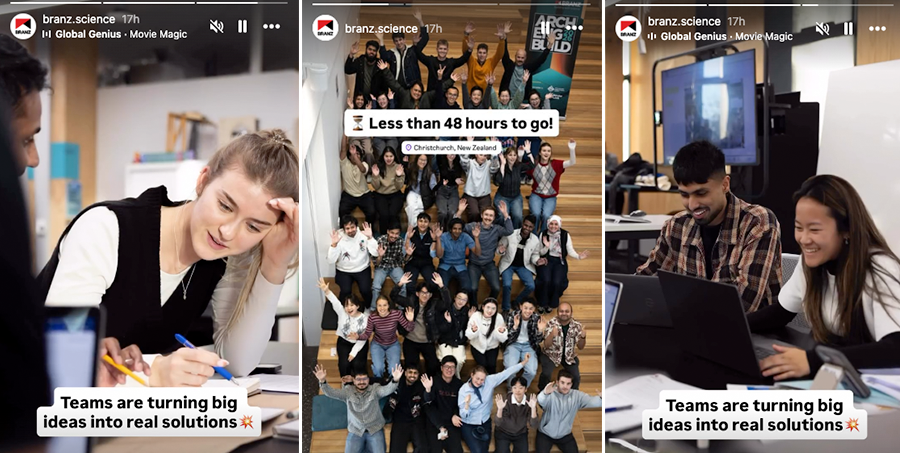
Everyone who took part in the ArchEngBuild challenge owes a huge thank you to BRANZ and Concrete NZ for continuing to invest in the next generation. From bringing together sponsors and supporters of the event, flying us to Christchurch, feeding us, housing us, giving us an exclusive tour of the impressive One New Zealand Stadium, through to everyone's enthusiasm, encouragement and behind-the-scenes efforts.
Hannah Fillmore (BRANZ), Ralph Kessell (Concrete NZ) and cameraman Ricky Watson (wannabeeproductions) deserve a special shoutout for keeping the vibes high from beginning to end, especially during the times when everyone else was running on empty.
Gratitude also goes to the judges, mentors and the team at Ara Institute of Canterbury for creating such an outstanding learning experience. And thank you, Christchurch, a city that continues to demonstrate what quality, resilience and sustainability can look like in practice.
Images courtesy of BRANZ, Don Royds and Konstantinos Antonopoulos
For LAA’s story on this year’s winners see Stepping up for landscape architects at ArchEngBuild.