The Green Pavlova programme - 2026
The Green Pavlova conference, run by Recreation Aotearoa, is a popular entry on the events calendar for professionals working in the overlapping and intersecting fields of parks, play, and open spaces. This year it took place on 13-14 May at Claudelands Park, Kirikiriroa Hamilton.
The opening keynote was shared by Julian Williams (Ngāti Makirangi, Waikato iwi), Taane Aruka Te Aho (Te Whānau ā Apanui, Ngāti Korokī Kahukura), and Waimirirangi Ormsby, a descendant of Waikato, Ngātiwai, Ngāti Tura and Te Whānau-a-Apanui.
Together, they explored the Waikato River as a place of deep reverence and a living space of connection, recreation and everyday life. They did this by reflecting on how cultural planning tools, iwi-led processes and cultural assessments can help restore both the health of the river and strengthen relationships with it.
The programme noted Taane's achievements as a respected rangatahi voice in te taiao spaces, having received the 2024 Prime Minister’s Indigenous Exchange Scholarship and participated in the Tuia Leadership Programme through Waipā District Council and the University of Waikato Te Āhurutanga Leadership Programme. Last year he was selected to be part of the first iwi-mandated rangatahi Māori delegation to attend COP30 - the United Nations Climate Change conference.
The event's closing day ended with an international panel discussion exploring the future of accessible, high-quality public space. The panel consisted of World Urban Parks Chair Mark Bowater, Parks & Leisure Australia President Kristin Davies, and Otium Planning CEO Kate Maddock. Geoff Canham, Principal Parks and Recreation Specialist and Director of Thrive Spaces and Places, provided moderation.
Plenary to go around
Plenary presentations and speakers at Green Pavlova included:
Open Space for growing Liveable Cities - presented by Mark Bowater, Spaces and Places Consultant at Sport New Zealand (with sponsorship from Green by Nature)
Mark's presentation posed questions such as: What are the hallmarks of liveable cities, how do we measure this, and what role does open space play? What does a best practice approach to open space provision, quality and access look like and how do we measure it? He drew on on years of insights, and recent experiences leading the open space precinct planning for the Melbourne Suburban Rail Loop. Mark has been a member of Recreation Aotearoa (formerly the New Zealand Recreation Association) for more than 25 years. At an international level he is currently the Chair of World Urban Parks which marked its 10th anniversary last year with the launch of a renewed brand identity.
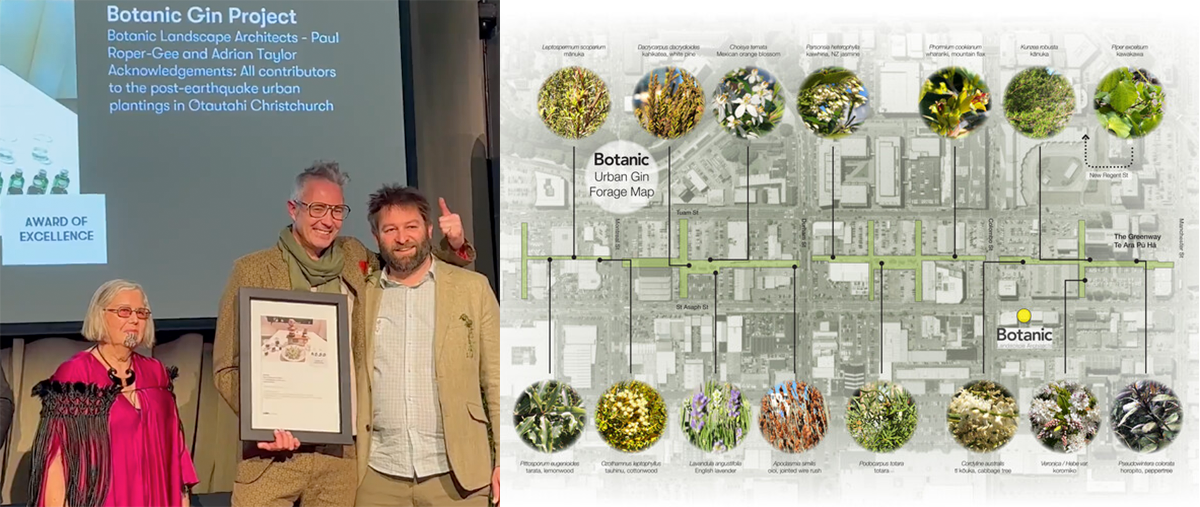
Scent, Taste and Place - presented by Adrian Taylor, Co-founder and Landscape Architect of Botanic Landscape Architects
Adrian's presentation highlighted Botanic's Urban Foraging Project as an activation of urban recreational spaces; strengthening connection to place, and bringing people together to co-create something meaningful - and fun. In 2024, Botanic received a He Iti Pounamu Award from the New Zealand Institute of Landscape Architects Tuia Pito Ora and presented the project at Lincoln University. Adrian also spoke about planting work done on Pūtahi Whakatetonga The South Frame in Ōtautahi.
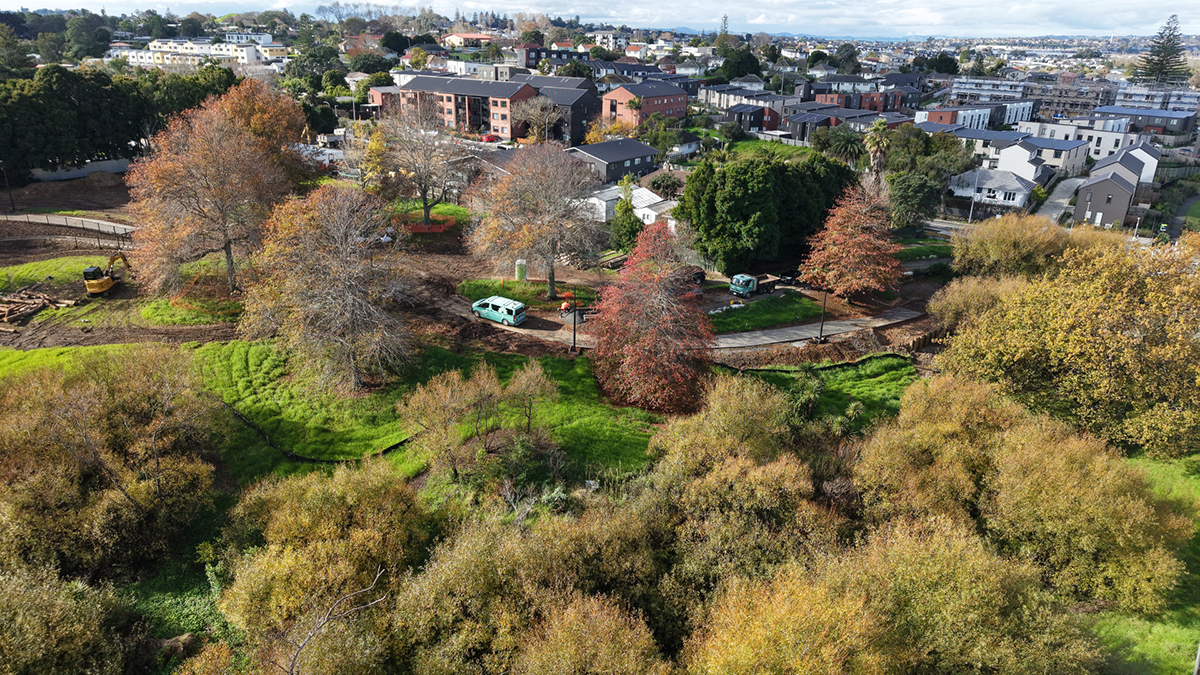
Photo credit: Resilio Studio
Eastview Reserve: Regeneration Through Partnership, Community Engagement and Integrated Design - presented by: Tipa Compain, Ngāti Pāoa; Zaelene Maxwell Butler, Ngāi Tai ki Tāmaki; Vandna Kirmani, Programme Manager at Auckland Council; and Gary Marshall, Director of Resilio Studio
This presentation demonstrated how a modest neighbourhood park can operate as powerful infrastructure for cultural connection, climate resilience, and community wellbeing through integrating traditional and contemporary play elements, ecological restoration, active transport, and cultural narratives within a single coordinated intervention in Glen Innes, Tāmaki. The theme of Pā Harakeke – people and partnerships – shaped the project from inception, working with mana whenua to inform spatial orientation, māra hūpara design, narratives, mahi toi, and riparian restoration outcomes. Mahi toi for Eastview Reserve was developed by Lorna Rikihana (Ngāti Pāoa) and Tessa Harris (Ngāi Tai ki Tāmaki).
From Recovery to Resilience: Planning for equitable play across Tairāwhiti - presented by Katie Kennedy, Play Advocate, and Angela Newman, Asset Planner - both from GIsborne District Council
This focused on the Tairāwhiti Play Study and Future Network Plan that was developed during a period of recovery and climate uncertainty following successive severe weather events, including Cyclone Gabrielle. Using post-event playground audit data, 41 playspaces across urban, coastal, and rural communities were assessed. Findings highlighted network gaps, aging assets, variable play value, and limited accessible play opportunities. In response, a Tairāwhiti-specific assessment tool was developed to prioritise fairly across site, suburb, and network levels, combining play provision, site suitability, and community equity indicators. This work established a strategic baseline for the next Long-Term Plan, with clear recommendations for community kōrero and future co-design opportunities with mana whenua and local communities at a site, suburb, and network level.
Muddy Urbanism: HOOPLA's work in Te Whau - presented by Nina Patel, Principal Urban Designer at Stantec/ Co-Director HOOPLA
For over a decade, HOOPLA has been reconnecting communities with the wai Te Whau (Whau River) - one of Tāmaki Makaurau’s most significant yet overlooked urban waterways, and an important portage route for Māori. HOOPLA has brought together rangatahi, teachers, iwi, designers, sports clubs, organisations, artists, businesses, and residents to create opportunities for people to experience the Whau in new ways, strengthening connection and awareness of this important catchment. Most recently, HOOPLA has been working to secure the long‑term future of the 35‑hectare Avondale Racecourse as a regionally significant, multi‑purpose recreational precinct for future generations.
Red Square Relocatable Play Pod. Photo credit: playgroundcreations.co.nz
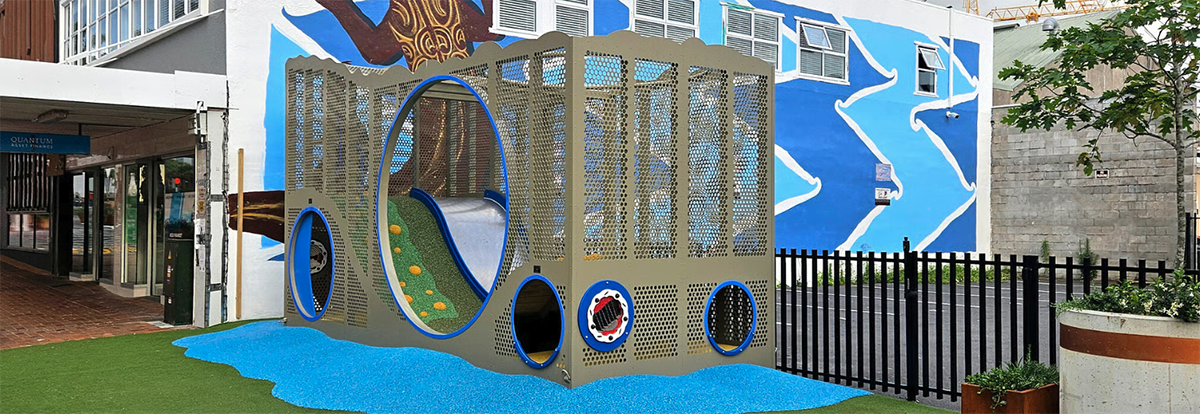
The City Becomes the Playground - presented by Kellie Burton, Urban Centres Development Programme Lead, and Emily McLean, Urban Centres Development Manager - both from Tauranga City Council
Tauranga’s city centre is in the midst of major transformation, creating a unique opportunity to reimagine how people move through, experience, and connect with urban spaces. Guided by the Playful City Strategy, the session shared how targeted, tactical interventions have shifted public perception and addressed real connection challenges. A key example being the creation of “play along the way” routes linking existing parking buildings to a new waterfront destination playground, situated on a constrained section of the harbour edge with limited co-located parking.
Christchurch's Sports Field Network Plan - presented by Martin Field Dodgson, CEO of Mainland Football, Dr Richard Gibbs, Senior Sports Turf Advisor at Greenspace 4D & Christchurch City Council, and Angela Leatherby, Sport Partnerships Lead at Christchurch City Council
Christchurch City Council adopted its Sports Field Network Plan [PDF link] in May 2024 to set out a pathway for upgrading sports fields and associated infrastructure throughout the city and Banks Peninsula over the next 10 years. The Plan contains three key goals – play where you live, participate for life, and succeed. A new partnership approach has provided assurance to the sports clubs that the Council is committed to listening to their needs and ensuring sport continues to play a big part in the city’s identity and future development.
Boffa Miskell At Green Pavlova
Breakout sessions during the conference included three presentations featuring landscape architects from Boffa Miskell:
Te Kai a Rangatira, Te Mahi a te Rangatahi saw Boffa Miskell landscape architects Nicole Tune and Zak Kelland present a case study about the Whānau Ātea destination recreation space on Māngere Maunga in Tāmaki Makaurau. This explored how tākaro-based storytelling, supported by simple digital tools, can amplify deeper narratives and the traditional reo (language) of tākaro within daily park experiences.
Developed in collaboration with the Tūpuna Maunga Authority, the kaupapa centres on a te reo Māori pukapuka tamariki (children’s book) and a QR-enabled mobile platform. Rather than relying on conventional interpretive signage, storytelling is woven through tākaro elements and a guiding mokopirirakau (native lizard) character, creating a low-barrier, intergenerational way for whānau to connect with language, place, and play.
In her presentation Te Wai Ora, Te Taiao Ora, Boffa Miskell partner and landscape architect Rebecca Ryder outlined the bold, future-focused transformation of Ahuriri Regional Park in the Hawke's Bay.
The Ahuriri Regional Park Masterplan focuses on improving the health of Te Whanganui-a-Orotū by cleansing stormwater as it flows through the estuary, and the park is envisioned to become a recreational asset for the community.
Megan Harshey, principal landscape architect at Boffa Miskell joined with Jeannie Galavazi, principal parks and reserves planner at Queenstown Lake District Council on the topic of Blue Green Urban Futures as embodied in QLDC's Blue Green Network Plan (BGN).
Guided by the Kāi Tahu philosophy of Ki Uta Ki Tai (from the mountains to the sea), the BGN recognises the interconnectedness of land, water, and people, embedding Te Mana o te Wai and cultural values into spatial planning.
Developed as a partnership between QLDC and Kāi Tahu and with collaboration from key stakeholders and the community, the BGN includes 21 Local Blue Green Plans for priority growth areas, supported by GIS mapping and an implementation framework. These plans ensure that as urban areas intensify, space for nature is proactively secured, enabling an aspiration that communities live well within functioning ecosystems.
Other presentations at Green Pavlova included:
Ancestral Wisdom, Play, and the Future of Education: From Aotearoa to the World - presented by Tatuu Roa co-founder Wiremu Sarich (Te Rarawa, Ngāpuhi, Tainui, Ngāti Hauā)
Developing the public urban forest across new residential spaces - presented by James Richardson, Arborist Planner at Waipa District Council
From Green Space to Green Assets [Nature-based infrastructure] - presented by Steve Verity, Principal Advisor Asset Management at Institute of Public Works Engineering Australasia (IPWEA)
He Taiao, He Raraunga: Making Recreation Affordance Visible in Spatial Data - presented by Dr Shayne Galloway, Founding Trustee at Digital Reef Charitable Trust
Leamington Domain Masterplan - presented by Chris Brockelbank and Aidan Kirkby-McLeod of Waipā District Council
Play across the generations - presented by Jacquelyn Collins, Play Portfolio Lead at Auckland Council
Remote Monitoring for Improved Management of Turf & Landscape Assets - presented by Michael Bradbury, Technical Lead Turf & Landscape at Syngenta
State of Play: Insights for Cities - presented by Ellie Davidson, Senior Regional Play Consultant at Sport New Zealand and Taylor Kamuhemu, Play Systems Advisor at CLM Community Leisure Management
Storm recovery and resilience in our parks and public spaces - presented by
Andrew Mackenzie, director of reNature and reNature's project engineer Richy Mundy-Castle.The Power of Strategic Planning: Rethinking open space provision - presented by Geoff Canham and Samantha Strong of Thrive Spaces & Places
The Recloaking of Coronet Forest: Project Tohu | Restoring Place, People, and Future - presented by Briana Pringle and Dave Winterburn of Queenstown Lakes District Counci
Urban Growth & Meeting Community Needs: A Strategic Property Review Approach - presented by Geoff Canham and Samantha Strong of Thrive Spaces & Places.
The full 2026 Green Pavlova programme is available here.