Beyond masterplans: regional spatial plans will reward decision clarity, not beautiful ambiguity
by Matthew Prasad | Harrison Grierson’s technical director of urban and spatial strategy
“New Zealand doesn’t have a shortage of masterplans. It has a shortage of outcomes.”
This line from a LinkedIn post by urban designer James Lunday landed with me because it describes something we’ve all watched play out. We keep producing beautifully drawn, carefully worded visions for the future. They launch well. People feel hopeful. The PDF circulates, teams are formed, and then … the years pass and the place barely changes.
That gap doesn’t come from a lack of thinking, or a lack of care. It comes from a habit that has become normal in our built environment sector. We’ve treated the plan as the finish line, then acted surprised when delivery becomes someone else’s problem.
Jame’s words and thoughts landed with me, but I want to go further, and discuss how (the new) Regional spatial plans are likely to change that context.
Regional Spatial Plans aren’t just another planning label. They are being introduced through the Resource Management reform agenda, through the Planning Bill (and the Natural Environment Bill), and they sit inside the statutory system rather than beside it.
If regional spatial plans are meant to shape what follows, then the old pattern of producing plans that read well but don’t hold up in delivery hopefully starts to disappear. Not because anyone has meant that before, but because the system around these plans is tightening.
This article is about that shift, and about a simple idea I keep returning to.
Yes maps matter, and good documentation matters, but the process that creates it matters more.
Spatial planning isn’t new, regional spatial plans are
Councils across Aotearoa have been doing spatial planning for some time now through growth strategies, structure plans, centre plans, catchment planning, future development strategies, and many other variations. Most of that work has been local in scale, sometimes city-wide.
Regional spatial plans lift the scale and change the dynamics. They bring multiple councils and agencies into the same decision space by default, and they are designed as part of the new planning system architecture.
The proposed framework is explicit about how these pieces connect. A combined regional plan consists of the regional spatial plan, plus the region’s natural environment plan and district land use plans. The reform material also signals that land use and natural environment plans must implement the regional spatial plan and cannot revisit decisions already made.
You don’t need to read that as a legal deep dive. You just need to read it as a signal. Regional spatial plans are being set up to be more than a vision document.
That changes what ‘good’ is going to look like.
The masterplan problem is partly a language problem
Part of what James is calling out is a delivery problem. However I feel part of it is also a language problem.
‘Masterplan’ used to mean something fairly specific. It was a single sheet, coordinated drawing, a master drawing that pulled disciplines into the same frame. It forced integration because it had to.
Over time I feel, ‘masterplan(s)’ has became a catch-all label. It now covers everything from a single drawing to a hundred-page report. Sometimes it means vision. Sometimes it means staging. Sometimes it means design. Sometimes it means all of them, even when nobody is clear which one is actually being asked for.
That drift and ambiguity has a cost.
When a masterplan is treated as the product, it becomes easier to stop once the document is done. Delivery becomes a separate phase, often owned by different people, with different incentives, and a different risk profile. The point I believe James was making
What we actually need, especially now, is a “master process”. A process that produces outcomes and keeps producing them as conditions and inputs change and evolve. Cities and settlements are rarely finished products
That doesn’t mean drawings don’t matter. It means drawings are not the commitment.
Everyone has a different centre, and that’s where plans lose traction
One of the hardest truths in this work is also one of the most ordinary.
Councils often sit at one centre with one set of priorities. Developers sit at another. Infrastructure providers sit at another. Mana whenua carry another set of priorities. Communities hold their own lived centre.
None of those centres are wrong. They are just different.
A masterplan as a document can smooth those differences over with broad language. It can create a sense of shared intent without requiring shared commitment. That is why it feels safe. It is also why it often stalls.
A “master process” does the opposite. It makes the differences visible early enough to build a shared pathway.
That’s where ownership stops being a line in a report and becomes a real question.
Who is accountable for moving the work forward once consultation closes?
Who stays at the table when trade-offs arrive, not just when the vision is being written?
Who keeps the direction aligned when budgets shift and programmes move?
If those questions aren’t answered in practice, the plan becomes a reference document. People quote it, but they don’t steer with it.
Regional spatial planning is emerging inside an ecosystem
Regional spatial plans aren’t landing into an empty space. They’re emerging inside a living ecosystem that keeps moving. Recent announcements by Minister Bishop and Minister Watts aimed at fast-tracking local reform demonstrate how changes will be rapid and continue for years to come.
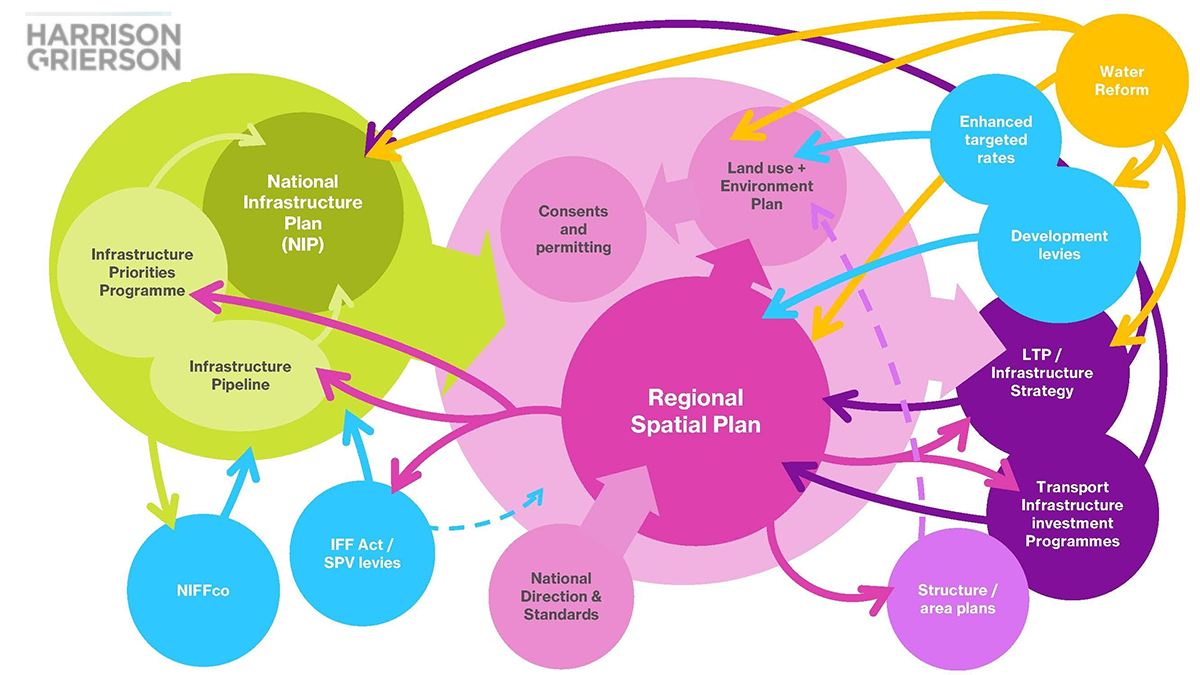
That’s why I created the bubble diagram below, which interestingly has become very useful in lots of ways I had not even thought of.
The diagram illustrates graphically how Regional spatial planning is becoming a connecting function inside a wider ecosystem of national direction and standards, statutory planning tools, investment and asset programmes, consenting pathways, delivery capability, and community and mana whenua partnership. Something that in my view has not occurred before.
When regional planning is treated as a standalone mapping exercise, the ecosystem doesn’t pause. Investment decisions keep moving. Delivery pressures keep shaping what’s possible. Consenting continues. The plan ends up reacting to the system instead of shaping it.
When the process is designed to work with the ecosystem, the plan is more likely to hold. It becomes something decision-makers can use to make choices that stick.
The Emerging Spatial planning ecosystem as I currently comprehend it:
The investment system is moving upstream, and that changes the planning conversation
A recent Government announcement on infrastructure investment oversight makes this link clearer.
The Government has set out changes to the Investment Management System aimed at stronger value for money, clearer delivery confidence, and better project selection.
Responsibility for infrastructure project assurance is shifting from The Treasury to the independent NZ Infrastructure Commission, Te Waihanga. Existing tools like the Infrastructure Priorities Programme and Gateway are being consolidated into fewer products focused on what decision-makers need. The announcement also flags new assurance for asset management and long-term investment plans, along with a stronger oversight group for high-profile, high-risk investments.
You don’t need to agree with every detail of that agenda to see what it means for spatial planning.
It pushes infrastructure needs, value, and deliverability upstream. These are not just delivery conversations that happen after a plan is written. They shape what is realistic, what can be staged, and what will hold when choices get difficult.
This combined with other shifts, signals a tangible and less theoretical change to how our built environments are delivered.
Regional spatial plans sit inside an investment system that is tightening its filters. A delivery mindset stops being a nice idea and becomes how plans avoid drifting into documents that everyone likes and nobody can act on.
“Design-led” only helps when we stop using it as a vibe
Design-led is often used as a shorthand for quality, or for care, or for aesthetic intent. It can also become a cover for vagueness. (read my previous thinking on this here)
Vague language is the enemy of delivery. It hides what is really driving the plan, so nobody can properly test it. Not infrastructure providers. Not financiers. Not mana whenua. Not communities. Not the market.
What works is naming the drivers early, in plain language, and letting people engage with them directly.
Sometimes the driver is hazard exposure.
Sometimes it is network capacity.
Sometimes it is affordability and staging.
Sometimes it is cultural values and what must be protected.
Often it is several of these at once, and the trade-offs are real.
Design-led practice, at its best, is synthesis under constraint. It makes trade-offs visible and workable. It doesn’t leave them for the last chapter.
Regional spatial plans will demand that kind of clarity because the plan is being positioned as something that influences what follows, not something that sits politely on top.
Two traps that produce shelf plans
I see two traps that keep producing plans with weak outcomes.
The first is the visioning trap. Safe language creates shared intent, but it avoids hard choices. It keeps everyone comfortable, then delivery reality arrives and the plan gets thinned out quietly.
The second is the map-first trap. Detailed mapping starts before the decision pathway is clear. Outputs multiply, debate shifts into technical detail, then the programme realises it still hasn’t agreed what it is trying to decide.
Regional planning amplifies both traps because there are more actors, more competing priorities, and more reasons for people to hold position.
The shared symptom is the same. The programme produces artefacts faster than it produces clear decisions.
What changes outcomes is a master process, not a master document
This is the part I want to put on the table, clearly.
We don’t need more ‘masterplans’ as documents. We need “master processes” that produce outcomes, keep producing them, and adapt as conditions change.
A “master process” does a few things consistently, even when the policy environment evolves.
It brings the right parties into the same room early enough that choices are still open.
It makes the real drivers explicit, so people can test them honestly.
It creates a pathway that can be carried into the places where investment and delivery decisions get made.
It builds legitimacy early, so communities and mana whenua can see themselves in the pathway, not just in the story.
This is what turns a plan into something people can steer with, rather than something they quote.
A practical message for senior leaders
Regional spatial plans will succeed when leaders commission the process, not just the artefact.
That doesn’t mean building bureaucracy. It means creating the conditions for decisions to stick across councils and agencies, through change, and under constraint.
A few grounded moves help.
Clarify who decides what, and when, so everything isn’t forced into consensus.
Bring delivery and finance in early enough to shape options, not just react.
Agree what good enough evidence looks like for the decisions that must be made now.
Protect pace by stopping re-litigation and drift.
Treat engagement as shaping, not as a late-stage checkbox.
These moves are not ‘nice to have’. They’re how multi-party programmes stay coherent and credible.
Closing thought
James Lunday is right. We don’t need more masterplans.
Regional spatial plans create a chance to reset what ‘good’ looks like. Less beautiful ambiguity. More clarity about what is driving choices, what is being traded off, who owns the pathway, and how the work stays aligned as the system evolves.
A good plan describes a preferred future and why, with transparency.
A strong regional planning process makes that future more deliverable because it is built on clear drivers, visible trade-offs, and decisions that hold.
For more of Matt’s critical thinking and insights see his Substack - Urban Notion.