LAA newswire: Around The World
The LAAtest newswire prepped for our regular Around The World ‘column’ contains the following newsy updates - ready to read at your work desk or at your leisure:
Landscape architects making their influence shown
2026 Landscape Australia Awards shortlist announced
American Society of Landscape Architects (ASLA) winners in 2026
Landezine International Landscape Award (LILA) winners in 2026
UNESCO’s World Heritage List
UN tells the world: Stop making Africa look small
Landscape architects making their Influence shown
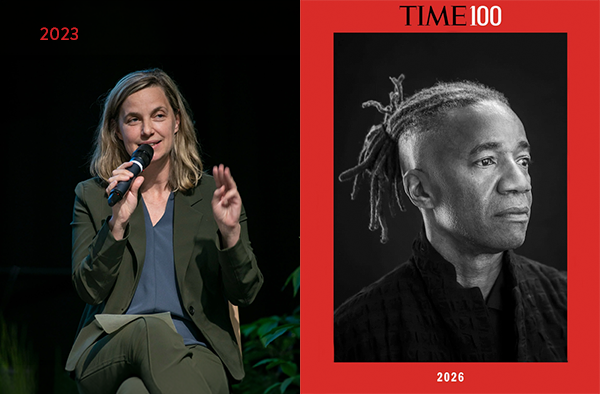
While the portmanteau of ‘starchitects’ isn’t necessarily attached to landscape architecture and landscape architects in the way it has been to architecture and architects, there are a number of stand-out practitioners of the discipline who gain recognition for their positive, groundbreaking and enduring influence.
A case in point, in case you missed it, is that earlier this year landscape architect Walter J Hood of Hood Design Studio was named in US/ international magazine TIME’s annual list of the 100 most influential people in the world.
This follows the same distinction being given to fellow landscape architect Kate Orff of SCAPE Studio in 2023 (in the same year that Kate was an inspirational keynote speaker at the 2023 NZILA Firth Conference held in Nelson).
TIME’s list recognises the impact, innovation and achievement of influential individuals. Hood joined artists Jafar Panahi and Benicio Del Toro, photographer Lynsey Daddario, Olympic gold medal skater Alysa Liu, and Mayor of New York Zohran Mamdani on the list.
In her tribute to Walter J Hood published by TIME Kate Orff said, “Whether he‘s riffing off of the intertwined practices of landscape architecture, sculpture, and cultural anthropology, or crafting community parks in Oakland, California, his work allows us all to take part in a wider civic conversation. Walter has an almost kaleidoscopic power to ground us where we are, by propelling us into the past and simultaneously toward a more just future that is slowly coming into focus.”
This recognition represents another milestone in the growth and evolution of the Oakland-based Hood Design Studio. In addition to this honour, Walter was recognised as one of Galerie Magazine’s Creative Minds for 2026, in May 2026 groundbreaking will commence on the major overhaul of Lincoln Center’s Damroch Park, the studio was selected to design the Kresge Foundation’s new campus in Troy, Michigan, with Diller Scofidio Renfro, and The African American Ancestors Garden: History and Memory at the International African American Museum (Monacelli Press) was published in 2024. Within the studio, Landscape Architect Alma Du Solier, who led the NVIDIA Campus and Intuit Dome landscape design teams was elevated to Partner, and Sarita Schreiber, who coordinated Migrations at the San Diego Airport was named Director of Social Art.
_________
Source prompt: DALY PR
Walter Hood on ruins, memory and ‘provocative abstraction’ in landscape architecture - Wallpaper
See also: Kate Orff recognised by TIME Magazine (LAA)
The 2026 Landscape Australia Awards Shortlist
As released last week, up to 100 projects feature in the inaugural Landscape Australia Awards shortlist. Final judging is underway with winners of the inaugural Landscape Australia Awards to be announced online on Thursday 22 October 2026 on the Landscape Australia and ArchitectureAu websites.
At a glance
The following links will take you to shortlisted entries for the following categories:
Public Design (27)
Small Project Design (16)
Urban Design (9)
Landscape Australia: “From urban train networks to wetland parks to initiatives that improve safety in cities, the shortlisted projects show how landscape is being designed to address the complex environmental, social and economic pressures influencing contemporary Australia”.
ASLA Winners in 2026
On 24 August the American Society of Landscape Architects gave recognition to 35 Professional Award winners from a field of 468 contenders.
ASLA President Brad McCauley: “From restoring waterways and coastal systems to creating healthier, more connected public spaces, these projects show how landscape architects are helping communities respond to some of our most pressing challenges”.
Overall five Awards of Excellence (see below) were announced in the categories of General Design, Urban Design. Residential Design, Analysis & Planning and Communications, along with a total of 27 Honor Awards spread across those categories.
In the Research category an Honor Award went to a case study titled ‘Heat Health: A pre- and 5-year post-occupancy thermal analysis of public streetscape performance and its impact on human health’.
Two special Awards were made:
THE ASLA / IFLA Global Impact Award (under the Analysis & Planning category)
The award is given to a work of landscape architecture that demonstrates excellence in addressing climate impacts through transformative action and scalable solutions, and adherence to ASLA’s and IFLA’s climate action commitments. The 2026 award went to The Four Coasts Project. The Engineering With Nature–Landscape Architecture (EWN-LA) Design Research Initiative is an interdisciplinary collaboration with the U.S. Army Corps of Engineers to develop nature-based designs for coastal infrastructure in the San Francisco, Philadelphia, Mobile, and Great Lakes USACE Districts.
Landmark Award
The Landmark Award goes to a distinguished landscape architecture project completed between 15 and 50 years ago that retains its original design integrity and contributes many benefits to the surrounding community. This year’s Landmark Award went to The Lurie Garden at Millennium Park, by GGN for the Millennium Park Foundation. The three-acre botanical garden opened in 2004 and is recognised as a symbol and space for dialogue around urban landscape architecture, native-plant gardening, sustainable horticulture practices, insect-and-bird-focused data and experiments, inclusive public garden programming, and equitable training and recruitment into landscape and horticultural fields.
_________
asla’s 2026 awards of excellence
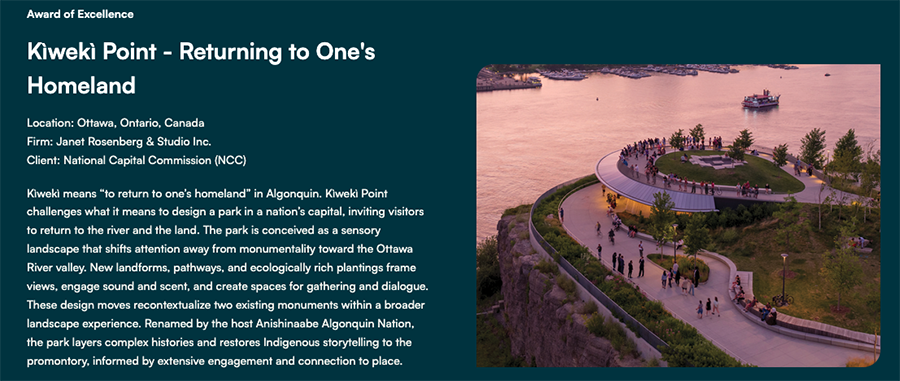
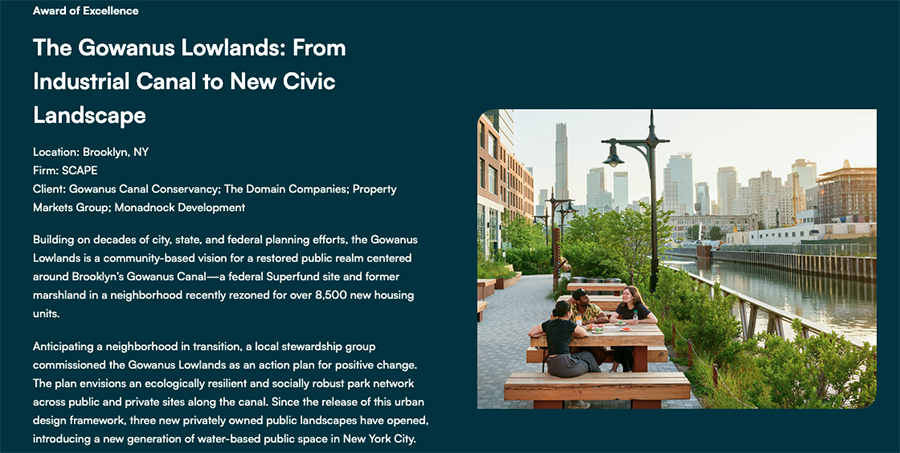
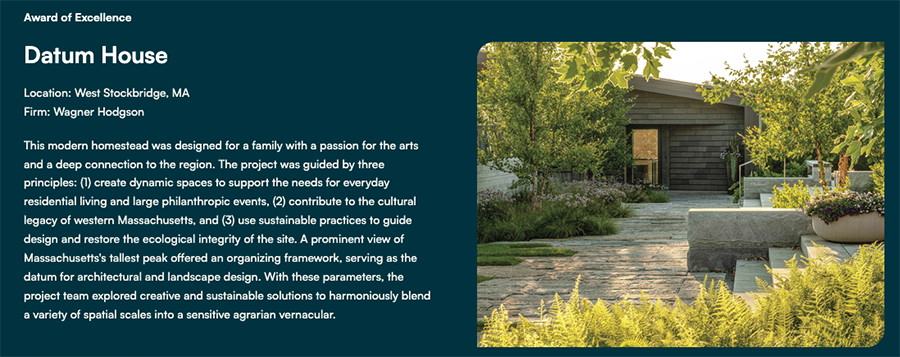
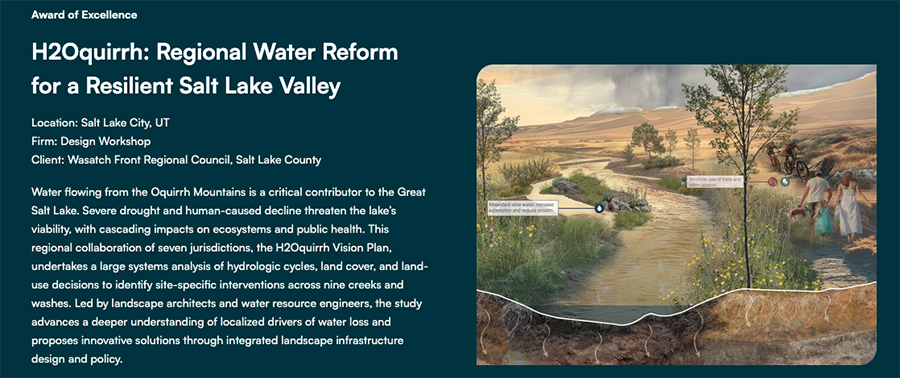
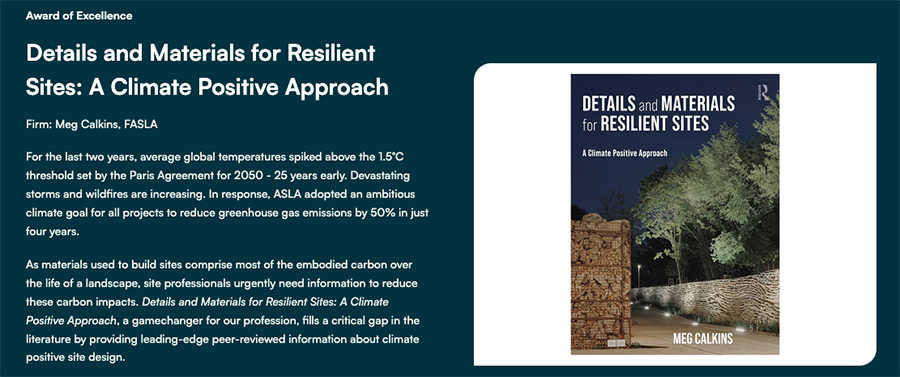
ASLA CEO Torey Carter-Conneen: “These projects make clear that landscape architects are not simply designing places—they are shaping how communities adapt to climate change, restore ecosystems, strengthen public life, and create healthier environments for all. We’re proud to celebrate the vision and leadership represented by this year’s winners.”
_________
Source: ASLA News Release
See also the ASLA Student Awards - 29 awards were made.
For even more of an awards top-up, ASLA-NY - the New York City chapter of NY - announced the recipients of its 2026 ASLA-NY Design Awards in April. Out of 80 submissions, the jury selected one Award of Excellence, eight Honor, thirteen Merit award winners, and new this year, one Emerging Firm Award. One of the Honor awards went to terrain-nyc - the practice headed by former Wellingtonian Steven Tupu - for the work achieved at Terminal Warehouse.
LILA winners in 2026
As announced in July, the 2026 Landezine International Landscape Award (LILA) programme saw 9 LILA Jury Awards and 9 LILA Jury Distinctions, as judged by jury members Jacqueline Osty, Jens Linnet, Michael Young, Silvia Benedito, and Zaš Brezar.
The 10th anniversary
Zaš Brezar, founder of Landezine, established LILA in 2016 with Robert Schäfer, independent journalist and founder of Topos magazine. Since its inception, the award has assembled a substantial archive, featuring all winners since 2016 alongside more than 2,000 project entries submitted in previous editions of the awards.
New Zealand firms such as Isthmus Group, LandLAB, Reset Urban Design, and Boffa Miskell have had multiple projects featured and submitted.
This year Reset was shortlisted in the Revisited Landscapes category for its work over many years at Brick Bay Farm Park. See also Autumn at Brick Bay.
_________
The 2026 LILA Awards
LILA Jury Awards in 2026 went to:
Ferme du Chaudron (Belgium)
Rhone River Banks (FRANCE)
Wangen Renaturation Argen (GERMANY)
Nuuk School (Greenland)
Parco Reggia di Rivalta, Reggio Emilia (italy)
Parque EL Jaguar (Mexico)
Juvo – resting area and viewpoint (Norway)
Codha eco-district (SWITZERLAND)
The Neuhoff District (USA)
LILA Jury Distinctions went to:
Marie Janson Plain (BELGIUM)
Tropical Warehouse (Galpão Tropical) (brazil)
Houguan Lake Eco Demonstration Park (CHINA)
The Crafts College in Horsens (denmark)
Rehabilitation of the Caupicho ravine in Quito (ecuador)
13th of November Garden (france)
More Feeling – thicket and sundance (germany)
Prairie Plots (USA)
Carol Pino Learning Garden (USA)
In addition the editors of Landezine awarded four other recognitions:
The 2026 LILA Honour Award was presented to Walter J. Hood, designer, educator, and founder of Hood Design Studio in Oakland, California. Earlier this year Walter was named in TIME magazine’s 100 Most Influential People of 2026 (see below).
.The LILA 2026 Office Award was presented to BASE, the French landscape architecture office founded by Franck Poirier and Bertrand Vignal.
.Zachary Elliott, a graduate of the MLA Landscape Architecture programme at the Bartlett School of Architecture, received the LILA 2026 Portfolio Award; and Liwei Shen received a Portfolio Distinction Award.
… And in breaking news … landezine lauded!
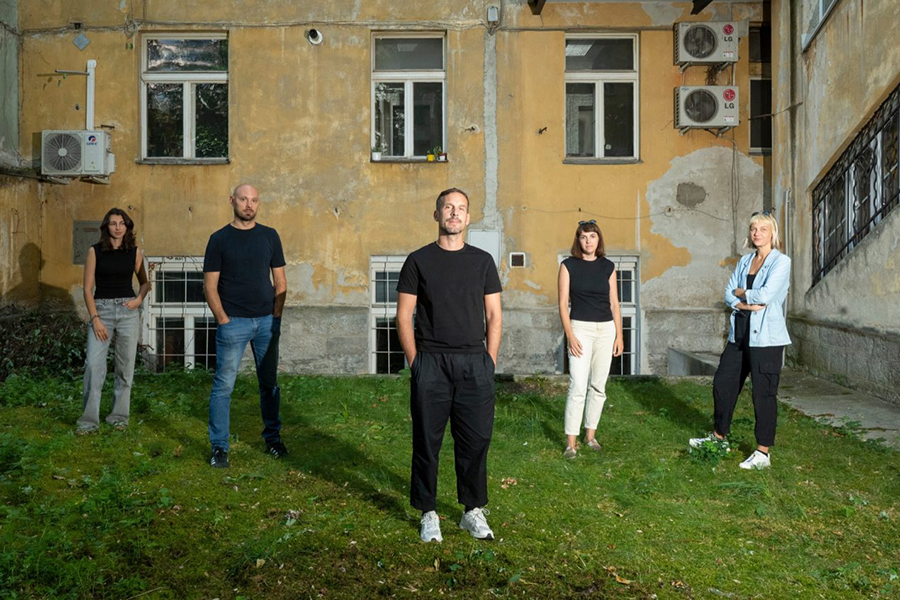
Landezine team (from the left): Katarina Poklukar, Rok Grča, Zaš Brezar, Pia Kante, Urška Škerl. photo: Nik-Erik Neubauer
At the 2026 Regional Conference of IFLA Europe, held just last week in Latvia, Landezine was presented the IFLA Europe Award 2026 in recognition of the exceptional contribution that the platform has made to landscape architecture and in helping to advance the profession and its role in society.
Indra Purs, President of IFLA Europe:
Landezine has significantly contributed to raising awareness of the value and importance of landscape architecture among professionals, decision-makers, students and the wider public.”
Across the seventeen years since it was founded in 2009, Landezine has been a dedicated watcher and documenter of how the discipline presents itself. As Landezine reflected this week, it has also, over that time, “become increasingly interested not only in what landscape architecture achieves, but also in what it avoids, conceals, harmonises or cannot yet recognise as belonging to it”.
UNESCO’s World Heritage List
As part of the 48th session of the UNESCO World Heritage Committee in July, held in Busan in the Republic of Korea, 25 new sites were adopted by consensus to UNESCO's World Heritage List - bringing the list to a total of 1,273 sites across 173 countries.
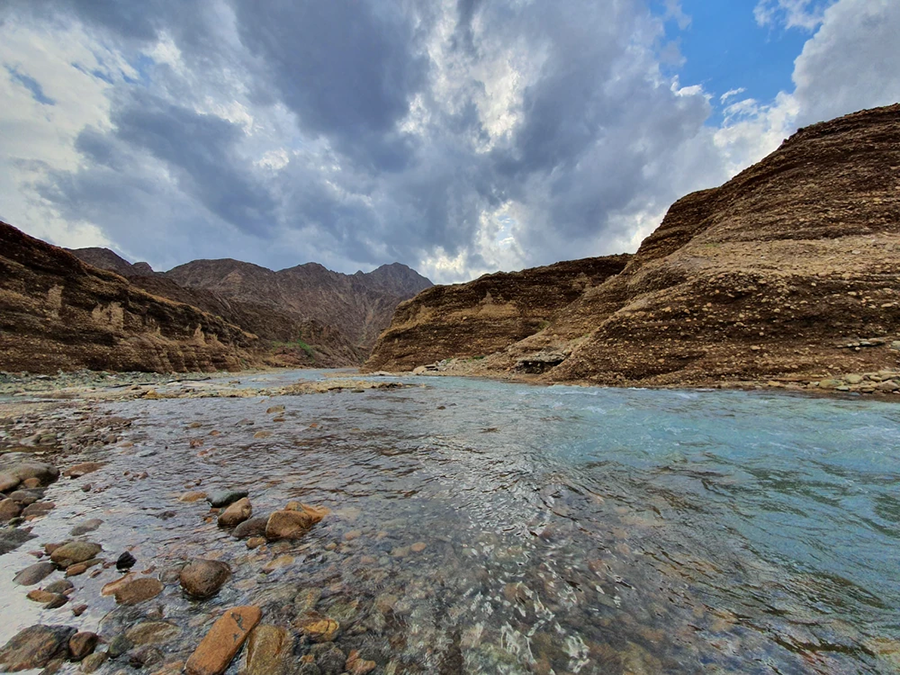
Clear water flowing after rains in the wadi. Photo credit: Nuri Asmita
The ‘inductees’, including 5 sites with unique natural landscape values in bold, are:
Aalto Works, Finland
Alamūt Castle and Related Fortifications, Iran
Amazonia Theaters, Brazil
Ancient Buddhist Site of Sarnath, India
Ancient Capitals of Asuka and Fujiwara, Japan
Aqaba Marine Reserve, Jordan - link
Boma-Badingilo Migratory Landscape, South Sudan - link
The Bony Fish Fossils of the Western Limfjord, Denmark - link
The Cemetery Complexes of the Xiongnu Nobility, Mongolia
Gdynia Modernist City Centre, Poland
Jingdezhen Handicraft Porcelain Industry Sites, China
The Medinas of the Historic Sultanates of the Comoros, Comoros
Mount Amel Castles, Lebanon
Okefenokee National Wildlife Refuge, USA - link
The Roças of Sao Tome and Principe, Sao Tome and Principe
Rock Mosques and Associated Sacred Sites of Mangystau, Kazakhstan
Royal Capetian Fortresses of Languedoc, France
Sebastia, State of Palestine
The System of Italian-style Condominio Theatres, Italy
Tashkent Modernist Architecture, Uzbekistan
Village of Sidi Bou Saïd, Tunisia
Wadi Wurayah, United Arab Emirates - link
Wat Phra Mahathat Woramahawihan, Nakhon Si Thammarat, Thailand
The wider area of Mount Olympus, Greece
Beaches of the D-Day Landings, Normandy, 1944, France
Three of these newly inscribed sites were submitted on an emergency basis: Boma-Badingilo Migratory Landscape (South Sudan), Mount Amel Castles (Lebanon) and Sebastia (State of Palestine). This underscores a growing number of heritage properties under threat in regions affected by conflict and instability.
In addition to those sites, three others – Historic Inner City of Paramaribo (Suriname), An Ancient City of Tauric Chersonese and its Chora (Ukraine) and Tyre (Lebanon) - were added to the List of World Heritage in Danger. They will now have access to technical and financial assistance to protect the site and will benefit from stronger support for conservation efforts from the international community.
A commitment to a more balanced and representative list saw three African countries feature for the first time - Comoros, São Tomé and Príncipe and South Sudan. In addition a new World Heritage Strategy for Small Island Developing States (SIDS) 2026-2034, has been introduced, backed by a budget of US$13 million. The Strategy aims to strengthen the capacity of SIDS to identify, protect and manage World Heritage sites, while addressing the specific challenges these States face – particularly the impacts of climate change.
Since 2023, the World Heritage List includes “sites of memory” to recognise events that a country and its people and communities wish to memorialise. Today, these Sites of Memory are places of reconciliation, contemplation and peaceful reflection. During the Committee session in Busan, the Beaches of the D-Day Landings, Normandy, 1944 (France) joined the World Heritage list as sites of memory, honouring the remembrance of the Allied landings of 6 June 1944.
The next session of the World Heritage Committee, in 2027, will be held in Istanbul, Türkiye.
_________
Sources: UNESCO media release, Forbes.com
UN tells the world: Stop making Africa look small
On 4 September the UN General Assembly voted overwhelmingly to encourage governments, schools and tech companies worldwide to stop using maps that make Africa look far smaller than it really is.
“Maps shape our understanding of the world,” Robert Dussey, Togo’s foreign minister said before the vote. “They guide education, nourish the imagination, and influence collective perceptions.”
The non-binding resolution promotes map projections that more accurately reflect the true size of continents – the culmination of an African-led campaign against the 16th-century Mercator projection, still the most widely used map in the world. It encourages use of the Equal Earth projection and other so-called equal-area maps when relative size matters, and to teach the limitations of any flat map in representing a spherical planet.
The point was made that no projection can perfectly reproduce the curved surface of the Earth on a plane. Each sacrifice something – area, shape, distance or direction – and each is suited to different purposes.
_________
Source: UN News
See also: correctthemap.org/ and What different world maps get right - and what they get wrong - BBC
An NZ aside:
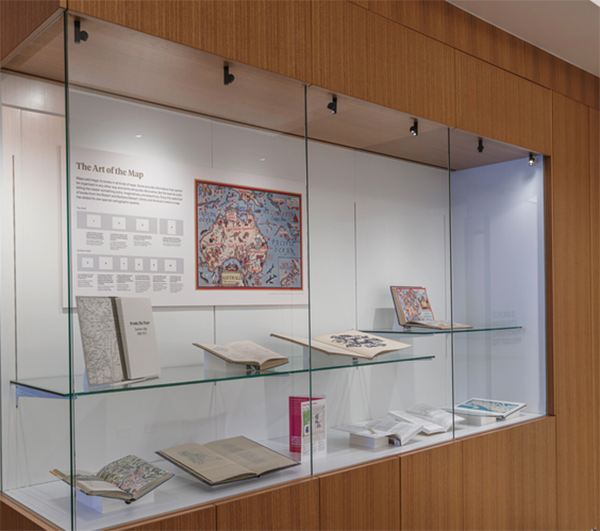
The Art of the Map
Between April to August this year the Christchurch Art Gallery dove into its archive to put on a celebration of maps in books - with an emphasis on the environs of Ōtautahi Christchurch.
Links to a selection of the maps that were displayed can be viewed here.