Trees are critical infrastructure
by Karl Check, Mātanga Huringa Āhuarangi | Nature & Climate Change Specialist - Boffa Miskell
IImage credit: LAA
Trees and nature more broadly are critical infrastructure for our cities.
As climate change brings both more extreme rainfall and more extreme heat, the role of soils, trees and green space becomes even more important. Yet we continue to undervalue the contribution they make and aren't creating space for them in the way we plan and develop our urban areas.
I was pleased to see Parliamentary Commissioner for the Environment Simon Upton calling this out in his recent letter to Minister Chris Bishop. The Commissioner is concerned that proposed planning reforms could leave us with "harder, hotter cities" by reducing councils' ability to require outcomes such as urban tree canopy and deep soil retention. The point is simple: climate change isn't an abstract future problem. It's about what it will be like to live in cities that are hotter in summer and more exposed to intense rainfall.
The letter also raises an important question. If we remove requirements for soils and trees, are we simply shifting costs elsewhere through bigger pipes, more stormwater infrastructure and greater reliance on engineered solutions?
One passage particularly stood out:
"Why not invite some practical and well-regarded developers, builders, landscape experts and engineers to a round-table discussion and ask them to tell you what currently gets in the way and how we could do a better job of creating liveable suburbs."
Sitting within a firm full of incredibly talented landscape architects, planners, ecologists and designers, it was good to see this expertise acknowledged. Creating greener, cooler and more liveable neighbourhoods is not at odds with development. Done well, it is part of good development.
It feels like we are at a critical juncture as we look to streamline the planning system. Let's do it in a way that recognises nature's role in creating cooler, healthier and more flood-resilient communities. Nature should be viewed as an enabler of better urban outcomes, not an impediment to growth.
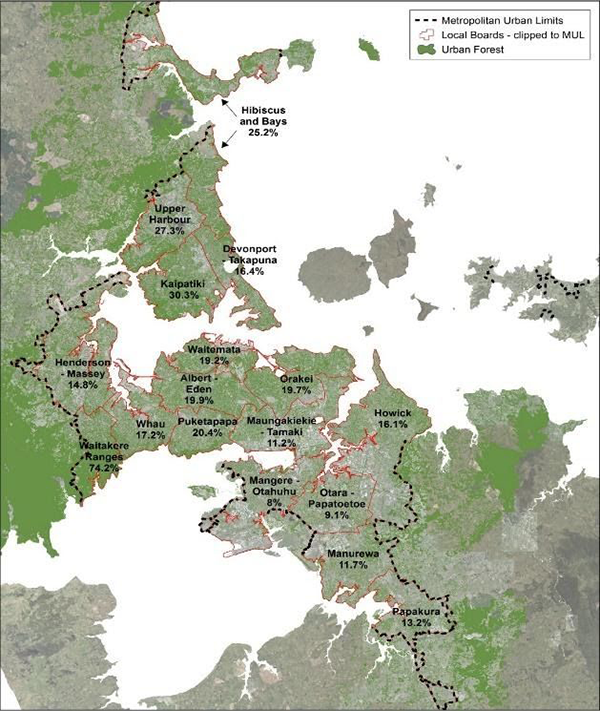
The image below introduced me to yet another dimension of inequality in New Zealand and was part of my inspiration for getting an Urban Forest initiative underway. Tree cover is only one measure, and perhaps a simplified one, but it provides a powerful reminder that access to the benefits of urban nature is not shared equally.
Courtesy Pure Advantage
Editor’s note: If you’re on LinkedIn you can find Karl here. His passion for urban forests, or urban ngahere has included doing guerrilla planting in his own suburban backyard and creating the Vector Urban Forest concept, which helped get around 30,000 seedlings planted each year.
_________
Further references & reading
Urban Trees and the Auckland Ngahere Strategy by Dean Howell - Pure Advantage (2021)
Are we building harder, hotter cities? The vital importance of urban green spaces - Parliamentary Commissioner for the Environment (2023)
Urban Ngāhere by Anna Delaney - Auckland Climate Action (2026)
The LAA book column: No Place for a Tree? March 2026
A video recording of the latest Christchurch Conversation on Urban Heat held on 18 August 2026 - YouTube
'Many, many more trees will disappear' under RMA replacements, advocate says - Radio NZ, 31 August
See also:
Forest Urbanisms: New Non-human and Human Ecologies for the 21st Century - Landezine