Law change is an invitation to unintended consequences
by Gavin Lister, Rachel de Lambert and Alan Titchener
As one of its final acts before the upcoming Election, the Coalition Government has passed new planning and environmental management legislation intended to promote private property rights, economic growth, and certainty.
Regrettably, however, the approach taken in the legislation is poised to lead to unintended consequences and an inevitable need for further changes to the law.
A stated aim of the new Planning Act is to promote economic growth and development while balancing such development with environmental protection, to the extent contained in the new Natural Environment Act.
At face value, those are desirable goals. However, the separation of land use and the natural environment into the two Acts artificially sets them up as competing goals when they are self-evidently intertwined. Focusing on ‘natural environments’ separately from land use and development also positions nature as ‘somewhere out there’, ignoring the essential presence of nature in our urban environments, where most of us spend most of our time.
In any event, separating ‘growth’ from ‘environment’ is more likely to harm than help our economy. New Zealand proudly and unashamedly trades on our natural values as central to our national brand. We rely on the qualities of our landscapes and lifestyles to compete for overseas talent and to retain our own – and to lure them home. These qualities are becoming more crucial, not less, especially for first world economies.
Among the changes made in the new Planning Act is the requirement that people considering effects on the environment under the new act must disregard (amongst other things), the “effect on landscape” (if the landscape is not outstanding or not an area of high natural character), and “the character, appearance, and aesthetic qualities of a use, development, or building. In other words, they must disregard the very qualities that make our countryside and cities unique.
There are some limited exceptions to this requirement, such as for ‘outstanding natural landscapes’; areas of high natural character in the coastal environment; wetlands, lakes, rivers and their margins; sites of significant historic heritage; and sites of significance to Māori.
However, even in those instances, Councils will need to provide compensation to the property owners for lost development potential under the introduced principle of ‘regulatory relief’.
It does not require much imagination to predict the outcome: cash-strapped Councils under rates caps will choose the only realistic option and cut protection. In the case of Queenstown Lakes District, for example, where almost all of the district is classified as ‘outstanding natural landscape’, the cost of relief will be prohibitive, despite the obvious importance of those landscapes to the area’s economy and growth.
An ideological foundation of the new legislation is to prioritise private property rights – a key pillar of the current government’s Coalition Agreement. It’s a beguiling argument – most of us believe in private property rights – except where our enjoyment of our property, or the places we love, is affected by others exercising their rights. Conflict will inevitably arise between insistence on the recognition of our individual rights and our personal lived experiences.
The effects of development does not stop at the title boundary
The qualities of our cities and landscapes undeniably arise from private ownership, but also from our appreciation, cultural connection and a shared sense of place. The effects of development do not stop at the title boundary, and our lives are not confined to parcels of real estate. The unavoidable reality is that we live in urban and rural landscapes. Resolving the tension between our private and public lives has been an enduring aspect of planning and environmental law since planning began.
Another stated objective of the new legislation is to increase certainty in decision-making. At face value, that also is a desirable aim. However, the corollary of certainty is inflexibility. It is easy to create certainty through rigid rules – everyone knows where they stand – or by adjusting the settings to make approval virtually guaranteed. Unfortunately, this can cause the unintended consequences of stifling growth and innovation, while enabling degradation of our cities and countryside.
Informed discretion looks to the future. Of course, it is less certain and more contestable, but it allows for a more responsive approach to place and design that can achieve both growth and beneficial environmental outcomes.
Planning and environmental law based on ideology and a promise of certainty ignores reality.
There will always be a tension between private and public interests – it’s the nature of the things themselves. We all have a stake in the places where we live and hold pride in the places that define our national identity. We share our cities and landscapes - they are part of who we are. We cannot (and ought not) eliminate that by legislation. Those realities will come out in other ways – very likely by requiring yet further overhaul of our environmental legislation.
We shouldn’t have to learn these truths all over again – we deserve more thoughtful law in the first place.
______
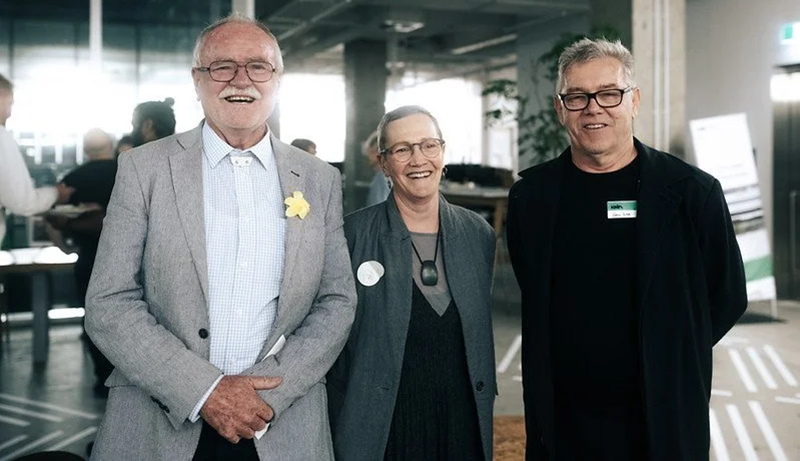
The launch for Te Tangi a te Manu. Photo credit: David St George.
Editor’s note: Alan Titchener, Rachel de Lamber and Gavin Lister (pictured above, left to right) are registered landscape architects with 130 years of practice between them. In 2022 they co-authored the highly regarded Te Tangi a te Manu: Aotearoa New Zealand Assessment Guidelines (published by Tuia Pito Ora New Zealand Institute of Landscape Architects), a taonga of landscape architecture practice in Aotearoa New Zealand.