The NZILA Auckland Branch asks what comes next for landscape architecture?
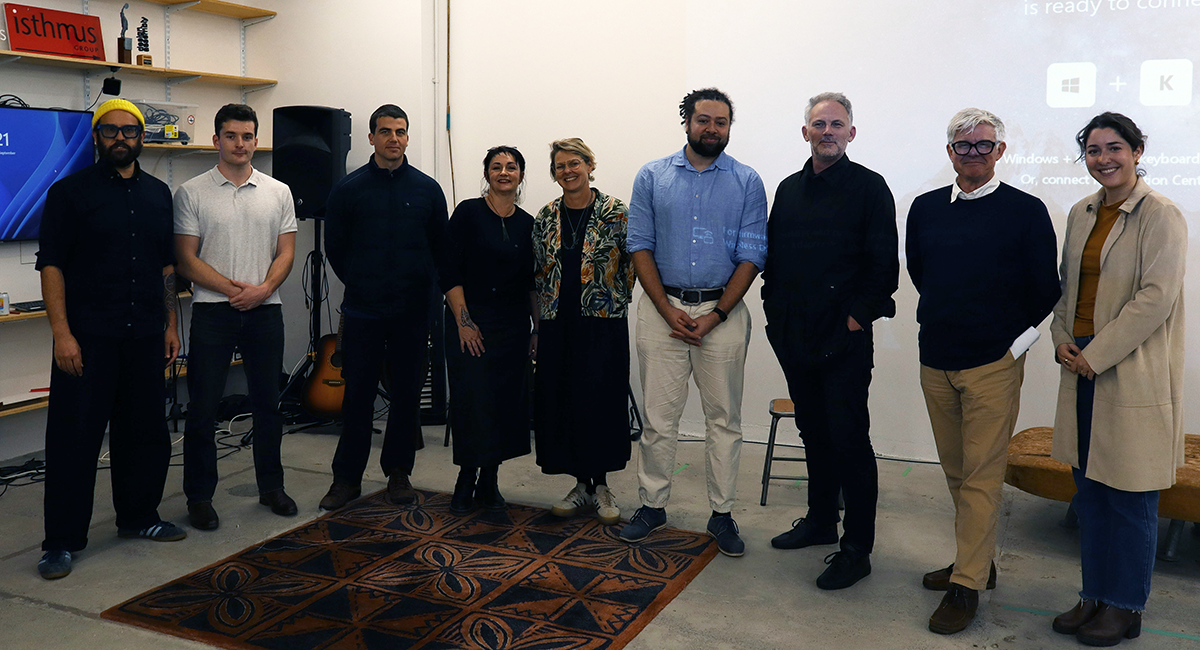
Left to right: Damian Powley, Michael Head, Rhys Baker, Debbie Tikao, Sara Zwart, Oliver May, Henry Crothers, Matthey Bradbury, Emily de Lautour. Photo credit: Jessica Juno.
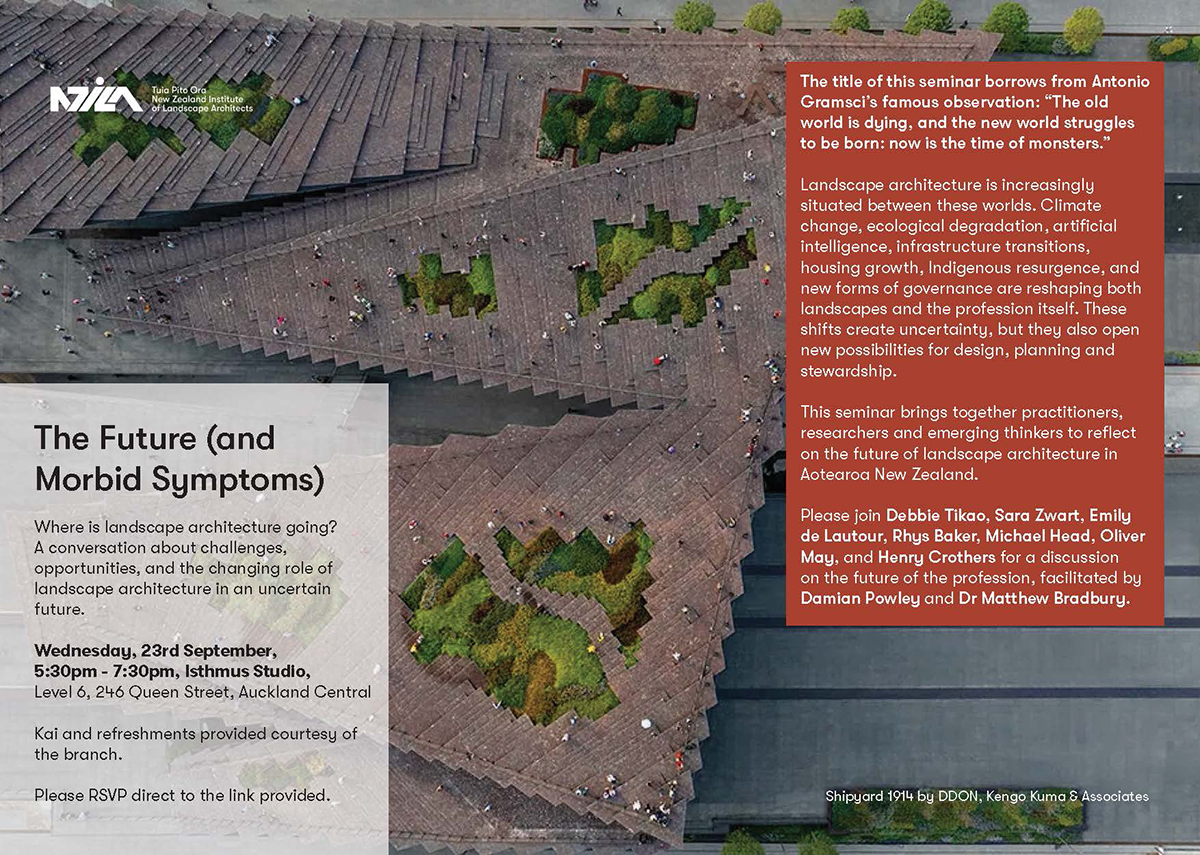
Landscape architects, urban designers, academics, and students gathered at Isthmus in Auckland on 23 September for The Future (and Morbid Symptoms), an evening seminar, hosted by the New Zealand Institute of Landscape Architects Tuia Pito Ora (NZILA) Auckland Branch in partnership with Isthmus.
Organised by Matthew Bradbury, Damian Powley, David Sullivan, Nicole Tune, Ethan Reid, and Michael Hawes, the seminar explored a provocative question: What comes next for landscape architecture?
The evening opened with a spirited mihi whakatau led by Damian Powley, setting the tone for a thoughtful discussion on the profession's future direction.
Introducing the seminar, Matthew Bradbury argued that the profession may be approaching the end of a remarkably successful era shaped by urban design and city-making. Over the past two decades, landscape architects have played a central role in transforming New Zealand’s urban environments through waterfront regeneration, public space design, transport infrastructure, urban intensification and the creation of more liveable cities.
With major projects such as Auckland’s City Rail Link having entered completion, Bradbury asked whether the profession is at the portal of what Italian political thinker Antonio Gramsci described as an interregnum; a period in which the old world is dying while the new world struggles to be born. In such moments, Gramsci observed, “morbid symptoms” emerge as familiar assumptions lose their relevance while future directions remain uncertain.
The symptoms of that transition are increasingly visible. Artificial intelligence, economic instability, housing pressures, social inequity, geopolitical uncertainty and accelerating climate change are reshaping the conditions within which landscape architects work. Rather than simply cataloguing these challenges, the seminar explored the leadership, skills and forms of practice that may be required to navigate them.
Different dimensions of change
Structured as a series of short provocations, the evening invited speakers to examine different dimensions of change.
Debbie Tikao opened the presentations by challenging participants to reconsider the foundations of urban design through the lenses of climate change, social equity and Te Tiriti o Waitangi. Drawing on more than 25 years of professional experience and leadership in taiao knowledge, she argued that the future of practice will require deeper engagement with Indigenous knowledge systems and environmental justice.
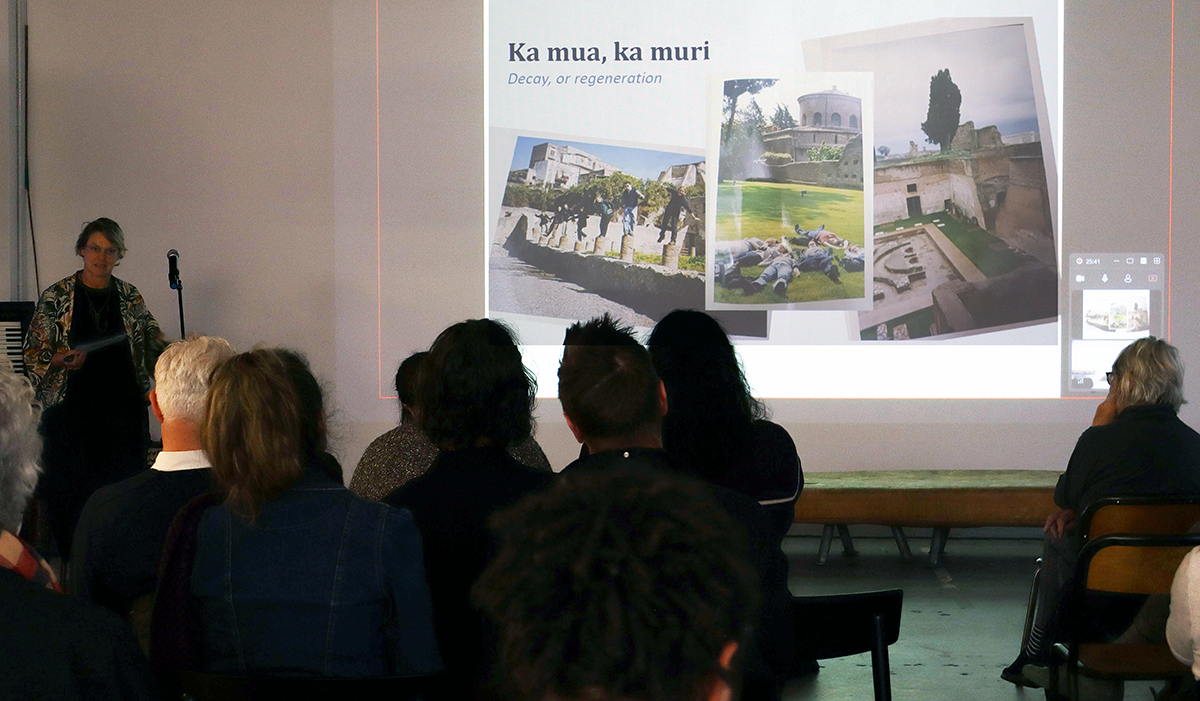
Photo credit: Jessica Juno.
Climate change remained a recurring theme throughout the evening. Sara Zwart, Regeneration Manager for Blue-Green Networks at Auckland Council, shifted the discussion from projects to people, asking what types of practitioners will be required to regenerate cities in an era of environmental uncertainty. Her presentation highlighted the growing importance of collaboration, systems thinking and the ability to work across disciplines, communities and institutions.
Rhys Baker of Resilio Studio extended the discussion into stewardship and maintenance. Focusing on stream restoration, flood resilience and ecological regeneration, Baker argued that climate adaptation will require the profession to move beyond project delivery and place greater emphasis on long-term care. He challenged landscape architects to think more deeply about funding, governance and the ongoing management of landscapes throughout their life cycle.
Shifting to a regional scale, Michael Head explored the provocative idea of the Hauraki Plains as a future regional park. His presentation encouraged participants to think beyond individual sites and projects and instead imagine landscape transformation operating across territories. Through large-scale ecological restoration and environmental resilience, Head suggested that landscape architects have an important role in shaping new regional futures.
Attention then turned to the institutional frameworks that influence practice. Oliver May examined the increasing uncertainty surrounding planning and regulatory systems in New Zealand. As governments reconsider environmental and planning legislation, he asked whether these changes represent a threat to the profession or an opportunity for landscape architects to redefine their influence and leadership.
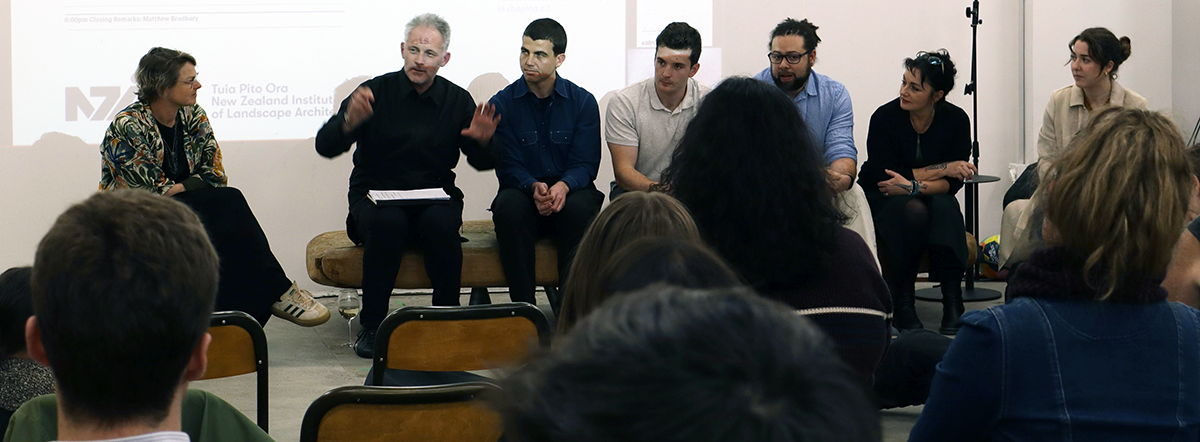
Photo credit: Jessica Juno.
Henry Crothers, Design Director at LandLAB and Director of the International Federation of Landscape Architects working group on Landscapes for Cities, Regions and Territories, proposed a vision of landscapes as operating systems. Exploring landscape-led approaches to urbanisation, he suggested that landscapes can function as dynamic frameworks capable of managing complexity, integrating data and supporting environmental performance across cities and regions. His key provocation was that landscape should come “first and last” in shaping urban futures.
The final presentation was delivered by Emily de Lautour of Walker Macy, who explored the implications of artificial intelligence for design practice and knowledge production. Rather than framing AI as either a threat or opportunity, de Lautour considered how emerging technologies might reshape creativity, expertise and professional value. Her presentation encouraged participants to think critically about how design disciplines evolve alongside technological change.
The audience discussion that followed demonstrated both the breadth of challenges facing the profession and the enthusiasm to engage with them.
One of the central themes was how society might better recognise and value landscape. Participants debated whether landscape benefits should be measured through performance indicators, ecological valuation and carbon-accounting frameworks, or whether landscape architects should resist reducing environmental and cultural values to purely economic terms.
Collectively, the speakers did not seek to predict the future. Instead, they offered perspectives on the conditions emerging around us and the possibilities these conditions create. Together, their presentations suggested that landscape architecture's next chapter may be less concerned with individual projects and more focused on navigating the interconnected social, ecological, technological, and political systems shaping contemporary life.
____________
Editor’s note: Thank you to Dr Matthew Bradbury of Manukau Institute of Technology and Unitec for supplying this event reportage for LAA.
A student perspective
Jessica Juno – 2nd year Bachelor of Landscape Architecture student at Unitec
Despite the ongoing challenges and concerns for our landscapes in Aotearoa, for me The Future (and Morbid Symptoms) brought up messages of both hope and resilience.
What stood out to me was the importance of having events like these to bring landscape architects together from across different spaces. The presentations and panel discussion were a reminder of how much there is to learn from and share with each other.
In understanding each other’s differences in perspective as well as the work we do as landscape architects creates an opportunity to strengthen and unite us as a discipline. While our work and motivations may differ, there remains a shared sense of care, responsibility and commitment to the land that connects us.
Julianne Buys – 4th year Bachelor of Landscape Architecture student at Unitec
The evening showcased the diverse approaches and perspectives within the practice of landscape architecture, considering our impact not only in Tāmaki Makaurau and across Aotearoa, but also on a global scale.
I left questioning what it would take for the profession to be able to reach its full potential in the coming years and what broader societal changes may be necessary to achieve this. As our world continues to change rapidly, can landscape architecture keep pace? How can we help more people understand and recognise the value of the work landscape architects do?