“Speed alone is not a measure of good planning” - or good law making
This is a big week for all those set to meet the deadline for submissions to the Planning Bill and Natural Environment Bill now before the New Zealand Parliament | Pāremata Aotearoa.
To date this has not excited much in the way of media headlines despite its significance - although three exceptions popped up in the last week:

Who should decide the value of your local environment? by Dunedin-based landscape architect Hugh Forsyth - source: Otago Daily Times (thanks Hugh, you inspired the headline to this article)
Costly, muddled, bad for Māori: New Plymouth considers resource reforms - source: Te Ao Māori News
Planning law overhaul puts Wairarapa’s dark sky reserve at risk - source: Wairarapa Times-Age
In the latter story - deserving of more national coverage - Debbie Donaldson of Kahu Environmental raised concerns that the proposed legislation risks shutting the door on the local council’s ability to protect the quality of the night sky - which in Destination Wairarapa’s estimation has generated a notable economic boost.
A sign of this legislation’s importance
A sign of this legislation’s importance is that the select committee handling it took the unusual step of publishing early advice from Ministry for the Environment (MfE) officials and the Parliamentary Commissioner for the Environment (PCE) as a late assist to informing the process.
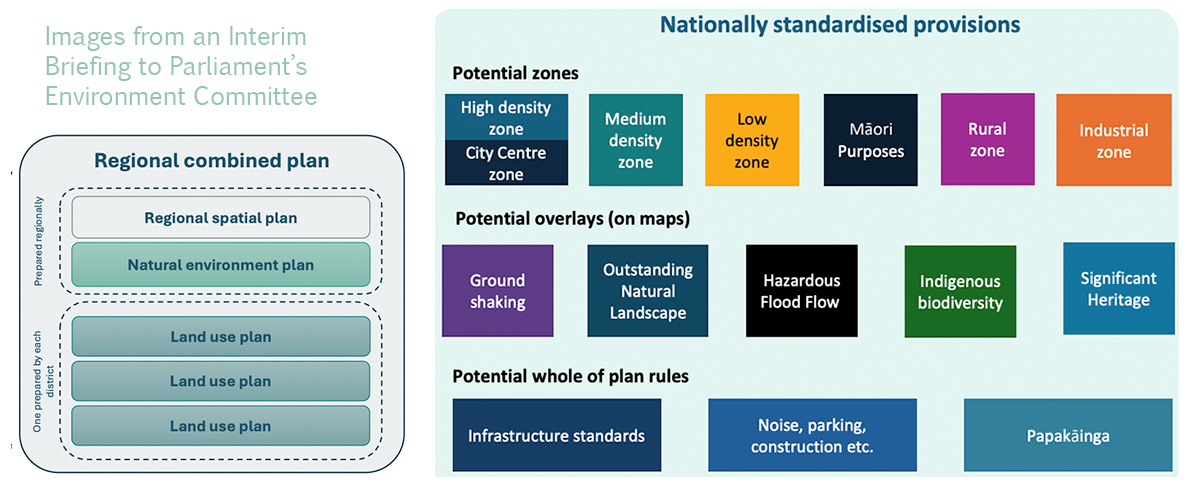
The MfE’s briefing note included a link to its Supplementary Analysis Report (PDF here) while one of the opening slides for the Environment Committee briefing itself, delivered on 29 January, acknowledged that the legislation has been “developed at pace and as a result there are some areas that need refinement”.
The initial input from the PCE - the Rt Hon Simon Upton, who has been appointed as an independent advisor to the Environment Committee - was framed as a set of 21 preliminary questions, including a question asking: “Do the goals, and how they are particularised by the key instruments, adequately protect the interests of future generations?”
Meanwhile other wheels continue to turn.
On 15 January for instance 10 new or amended national direction instruments under the Resource Management Act came into effect, after the infrastructure, development and primary sector national direction, freshwater national direction and going for housing growth consultations held during 2025.
As suggested at Newsroom.co.nz these offer a “ taste of New Zealand’s development-friendly future” - and of what debates will be on the table as Election year campaigns intensify.
Reforms across the Tasman: We’re not alone
It’s hard not to notice the occurrence of an acceleration of planning reform legislation across many different jurisdictions around the world, with many shared features.
Amongst the 30 slides presented by MfE to the Environment Committee on 29 January, it was interesting for instance to see an image from the Greater Sydney Spatial Map used as an illustration.
New Zealand Cabinet Minister Chris Bishop, (Infrastructure, Housing, Transport), frequently engages with counterparts in Australia, with visits to Sydney and Canberra to discuss, for example, the National Infrastructure Plan. In 2025 he met with NSW Premier Chris Minns to discuss housing, as seen in this video from The Centre for Independent Studies.
It’s very useful then that the Planning Institute Australia (PIA) recently put together a high-level snapshot of planning reform across Australia.
The PIA notes that reform is unfolding very differently in Australia’s states and territories as “shaped by local pressures, political cycles and the maturity of each state's unique planning system”, adding that “planners and governments are responding to significant housing supply challenges, infrastructure delivery constraints and community expectations in distinct ways”.
At the Federal level a National Planning Reform Blueprint, sub-titled ‘Planning, zoning and land release measures to improve housing supply’ [PDF here] appeared in 2024, and the Environment Protection and Biodiversity Conservation Act 1999 (EPBCA) has just undergone a major overhaul after the introduction of a package of reform bills in October 2025 - including the Environment Protection Reform Bill 2025.
You can view a video explainer of the EPBCA changes here – as made available on 15 January 2026.
The EPBCA applies when a development has a significant impact on matters of national environmental significance. Similarly to our RMA reforms its overhaul represents the most ambitious reform of overarching environmental law in Australia in a quarter of a century.
A roadtrip: What Can We learn from Australia?
_____________________
New South Wales
Changes made to legislation and a measured approach to strategic planning in NSW, Australia, offer some parallels to aspects of change proposed here in Aotearoa New Zealand.
While subject to some material last-minute refinements, the Environmental Planning and Assessment Amendment (Planning System Reforms) Bill was passed by both Houses of the NSW Parliament on 11 November 2025.
During its passage strong objections were raised by Australia’s Environmental Defenders Office, including that the Bill purported to relate to housing but would affect ALL types of development. The EDO also expressed concerns that the planning system was being reoriented to simply promoting development, “shifting focus away from the wellbeing of the community and the environment in decision making”.
The new law gives status to a Housing Delivery Authority and a Development Coordination Authority as well as consolidating and clarifying the roles and functions of the Independent Planning Commission, the Minister, regional planning panels, public authorities and councils (consent authorities) by removing the regionally significant development pathway, abolishing Sydney district and regional planning panels and clarifying roles and functions for development applications. It has yet to take effect.
Meanwhile the NSW Department of Planning, Housing and Infrastructure is now consulting on A new approach to strategic planning, a discussion paper published in December 2025. Submissions there remain open until 27 February 2026.
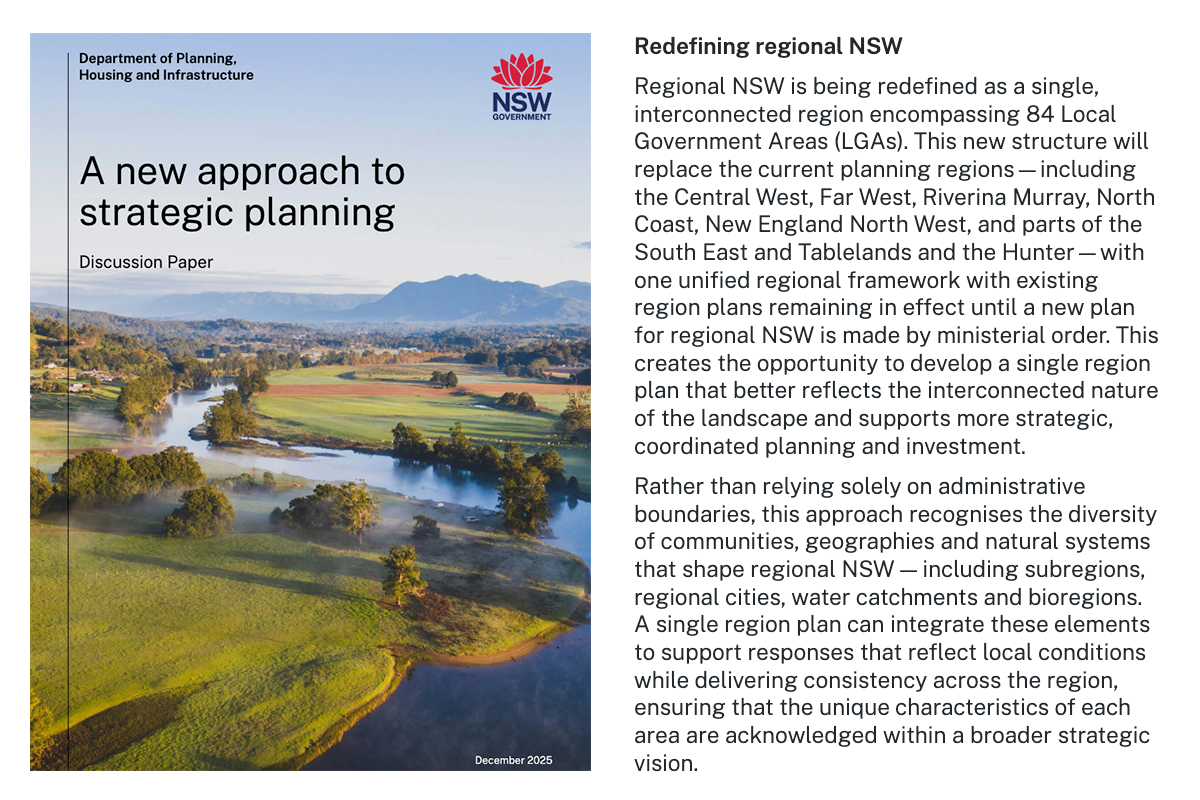
An extract from the NSW Government’s discussion paper ‘A new approach to strategic planning’.
This discussion paper heroes the statement that “The places and landscapes where we live, work and spend time shape our lives. Strategic land use planning guides how these places grow, change and are protected”.
The new approach proposes a 3-tier planning framework that is agile, modular and that enables “updates to individual components or technical appendices without rewriting the entire plan”. The cascading tiers are:
State Land Use Plan – what must happen and why, with clear land use priorities and policy directions
Regional Plans – increase the focus on where and when to achieve the priorities, to increase certainty
Local Strategic Planning Statements (LSPSs) – focus on locally-sensitive implementation of the priorities
In addition a Industrial Lands Action Plan was released in NSW in January 2025 followed before end of year by a draft Statewide Policy for Industrial Lands [PDF here].
It includes the following aspiration:
Where relevant, significant landscape features such as ridgelines, watercourses, and vegetation should be retained to preserve landscape character and ecological values. The design of industrial areas should respond to the landscape setting, with consideration given to the appropriate format, scale, and intensity of development for the topography and visual context of the site.
_____________________
Victoria
Victoria’s reforms look at the roles and responsibilities of all major players in the planning system including councils, the Minister for Planning, and the Department of Transport and Planning.
The Victoria State Government is reviewing and updating the Planning and Environment Act 1987 (PE Act). It is doing this with the publicised purpose of “building a modern, fit-for-purpose planning system” through legislation such as the Planning Amendment (Better Decisions Made Faster) Bill 2025 (this was passed by the Legislative Council on 9 December 2025 to then return to the Legislative Assembly to consider amendments made by the Council).
Interestingly, Planning Institute Australia (PIA) Victoria was concerned that, as originally drafted, the Bill risked increasing “the likelihood of poor long-term outcomes” and urged a focus on ‘getting the detail right’.
Amendments to the PE Act have been introduced to safeguard the state's distinctive areas and landscapes.
The next Victorian State Election is scheduled for November 2026.
_____________________
Queensland
Queensland’s planning framework, empowered by the Planning Act 2016, is known as ‘Delivering for Queensland’.
There is a State Planning Policy (SPP) that is arranged under five broad themes: liveable communities and housing; economic growth; environment and heritage; safety and resilience to hazards; and infrastructure. The Department of State Development, Infrastructure, Local Government and Planning is responsible for reviewing a raft of issues and interests, including the SPP.
_____________________
South Australia
Legislation passed in South Australia is introducing significant changes to the state’s planning system.
This includes the Planning, Development and Infrastructure (General) (Miscellaneous) Amendment Regulations 2025 (effective 5 November 2025) and the Statutes Amendment (Planning, Infrastructure and Other Matters) Bill 2025 (effective this year).
Plan SA is a portal managed by the Department for Housing and Urban Development. It provides access to a Planning and Design Code (this has 125 results on a search for ‘landscape’) as well as the SA Property and Planning Atlas (SAPPA).
South Australia has a State election in March 2026.
_____________________
Western Australia
WA is implementing reforms to accelerate housing delivery, with new regulations passed to define "significant developments".
Released by the WA State Government in March 2018, the Perth and Peel 3.5million planning frameworks remain the core long-term strategy for land use and infrastructure to accommodate a population of 3.5 million. There is also a strategic assessment from the Department of Climate Change, Energy, the Environment and Water that looks at the best way to “protect the environment and meet the needs of a growing city”.
In 2025 the Parliament of Western Australia ran an Inquiry into land development and planning which attracted approximately 452 submissions, including one from the Western Australian branch of the Australian Institute of Landscape Architects (AILA). A report has yet to be tabled.
The brief AILA submission made the following points:
There is a critical need to better align planning processes with climate and environmental priorities. Land use planning should explicitly incorporate:
Climate change adaptation and mitigation objectives
Biodiversity and habitat protection within urban and regional growth areas
Water-sensitive urban design and integrated water management
Urban heat reduction and canopy protection through consistent tree retention and planting policies
It was noted that “these elements are often treated as secondary or compliance-based issues rather than as central to strategic planning and investment”.
Advocacy was made, particular to Western Australia, for increased transparency in:
The assessment and justification of major land transactions and rezoning decisions
The evaluation of design quality, sustainability, and environmental performance
Reporting on community benefit and longer-term environmental outcomes
AILA WA strongly promoted a positive planning and development system “that is transparent, evidence-based, and designed to achieve balanced outcomes across the community, private sector, and future generations”.
The vital role that landscape architecture and landscape architects play ”in shaping this balance, integrating environmental, social, and design expertise to ensure Western Australia’s land use and development decisions deliver enduring public value” was championed.
_____________________
Tasmania
The Tasmanian Planning Policies (TPPs) come into effect on 1 July 2026.
The TPPs will guide the review of the regional land use strategies (RLUS) content and inform the State Planning Provisions (SPP) review and amendments to Local Provisions Schedules (LPS). The TPPs cover policies on: Settlement; Environmental Values; Environmental Hazards; Sustainable Economic Development; Physical Infrastructure; Cultural Heritage; Planning Processes.The full document is available as a PDF here. It contains content on Landscape Values as well as Tourism.
_____________________
Northern Territory
The Northern Territory Government consulted on a Strategic Planning Policy (SPP) in 2025.
This has now been finalised to provide overarching, high-level direction for the preparation of strategic land use plans and planning policies across the NT. It aligns with the objectives of the NT Planning Act 1999 which aim to: protect the quality of life of future generations; maintain the health of the natural environment and ecological processes; assist the provision of public utilities, infrastructure, and community facilities; promote the sustainable development of land; encourage good design that respects local amenity; support the conservation and enhancement of places, areas, buildings, and landforms of cultural, aesthetic, architectural or historical value.
_____________________
Australian Capital Territory
The ACT has published a Statement of Planning Priorities (SPP) with a strong emphasis on landscape.
Priority 8 [PDF here] states that as Canberra continues to grow it is important that environmental values are protected and enhanced to achieve the vision of Canberra as a ‘city in a landscape’. District Strategies have identified the importance of city-wide environmental and biodiversity connections and blue green corridors, as well as opportunities to embed living infrastructure into planning policy.
To support this the Government will take a landscape approach, including strategic spatial
planning to proactively protect and restore key areas of environmental value for the future, both
within the urban footprint and on the urban interface.
Note: All states and territories in Australia have a Planning Commission or similar.