Our proposed new resource management laws: Sans landscape!?
by Peter Kensington – Chair of the NZILA Environmental Legislation Committee
Within the two new Bills that are proposed by the Coalition Government to replace the Resource Management Act 1991 (RMA) – currently open for submissions to Parliament’s Environment Select Committee – there are key issues that need resolving to ensure an optimal future statutory platform for resource management in Aotearoa New Zealand.
The Bills propose a fundamental shift with a deliberate split into a Planning Act and a Natural Environment Act. These changes, as proposed by the Bills, are well set out in an overview document released last month by the Ministry for the Environment: Better Planning for a Better New Zealand.
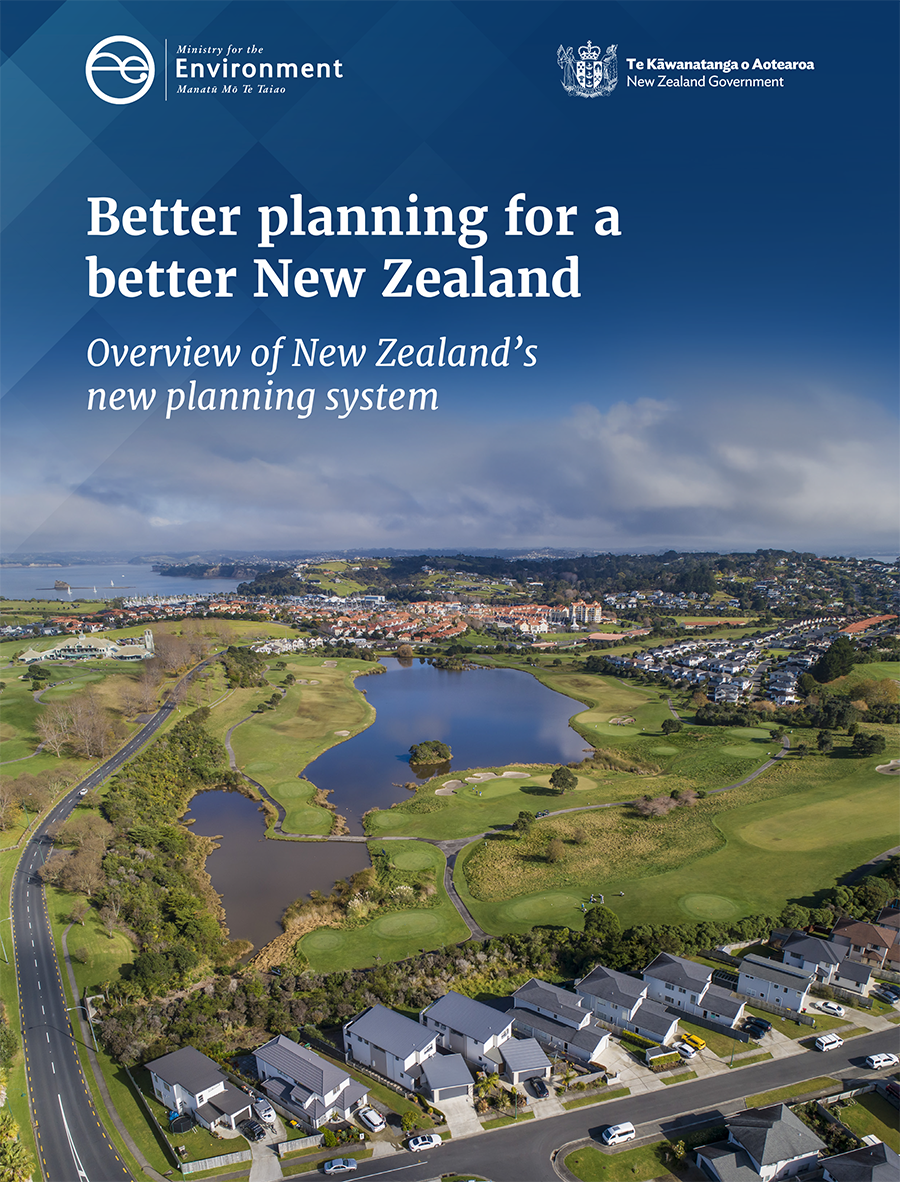
Page 15 of the overview notes that, under the Planning Bill (PB), effects that are ‘in scope’ for consideration include “risks related to natural hazards, neighbour-to-neighbour impacts like noise, vibration and shading, and the benefits of increased housing supply and infrastructure capacity (including roads)”. Effects deemed “not to affect others” (despite points of friction) and that will be ‘out of scope’ include:
“… matters internal to a site (like building layout or balconies), visual amenity, private views, and negative impacts on competing businesses. Subjective landscape and amenity effects that preserve character will also be excluded, except to protect outstanding natural landscapes and features, areas of high natural character in the coastal environment, wetlands, land and rivers and their margins, and significant historic heritage.”
The particular exclusion of landscape and visual effects, being key components of peoples’ enjoyment of property and the environment, should be of real concern to us all. For example, if a development that is proposed in your neighbourhood (perhaps on your immediate neighbour’s property) far exceeds the relevant expected building and development standards (that will be set at a national level) then there will be no ability for decision makers to consider such impacts and how these impact your wellbeing.
Finding a solution
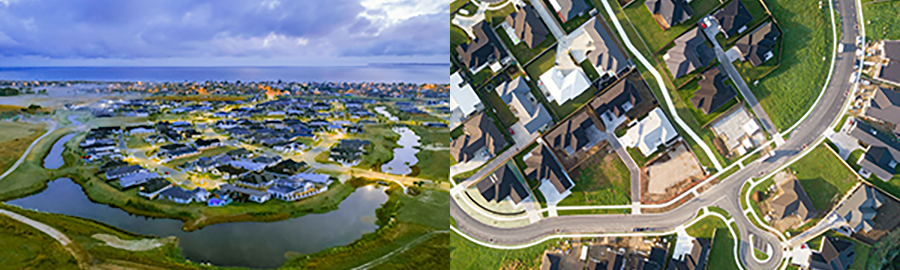
Images from Better Planning for a Better New Zealand.
The Environmental Legislation Committee working group of Tuia Pito Ora New Zealand Institute of Landscape Architects (NZILA), were encouraged by the commonalities of position brought to light at a well attended in-person national member hui and supporting NZILA webinar over the last fortnight about the changes.
The collective perspectives brought to us from Emily Grace of the New Zealand Planning Institute (NZPI), Julia Wick on behalf of the Resource Management Law Association (RMLA), Graeme McIndoe from the Urban Designers Institute Aotearoa (UDIA) and Greg Severinsen of the Environmental Defence Society (EDS) on 20 January 2026 were invaluable.
I took away some extremely useful insights from our national hui, contained in the constructive critiques from our presenters and the careful responses made from our members in attendance. Collectively attendees laid out a highly cogent and broadly compelling agreement on aspects of both the PB and Natural Environment Bill (NEB) that are, as yet, not as fit for purpose as they could and need to be.
We must acknowledge and agree that the RMA – once hailed as pioneering legislation – has passed its ‘best before date’, after becoming entangled and overwhelmed by inefficiencies at a process level. A pragmatic view for streamlining of systems and improving consistency of performance has merit.
Concerns raised by presenters at our national hui moved into points like the difficulties of translating aspirational goals such as creating “well-functioning urban and rural areas” (or which might be better termed well-functioning urban and rural environments) into practice. This particular term lacks adequate definition, which could be problematic under circumstances where the balancing of private and public good is being markedly tipped towards private interests. There also appears to be a disconnect between the purpose and the goals of the NEB when it comes to restoring our environment, particularly in our rural areas.
Emily Grace from the NZPI emphasised the need to settle on consistent terminology and clear success measures and to address an absence of sufficiently strong statutory links between the PB and NEB to avoid fragmentation and sustain semblances of essential integration.
Julia Wick from the RMLA pinpointed concerns over the presence of overlapping goals that are at odds with each other and that could potentially undermine long-term certainties. General concerns about the proposed legislation’s elements of centralisation coupled with a weak alignment with Treaty principles were also raised. Julia subsequently communicated a related message to RMLA members, stating:
“At the heart of our [NZILA] position is a simple message: well-designed environments strengthen communities, improve wellbeing, and deliver long-term economic and environmental value. Landscape is integral to well-functioning urban and rural environments, yet landscape effects - both positive and adverse - are not adequately recognised in the proposed legislation, a concern shared across related disciplines, including heritage.”
Graeme McIndoe from the UDIA made a strong case for avoiding unnecessarily compromised urban areas / environments. He expressed comfort with some proposed legislative clauses, particular to the cascading new hierarchy from national policy direction and national standards down to (regional) spatial plans and (district) land use plans, and to procedural principles, but not so to disregarding effects such as the streetscape footprint made by buildings where that precludes good design – including running counter to accepted and justified safety principles like Crime Prevention Through Environmental Design (CPTED).
In making the point that “it’s incumbent on Parliament to ensure risk of regulatory failure is eliminated”, Graeme shared a preliminary observation that:
“New Zealand cannot afford to permit abjectly low quality, unfit for purpose development that may be acceptable to sponsors and some developers now, but is of little benefit to future users, degrades its setting and may have to be replaced in short order.”
In flagging the direct connections that exist between landscape architectural involvement in good urban design outcomes, Graeme’s point of view encouragingly signalled support for retaining landscape and visual effects within scope, both to “mitigate real effects and to achieve substantive benefits”.
Common ground
For me, the common ground I keep circling around is the back story of how much progress the landscape architecture profession has made in deploying best practice and proven expertise; based firmly on the values of our environment, at various scales (including local), that can effectively communicate effective outcomes, to assist decision makers, resulting from factual and best-practice enquiry.
Much of this is referenced in Te Tangi a te Manu, our widely endorsed and respected guidebook for the planning, design, assessment and management of the landscape in Aotearoa New Zealand, which seeks to manage and enhance landscape values. We acknowledge that development must continue to occur, but being in balance with and respectful of the natural environment.
We live in a country that makes much of having a ‘pristine environment’. It was noticeable that on the same day that the proposed new laws had their first reading, answers during the preceding questions time in Parliament featured a discussion about the worth of tourism based on our “stunning landscape and unique, world-class experiences”, which I note is also important to our film industry. The GDP worth of our rural sector is also incredibly dependent on the decisions made about our safeguarding of whenua and landscape.
The PB and NEB form a ‘marquee set’ of legislation for the current Coalition Government and an opportunity for all of us to muster our best thinking. When taking into account the measure of bipartisan support for this legislation, those at the hui we held were faced with a reality check that the chances of significant changes are slim.
However there is an awareness that the complexities are such that getting it all right in the somewhat rapid drafting process – without any errors, omissions or areas to revisit and revise – was always going to be difficult to achieve. To quote Labour’s Rachel Brooking, a caution to heed about entering a fully permissive regime is that “if you just say ‘yes, yes, yes, yes’ to everything, there is [always] a consequence”.
There is a lot of detail to unfold yet, as well as accompanying question marks about the capacity to manage implementation timeframes; even more so now that local government structures are in a state of flux, and that the capabilities for steering the transition of this major overhaul into place will rely on a major new public sector body – the Ministry for Cities, Environment, Regions and Transport (MCERT).
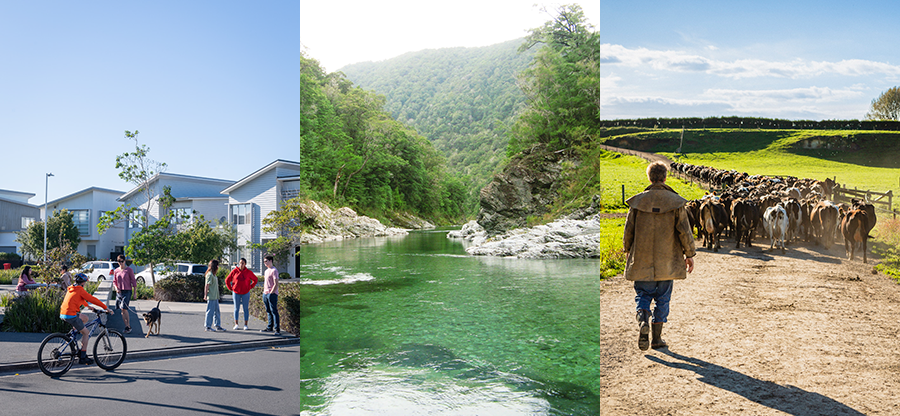
Images from Better Planning for a Better New Zealand.
The big backdrop should be an understanding that the environment as a whole is interdependent and inseparable: while urban growth and development, including infrastructure, can occur, it must be well-planned, designed, appropriately located (spatial planning) and managed for the place within which it is occurring, in order to create well-functioning places for us to live, work and play.
We all have a stake in getting this legislation right and I encourage you to make a submission. The deadline for submissions to Parliament’s Environment Committee is almost upon us – you have until 4.30pm on Friday 13 February 2026 to have your say.
See also:
Related links for further reference
Te Kōkiringa Taumata | New Zealand Planning Institute (NZPI)
Reform Survey – 30 January 2026
Media Release – 9 December 2025
Provisional Positions on Reform Proposals – December 2025
Position Statement – December 2024
For more see the NZPI’s LinkedIn posts and Facebook
Resource Manager Law Association (RMLA)
For more see the RMLA’s LinkedIn posts
Urban Designers Institute Aotearoa (UDIA)
See the UDIA website and LinkedIn page
Environment Defence Society (EDS)
See the EDS website or Facebook page