Submitters being heard on the Planning and Natural Environment bills
Tuia Pito Ora New Zealand Landscape Institute of Architects will have its turn at the submitters’ desk at Parliament this week, to speak to the Environment Committee on the NZILA’s submission responding to the new laws proposed to replace the Resource Management Act.
The NZILA’s scheduled appearance is 12.10pm this Thursday 12 March, and will be able to be viewed live at Parliament.nz Shannon Bray will then appear immediately afterwards to speak to the submission by Wayfinder Landscape Planning & Strategy.
Hearing from the Natural Hazards Commission
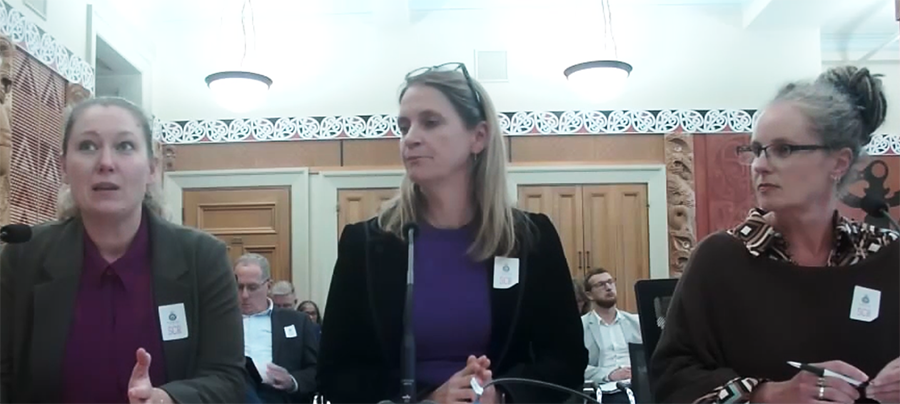
Submitters heard from on Monday 9 March included the Natural Hazards Commission, represented by: Sarah-Jayne McCurrach, Head of Risk Reduction; Dr Jo Horrocks, Chief Resilience & Research Officer; and Wendy Saunders, Champion of Land Use Planning (as seen above, from left to right). Wendy was a featured speaker at the 2024 Firth NZILA Wānanga.
The first question after the NHC’s oral presentation related to the way that the likelihoods of natural disasters are assessed. The committee was reminded that as of December the government has brought into effect a national policy statement for natural hazards.
Wendy Saunders noted “there is a matrix in there which has different likelihoods associated with it”, adding “whether or not that goes far enough or could be extended to be more hazard specific is something that could be looked at as part of National Direction”.
Sarah-Jayne McCurrach acknowledged that there is a huge amount of uncertainty in any of the scientific modelling done by NHC, adding “we can't let it stop us making decisions” or lead to a lack of confidence in making decisions. On a point raised about ‘truth testing’ for the modelling, she gave the example of a tsunami database that includes quite a lot of reconciliation with oral history and from people who have observed different impacts in their lifetimes.
Another way the NHC has for validating models is that it publicly shows settled claims for different natural hazard events since 1997, meaning that there is a layer of impact data to put on top of the modelling, and “in many cases, that shows that the models have quite a lot of accuracy”.
Environment Committee chair Catherine Wedd, the National Party MP for Tukituki, asked about the NHC’s push to see natural hazard risks included as a human health limit in clause 49 of the Natural Environment Bill. Wendy Saunders pointed to examples where risk to life has been factored into planning. She cited the Port Hills of Christchurch in regards to rock fall, boulder roll and cliff collapse, and to Matatā in the Whakatane district in respect of debris flow and managed relocation.
Wendy Saunders also referred to nature-based solutions:
As far as natural hazard management goes nature-based solutions are always an option to be looked at as part of the suite of tools that are available to manage different natural hazards as well, so that could be coastal hazards, flooding, and land instability for instance. Nature-based solutions can have a role in that. So I think there is a place for those in the bills.
The following is a transcript of the NHC oral presentation to the committee, as delivered by Dr Horrocks:
When you work in natural hazards people often ask us what’s the single biggest thing that could reduce the impact of disasters. And I think most of us agree that it’s not better emergency response capability, it’s not better hazard models, it’s not even better engineering. It’s making sure our planning system consistently steers development away from the very highest risk places in the first place.
Most of the losses New Zealand experiences from natural hazards are not caused by the hazard itself. They’re caused by the exposure we create over time, through the decisions we make on where we build and how we build. How our land is used, how intensively we build and whether risk is identified early enough to shape good decisions. Those decisions accumulate over decades. When they recognise natural hazard risk the impacts of events can be manageable, when they don’t the costs are measured in lives lost, houses damaged, disrupted communities, and very large recovery bills.
Through the claims we receive under the natural hazard insurance scheme, we see the consequences of those decisions very clearly in the claims that we receive. Many of the losses we deal with arise from development that has occurred in places where the risk was already known.
That is why land use planning is one of the most powerful risk reduction tools available to New Zealand.
Natural hazard losses are not just insurance losses. They fall across the system on households, on local government, on infrastructure providers, and on the Crown. When insurance cover narrows or declines, even more of those costs shift to households and government. And we're seeing that quite recently.
Planning decisions, therefore, shape not only the physical risk, but long-term fiscal exposure as well. For that reason, these bills are important.
They're not just about improving planning processes. They're about whether New Zealand's planning framework consistently recognises and manages natural hazard risk at its least costly intervention point. Once development is in place, the choices available to us are much narrower and far more costly.
In our view, the draft legislation represents a significant step forward. In particular, we strongly support the move towards risk-based planning and the clearer expectation that natural hazard risk must be considered in decision making.
The test will be in how it's implemented and operationalised. There are significant opportunities, but we also need to guard against inconsistent practice.
So our submission focusses on a small number of targeted changes that we believe will help the system work more clearly and consistently in practice.
First, we recommend including a definition of risk-based planning in the legislation. The concept is central to the new framework, but without a shared definition, there is a risk that different councils and decision makers apply it in different ways. A clear definition would support consistent interpretation and implementation.
Second, we recommend ensuring the framework can respond when natural hazard risk becomes significant, including situations where existing land use rights may otherwise prevent risk reduction.
Third, we suggest that the legislation provide a nationally consistent mechanism to address situations where serious natural hazard risk to life is identified. At present, councils deal with these situations in a range of different ways, which can create uncertainty and uneven outcomes.
Finally, we recommend maintaining consistency between the new legislation and existing standards where possible, so that the overall system remains coherent and workable for councils, developers, and communities.
So in short, we think these bills provide a really strong foundation. The changes we propose are modest, but important. They are intended to improve clarity, consistency, and practical operability so that the planning system can more effectively manage natural hazard risk, supports safer development over time and reduce avoidable social and fiscal costs in the future.
A PDF copy of the NHC submission can be downloaded here.