RMA Reforms: Will the wise and compelling words of Simon Upton be heeded?
The step taken by the Parliamentary Commissioner for the Environment, Simon Upton, to release an authoritative challenge to the readiness of the RMA replacement laws deserves to be taken seriously.
Even for a longstanding and respected independent Officer of Parliament, it is a big call to so forcefully declare - in an official Note sent to all Members of Parliament - that the conjoined Planning Bill and Natural Environment Bill, now currently headed for a second reading, are "not yet ready to be enacted".
In giving his reasoned assessment that the the Bills would benefit from more consideration, he noted on Wednesday that further time would enable the Government’s first draft of its proposed National Policy Direction to be "scrutinised before the legislation is settled".
Another reason he offers for hitting pause is his strong view that the bills do not "come close to providing the basis for a 'broad and enduring consensus across society'.
This is not a lone voice from the wilderness and would not have been a step taken lightly. Indeed Mr Upton is at pains to explain the lengths he has gone to already in applying careful scrutiny across these draft laws in his advisory capacity for the Environment Committee (see below), and, importantly, his unique and compelling mandate for going further.
Why does the pCE Want the bills to go back to the Select Committee?

The full extent of Mr Upton's 14-page assessment note can be read here.
As reported first by Businessdesk, the Parliamentary Commissioner for the Environment’s major concerns include a concern with an absence of checks and balances in the proposed new system, and the complete discretion Government Ministers would have under the current versions of the bills "to strike whatever environmental or developmental balance they prefer".
His position is that "there should be a careful and comprehensive review of the extent to which matters have been left to ministerial discretion, both as to environmental impact and process."
Mr Upton: "With broad and unchecked ministerial discretion, there is a greater risk that direction will flip-flop as political tides ebb and flow. The repeated revisions to the National Policy Statement on Freshwater Management with each subsequent government is a salutary example".
His recommended remedy is for the use of an independent body during the development of at least the first iteration of national direction and for any future comprehensive reviews. He even adds "should the Minister decide to depart from those (independent) recommendations on a proposed national policy direction, they should, in the interests of transparency and accountability be required to formally set out the reasons for so doing".
On technical matters he also calls into question "the sequence in which new planning documents are (proposed to be) put to bed", arguing that natural environment plans (NEP) should be developed in parallel with regional spatial plans (RSP) rather than afterwards, because decisions about the placement of key infrastructure corridors and the direction of urban expansion can't be made without understanding the environmental constraints that exist.
On the topic of the loss of 'localism' Mr Upton states: "The much-cited ‘funnel’ means that the legislation imposes a hierarchy that will prevent matters settled at higher levels being re-opened at lower levels"; with "almost everything undertaken at regional and local levels of government (to) be scripted by central government".
Without additional changes to the legislation, he predicts, for instance, that place-based conflicts with a potential for turning into national issues, such as debates on housing intensification in Auckland, could become more frequent as a side-effect of what he characterises as enlarged micromanagement of local issues by central government.
The underlying caution he delivers - one that should be familiar to all MPs - is that not all communities (or ecosystems) can be standardised and homogenised.
where Do Landscape And Amenity Fit?
From a landscape architecture and landscape planning perspective, the most relevant earlier recommendation that Mr Upton made to the Environment Committee during its deliberations appears under the heading: Landscape and amenity.

Mr Upton’s nullified recommendation (as provided to the Environment Committee in May 2026).
MR UPTON ON LANDSCAPE EFFECTS
Landscape effects are important for maintaining and enhancing the character of the built environment, which forms part of the identity and wellbeing of local Communities. This extends to a community’s or region’s ‘brand’ in the context of tourism, and sense of place and spiritual connection in the context of cultural or local landscapes.
Excluding landscape effects from the system will limit the ability to consider how development may affect local values, which will differ from place to place. It is important to retain the ability to identify and manage those values at a local level in the plan-making process. As outlined by submitters, including the Queenstown Lakes District Council, councils have invested significant time, resources and legal effort to develop, test and defend overlays for landscape values (including those that are not outstanding) and associated land use controls in plans.
Removing consideration of the effects of landscape from the system prevents councils from imposing provisions that support some important economic activities such as tourism. New Zealand may live to regret failing to protect the visual experience that tourists (and the local community) currently enjoy in places like Queenstown or the Bay of Islands. It will also undermine long-established and hard-fought case law recognising the importance of character, identity and open-space values that many New Zealand communities value. Not everything can be easily reduced to property rights.
MR UPTON ON VISUAL AMENITY
Submitters, including the Resource Management Law Association, New Zealand Institute of Landscape Architects and Urban Designers Institute Aotearoa, expressed concern that the goal of creating ‘wellfunctioning urban and rural areas’ will be difficult to achieve if visual amenity effects cannot be considered, and I agree.
Submitters, including NZPI and local authorities, have expressed how difficult it is to isolate visual amenity effects from (neighbourhood) friction effects. I note that the Ministry has recommended removing ‘visual amenity’ and ‘physical features’ from cl 14(1) (e), but seeks to retain reference to ‘character’, ‘appearance’ and ‘aesthetic qualities’ as effects that are to be excluded from the system, on the basis these terms are less subjective.
While on paper this may be seen as an improvement, I consider ‘character’, ‘appearance’ and ‘aesthetic qualities’ are synonymous with ‘visual amenity’ and that this proposed change makes no material difference to the application of this clause as introduced to Parliament. This is because the character, appearance and aesthetic qualities of development are core parts of ‘visual amenity’ that can have impacts on social wellbeing and people’s experience of spaces and places.
... excluding these effects from the system may make it difficult to achieve the goal to ensure land use does not unreasonably affect others. Clear guidance will be needed from central government on exactly what is meant by ‘aesthetic qualities’, ‘appearance’ and ‘character’ if the exclusion of such effects is retained in the Bill.
MR UPTON ON A MIDDLE GROUND
The middle ground in our communities is probably one that opposes costly micro-interventions in people’s homes and businesses but accepts the need for preserving broad, widely appreciated character and landscape values. This is not an exact science, and councils need to ensure they have wide community support before embarking on matters touching on visual amenity and landscape values.
Rather than excluding effects on visual amenity and landscape values from the system, a more pragmatic solution could be to use national instruments to give clear guidance on aspects of visual amenity and landscape that can be considered and those which should be excluded.
This direction would then be reflected in plans, with only those matters explicitly provided for in national instruments able to be considered during consenting and designation processes. Committee members might like to reflect on the strong reaction in Auckland and, in particular, some inner-city suburbs to recent densification proposals. These have as much to do with visual amenity and character as anything else. It would be naïve to believe that New Zealanders in less privileged settings feel any less deeply about some of the landscapes they have grown up in. There is a middle ground
Other Issues Raised By Mr Upton
CUMULATIVE EFFECTS
In his advice back to the Environment Committee in May, Mr Upton had already recommended, with some minor success, that the committee should request a detailed briefing from officials on how cumulative effects are to be defined and managed in the proposed system.
The reasons he stated for giving attention to cumulative effects, were:
Managing cumulative effects becomes even more important when, as is proposed, the adverse effects threshold for both the built and natural environment is proposed to be higher. Changes have been recommended to clarify the circumstances in which cumulative effects should be considered, as an exception to the general presumption that less than minor effects are to be disregarded. However, no further detail is provided, making it difficult to understand how this will be handled. Appropriate management of cumulative effects is integral to the success of the proposed system.
Cumulative effects are often discussed in relation to the natural environment – for example, the combined effects of sediment or nutrients from primary production activities across a catchment, or ecosystem fragmentation as a result of incremental habitat loss (‘death by a thousand cuts’). But cumulative effects also affect the built environment. For example, fragmentation from allowing urban development that does not align with council growth planning, or that leads to reductions in resilience to natural hazards, or exacerbation of their effects due to poorly located, designed or serviced urban development, may all lead to adverse social and economic outcomes.
One cumulative effect that Mr Upton singled out was having lots of high-density residential units built as close as allowed to property boundaries with minimal permeable surface area.
He pointed out that ruling out consideration of cumulative effects in such an example "could result in the potential for stormwater management issues (e.g. increased flood risk) both on-site and beyond the boundary".
This is a recurring and problematic issue of a type that landscape architects work on to mitigate in advance, with ever-more pressing design solutions being called for as climate adaptation and natural hazard responses, including green infrastructure.
GOALS IN THE NATURAL ENVIRONMENT BILL
One of many other things that has drawn annoyance from the Parliamentary Commissioner for the Environment, was an amendment by the Environment Commitment to add reference to food and fibre production to Goal 1(a) of the Natural Environment Bill (NEB).
His response was:
The NEB is supposed to be about the use protection and enhancement of the natural environment. It has no role in managing land uses, as these are dealt with under the Planning Bill. Food and fibre production are land uses and, based on the policy rationale, should not appear in the goals of the NEB.
Food and fibre production make use of the natural environment, but so does every sector. Why were energy production [or mining] or tourism, for example, not recommended for inclusion? This proposed addition highlights the risk of elaborating goals to meet sector lobbying and opens the way for an ever-expanding list of uses to satisfy the desire for particular sectors to advance their interests.
BIODIVERSITY
With reference to biodiversity Mr Upton expressed an expectation that money will urgently need to be spent on improving biodiversity information, and that "in the meantime, whilst this information is being gathered, clear national direction will be needed to prevent the clearance of important indigenous vegetation".
A Timely History Lesson
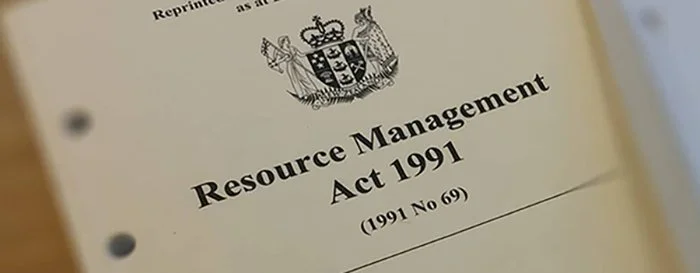
It should be noted that as a former (National) Member of Parliament (1981-2000) and former Minister for the Environment, Mr Upton possesses a long memory.
In this week's ‘Note to current MPs’, he provides a potent reminder that "we have been here before".
Mr Upton: "In 1990, Sir Geoffrey Palmer ran out of time to finish his flagship reform before the approaching General Election. In a simpler, bi-partisan world, it was agreed that the Bills should be carried over to the next Parliament. The then Opposition reserved to itself the right to review the Bill, but agreed that so much effort had been expended that the legislation should be enacted in some form. When, following review, it came to its third reading in 1991, there was no division on the Bill. Parliament unanimously signed off. It was by no means a perfect creation. But that consensus may have been one of the reasons it lasted 35 years".
His 'history lesson' recalls that the RMA was an explicitly environmental statute, and conveys the viewpoint that the RMA did at least acknowledge there are "real consequences (or externalities) from economic activities that cross the boundaries of adjoining neighbours and can damage common pool resources like air and water".
"THE NATURE OF THE BEAST"
Mr Upton notes that the "protracted nature" of the repeated process of moves to replace the Resource Management Act under the current and preceding Governments has consumed over seven years of officials’ time and countless hours of commentary and critique.
He attributes this to the extraordinary complexity of what this legislation "tries to facilitate and the inherently conflicting interests it cuts across ... That is the nature of the beast".
His words are far more than mere reflections, and his predictions for the future if the bills are not given further consideration, deserve to be heard around the motu.
Bring on the second reading debates!
Simon Upton, 68, is due to step down as Parliamentary Commissioner for the Environment, after 10 years in the role, on October 9, 2027. His predecessors in the job were: Helen Hughes (1987–1996), Dr Morgan Williams (1997–2007) and Dr Jan Wright (2007–2017)
The opening to Mr Upton’s Note to Members of Parliament this week featured this paragraph:
The RMA has certainly had its problems. But much has also been achieved. At the time the RMA was passed into law, there was an open rubbish dump in the middle of my home town, Ngāruawāhia, sandwiched between State Highway 1 and the main trunk railway line. Fires smouldered here and there, there were birds and rodents in abundance and a noxious smell that spread to close-by housing. It looked and felt like something closer to the third world than the New Zealand of our imaginations.