Reports on RMA replacement laws land with an inexorable thud
This week Parliament's Environment Committee has delivered a majority vote recommending that the House should proceed through a second and third reading to pass the Planning Bill and Natural Environment Bill as replacements for New Zealand's Resource Management Act.
No significant changes were made to the core elements of the proposed new laws, nor on substantive matters raised directly by Tuia Pito Ora New Zealand Institute of Landscape Architects in its written and oral submissions to the committee in February/ March.
Landscape remains largely outside the decision-making framework and the term 'visual amenity' has been excised from clause 14 of the Planning Bill. Instead attention to considering effects on outstanding landscape and landscapes of high natural character only, has been underlined.
How best to present wider concerns from the profession, ahead of what should be vigorous Parliamentary debates for the second reading of this legislation, is being formulated within the NZILA.
It is rightly anticipated that there are implications for the entire profession and the value that practitioners add across the development process. At the workface, there is also a high awareness that the timeframes envisaged around implementation of the new laws will impact on project scoping, consenting strategies and client decision-making, both in the near future and during the upcoming transitional years. Other scenarios seem to be that working as a landscape architect in areas such as landscape planning will likely be similar in principle, but different in practice.
A key overarching question, considered to be of wider public and nationwide interest, is whether there will be fewer opportunities under this new system to consider whether developments are appropriate for their landscape setting or how they will be experienced by neighbouring communities. These considerations form a vital part of underpinning the overall quality of development for current and future generations.
Spelling out what lies ahead
The Government has acknowledged that a clearer picture of how the complex new planning system will operate in practice has yet to emerge. Accordingly the Minister responsible for RMA Reform, Chris Bishop, gave an assurance this week that the Government will "shortly release an illustrative draft of the new National Policy Direction, continuing the next phase of these reforms".
This week's release of the Environment Committee's report/s on the proposed legislation provided a 140-page-long (majority view) outline of "the rationale" for recommended tweaks made across both bills to knock them into shape.
This was followed by 17 pages containing brief minority view responses to the legislation from Labour, the Green Party and Te Pāti Māori, including points of clear opposition (see further below).
Lastly each report was accompanied by a copy of the redrafted versions of each bill running to hundreds of pages - with a note that completion of the proofing process may yet take a couple of weeks.
A detailed reading of the changes alone could also take weeks! They include things like various small changes to address inconsistencies between the two bills, a wording change to better specify the approach to consideration of cumulative effects and a recommendation to add a definition of infrastructure that would capture modification of natural features to perform certain functions ('green infrastructure').
One of the new clauses (67b) focused on core obligations for the preparation of Regional Spatial Plans. Those obligations were summarised as:
map, or otherwise record, the broad spatial layout of the region over the next 30 years or longer
identify priority locations for growth and change
identify drivers of change over time
identify significant existing and future infrastructure
identify significant constraints on using or developing the land or coastal
marine areaidentify priority locations for climate change adaptation planning
implement relevant national instruments under both the PB and the NEB in a way that helps to resolve any conflict between them.
It is important to note that the working of the select committee process included the input of independent advice from the Parliamentary Commissioner for the Environment (Simon Upton) and lawyer Bronwyn Carruthers KC. The way this advice was taken on board, or largely not, is detailed in the committee's (majority) report, for example:
We considered Ms Carruthers’ suggestion to amend the purpose clauses to detail how the bills would interact, but ultimately decided this was not necessary. we consider that it strikes the appropriate balance between top-down direction and bottom-up engagement.
... and
We acknowledge the PCE’s concerns that “enjoyment of land” is subjective and ideological. He warned of unintended consequences of this language being included
For more of this 'devil in the detail', see the list of advice documents further below.
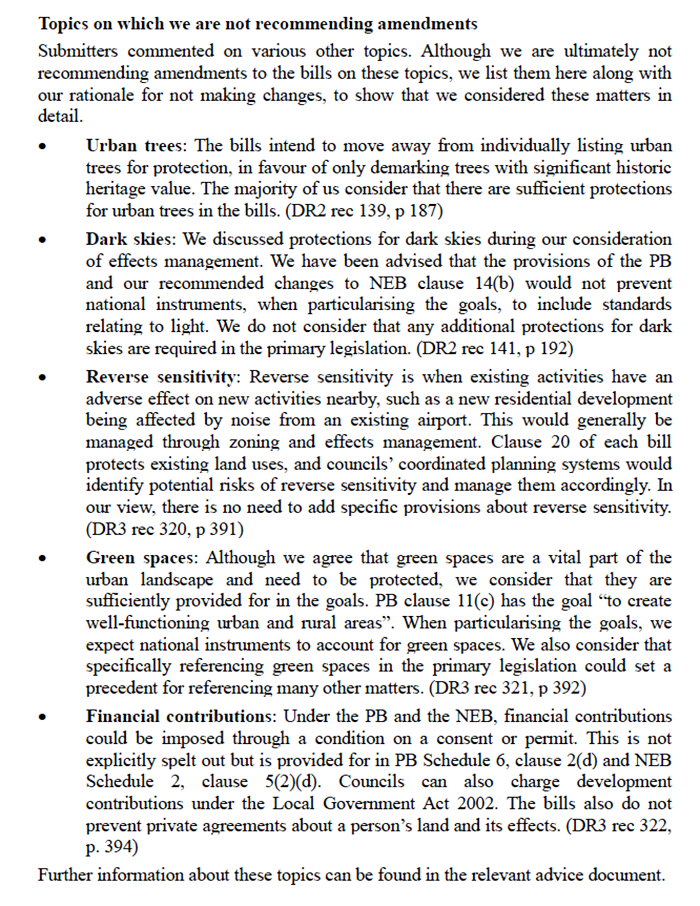
It’s also noteworthy to see the topics on which the Environment Committee chose to spell out it had decided not to recommend amendments, but had considered.
REACTIONS
An early reaction from Dr Greg Severinsen, reform director at the Environmental Defence Society (EDS), is that "fundamentally flawed" elements of the Bills have, if anything, been doubled down on, adding "it is clear throughout the report that the strong advice received from the Parliamentary Commissioner for the Environment [as an independent adviser] has been systematically ignored".
EDS is running a free webinar exploring the Committee’s recommendations in more detail this coming Tuesday 28 July from noon till 1pm.
Labour representatives on the Committee - Rachel Brooking, a former resource management lawyer, and Priyanca Radhakrishnan - stated a suspicion in their commentary that the reason for adhering to the two-Bill design was a deliberate attempt to negate the 'integrated management' approach of the RMA. "We heard that this was a Cabinet decision but the reasoning was absent".
As compared with the RMA, they used the term "regressive" to describe a shift in the handling of mana whenua issues and concluded that "almost all policy decisions made during the select committee process have made the bills even more unpalatable and unworkable".
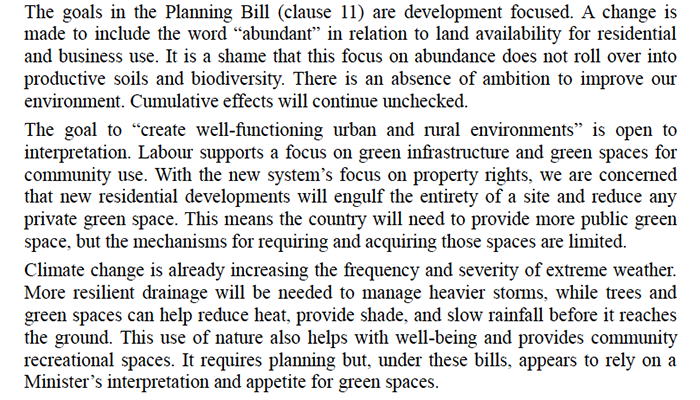
An excerpt from Labour’s differing view
Likewise the Green Party's set of primary concerns ranged across criticisms of the two-Bill approach, purposes and goals, environmental protections, powers of Ministerial direction, and regulatory relief (described as "immensely costly, unworkable, and inappropriate") as well as a call for regional spatial plans to specifically enable nature-based solutions and green spaces.
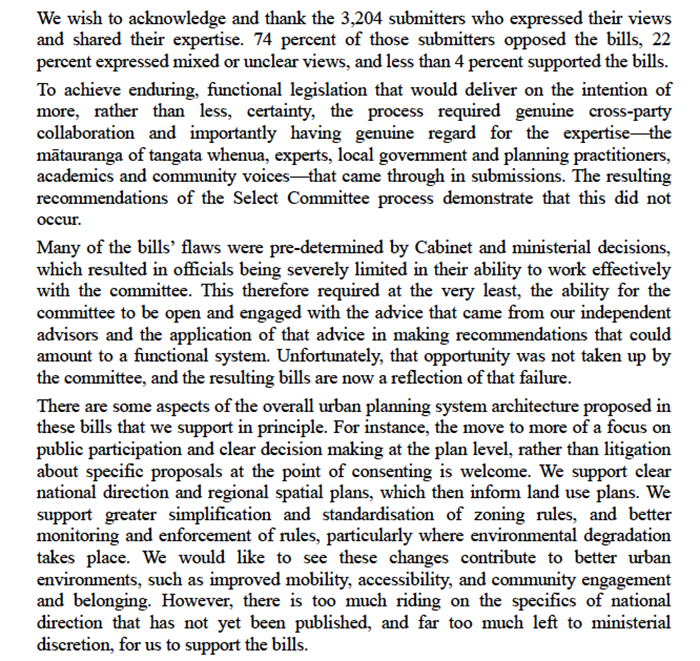
An excerpt from the Green Party’s differing view
The exact timings on the progress of the Planning Bill and Natural Environment Bill aren’t yet known. What is known is that the pressures on pushing these reforms through, combined with the crowded agenda and calendar of other Government priorities occurring around sectors such as local government plus the fact that 2026 is an Election year, will be intense.
BACKGROUND DOCUMENTS
For an overview of the totality of public submissions made on the Planning Bill and the Natural Environments Bill, LAA recommends looking at a three-page document prepared by the Ministry for the Environment (now MCERT) that distilled them under 11 topic areas that will continue to carry various degrees of high relevance:
Integration (between and within Bills) and Goals
Secondary legislation (including Ministerial powers)
Participation in the system
Māori rights and interest
Implementation
Effects Management
Regulatory Relief
Limits and allocation
Heritage
Competitive urban land market
Infrastructure.
A new dump of the high volume of advice received in relation to the bills is now lodged in the select committee database. For ease of reference and access LAA has compiled this list; consisting of approximately 50 background documents.
_________________
ONE DEPARTMENTAL ADVISER
Ministry for the Environment
Initial briefing – 27 January 2026
Overview of NZ’s new planning system – 27 January 2026
Upholding Treaty settlements and other arrangements – 18 February 2026
Responses to committee questions – 27 February 2026
Māori rights and interests and Treaty Settlement provisions – 5 March 2026
Emerging themes in submissions – 13 March 2026
Property rights – 13 March 2026
Urban trees in new system – 13 March 2026
Approach to departmental reporting – 17 March 2026
Advice on highly productive land – 20 March 2026
Departmental report 1, Planning Bill and Natural Environment Bill – 13 April 2026
Departmental report 1, Summary of recommendations by clause – 15 April 2026
Figures 2-5 from Departmental Report 1 – 15 April 2026
Departmental report 2, Planning Bill and Natural Environment Bill – 17 April 2026
Departmental report 2, Summary of recommendations by clause – 17 April 2026
Departmental report 3, Planning Bill and Natural Environment Bill – 1 May 2026
Departmental report 3, Summary of recommendations by clause – 1 May 2026
Departmental report 4, Planning Bill and Natural Environment Bill – 22 May 2026
Departmental report 4, Summary of recommendations by clause – 22 May 2026
Responses to additional information requests – 20 May 2026
Transition and implementation deadline – 20 May 2026
Response to additional information request – Regulatory relief – 22 May 2026
Regulatory Relief Liability Estimation Report, Martin Jenkins – 22 May 2026
Wildlife approvals questions – 23 June 2026
Limits diagram – 24 June 2026
Interim limits diagram – 25 June 2026
... Ministry for Cities, Environment, Regions and Transport
Regulatory relief recommendation – 7 July 2026
Catchment groups – 7 July 2026
_________________
TWO INDEPENDENT ADVISERS
Parliamentary Commissioner for the Environment (PCE)
Preliminary consideration questions – 18 December 2025
Comments on the initial briefing – 18 February 2026
Advice on legislative design and core components – 27 March 2026
Ministerial powers and constraints on participation – 27 March 2026
Advice on biodiversity challenges – 27 March 2026
Suggested matters for independent advice – 15 April 2026
Ministerial discretion, and limits framework – 20 April 2026
Initial comments on Departmental Report 1 – 22 April 2026
Initial comments on Departmental Report 2 – 23 April 2026
Initial comments on Departmental Report 3 – 5 May 2026
Comments on Departmental Reports 1-3 – 19 May 2026
Advisers report, Planning Bill and Natural Environment Bill – 26 May 2026
Initial comments on Departmental Report 4 – 27 May 2026
Further comments on Departmental Report 4 – 5 June 2026
Bronwyn Carruthers KC
Advice on initial questions – 2 June 2026
Treaty settlement redress and arrangements – 22 June 2026
Review of excerpts for Sch 3, Part 4 – 23 June 2026
_________________
Parliamentary Counsel Office (PCO)
Record of selected changes made in Planning Bill – 25 June 2026
Record of selected changes made in Planning Bill, version 2 – 29 June 2026
Record of selected changes made in Natural Environment Bill – 25 June 2026
Record of selected changes made in Natural Environment Bill, version 2 - 29 June 2026
Regulations Review Committee
Letter: Concerns about powers to make secondary legislation in NEB and PB – 26 March 2026
Previous articles in LAA this year:
January - Why Landscape Still Matters Under The Planning And Natural Environment Bills
January - Focus on planning reforms: Navigating between a rock and a hard place
February - Our proposed new resource management laws: Sans landscape!?
February - “Speed alone is not a measure of good planning” - or good law making
February - RMA replacement legislation enters the select committee phase
March - Submitters being heard on the Planning and Natural Environment bills
March - The 'wait and see' for recommendations to amend proposed new planning system