Familiar, But Unread: Landscape and the Loss of Story
Contributed by Ananda Acharya, Landscape Architecture Graduate at Te Herenga Waka | Victoria University of Wellington
Most of us assume familiarity equals knowledge. We pass the same corner shop, cut across the same patch of grass, point to the same hill, and so we think we know the area.
But familiarity alone can be shallow. Earlier this year, working in Te Motu Kairangi (Miramar Peninsula), I found that understandings of the deeper histories of the land are unevenly held.

Te Motu Kairangi, Wellington. A landscape widely recognised, but unevenly understood. Familiarity produces visibility, not knowledge. Photo credit: Ananda Acharya.
While one long-time resident seemed to carry generations of memory, another neighbour – who’d lived there for decades – possessed much lesser recall. That gap made me think: how can a place be ‘known’ and ‘unknown’ within the same proximity and similar periods of time? It suggested to me that individual connections made to the history of a place are not evenly distributed; they are fragile, concentrated, and easily lost.
This same gap made me wonder how areas hold meaning at all.
We do not simply encounter objects in space; we read them over time. When I use “story” in this article I mean the device by which we make sense of time and place: the marks, rituals, names and traces that order events into meaning.
Story has two sides: the content (what happened, the names and memories) and the narratives (how it is shown). Stories are the link between people and environment; they bind past, present and future into a kind of shared identity. When stories thin or vanish, a place grows harder to read, and easier to forget.
Now it is clear that when the larger stories of a landscape fade, people search for meaning elsewhere. What remains are the small, informal stories – the marks, paths and traces that survive when the official other narratives have thinned.
These traces are usually treated as accidents, but that view is too simple. An effect can become a cause -small, improvised marks once dismissed as accidents can, in time, become the stories a place needs.
A person who walks the official trail learns what the signposts say. A person who takes the desire path learns something different. By choosing the unofficial route they experience a distinct encounter with the land — one the prescribed track cannot give. The point is that story moves both directions: we shape the landscape, and the landscape shapes us. Not every trace is damage; some are attempts to belong.
In praise of the desire path
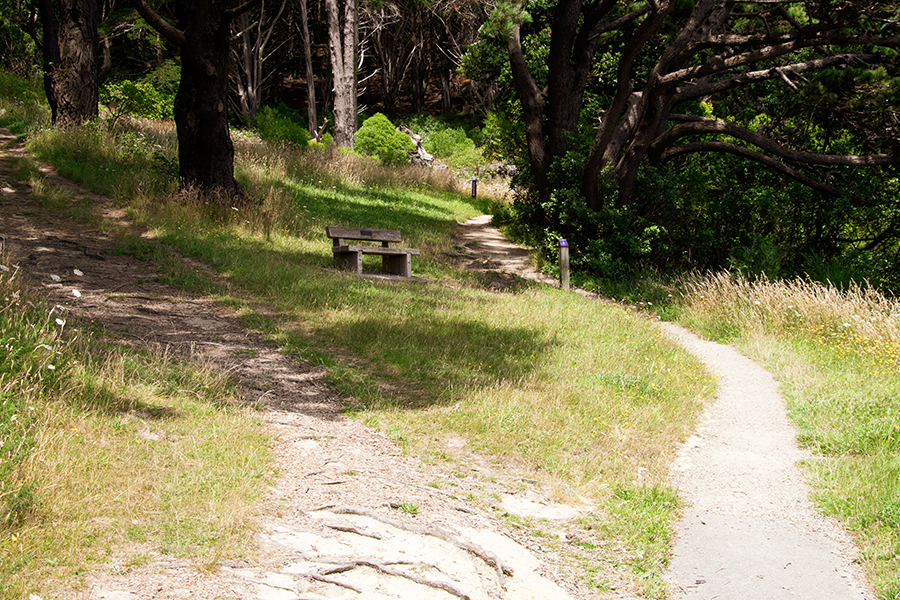
Desire paths record repeated decisions. They show how people actually move, not how movement was prescribed. Photo credit: Ananda Acharya.
The clearest place to see this is in the desire path. A desire path is the simplest form of informal story: a thin, worn line cutting across the grass, formed not by design but by repetition. It appears because people choose convenience, directness, or curiosity over the intended route.
Over time, the shortcut becomes its own quiet argument about how a place should function. These paths reveal the public’s real behaviour, not the planner’s imagined behaviour. They show where people naturally move, where official design falls short, and where habit claims authority. A desire path is not an accident. It is a small but deliberate vote for a different relationship to the landscape, one shaped from the ground up.
If a desire path is a public argument about how to use a place, a child’s handprint is the same argument in private – the impulse to test, to leave a trace, to make the world answer.
A fresh mark in the ground gives the land a momentary life. You see it in a child at the beach. The child presses a handprint into the sand and watches the tide erase it. The child’s mark is a test: push the world and see how it pushes back. This simple experiment explains much about how we begin to know a place. A child’s handprint and a worn path are evidence of an instinct: we narrate the world by acting in it.
Yet knowledge by play is one thing; memory is another. If every fleeting act were taken as heritage, we would be building memory on sand.
Real belonging requires stories that bear repetition and resistance; stories that remain when the weather, the tide and the fashions have moved on. These small tests matter, but they are not the full account. If informal marks show how people now relate to place, the deeper stories show how responsibility is carried across time.
Humans confuse antiquity with authority. They point to an old stone and call it heritage, as if age were proof of meaning. But meaning is kept by doing, not by keeping.
A ritual that is repeated, a path that is walked, a craft that is practised, these are the processes that turn act into memory. Apply an alien theory to a land and its story collapses; the words do the erasing. The proper question is never “How old is this?” but “Who still does it?” Eternal storytelling is therefore a technique: a living competence, not a museum case.
If eternal storytelling is a technique, we must ask the only useful question: who still practises it? Most places cling to their past by preserving what is already dead — a ruin fenced off, a plaque polished, a structure spared from weather but emptied of use. This is the museum instinct: to guard what cannot move, and then call it memory.
The ‘Way of continuity’ and the ‘Way of movement’
But a landscape is not remembered by standing still. It is remembered by being remade. The living story belongs to those who repeat an act until it becomes part of the land itself. Where practice continues, memory survives; where practice stops, memory rots, no matter how old the stones are.
To see what this looks like in its purest form, we must turn to a place where the past is carried forward not by preservation but by repetition, where renewal is the proof of devotion, and rebuilding is the act that keeps the story alive.
This is the discipline of Ise Jingu, as practised in Japan.
The renewal of Ise Jingu is the ‘Way of continuity’. Those who build the shrine must know this Way, and those who approach the land must understand its meaning.
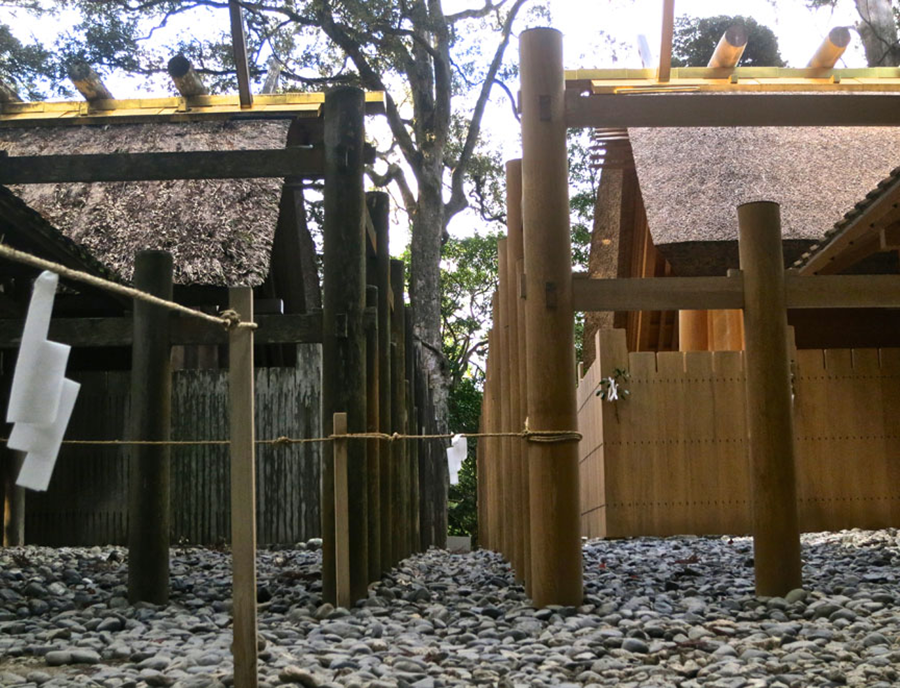
Ise Jingu, Japan. The shrine is dismantled and rebuilt every twenty years. Continuity is maintained through repetition, not material permanence. Source: Jonelle Patrick
Many people often mistake the age of a thing for the strength of its spirit, but this is an error. The Way of renewal does not depend on old timber. It depends on the discipline of rebuilding. Every twenty years the shrine is taken down and raised again, and through this steady repetition the form is kept alive in the hands of craftsmen. The mountains, the forest and the sky are regarded as the first teachers, and the layout obeys their presence. Thus destruction and creation are treated as one act.
This is the natural order. In this practice the shrine is both finite and enduring. The spirit does not remain because the wood remains; it remains because the work continues. This is the eternal-storytelling story of Ise, and those who do not grasp this principle cannot understand the continuity of place.
The same discipline appears in another form.
The pilgrimage routes of the Himalaya are the ‘Way of movement’. Those who walk them must know this Way, and those who read the land must understand its rule. Many assume that meaning lies in the mountain itself, but this is a mistake.
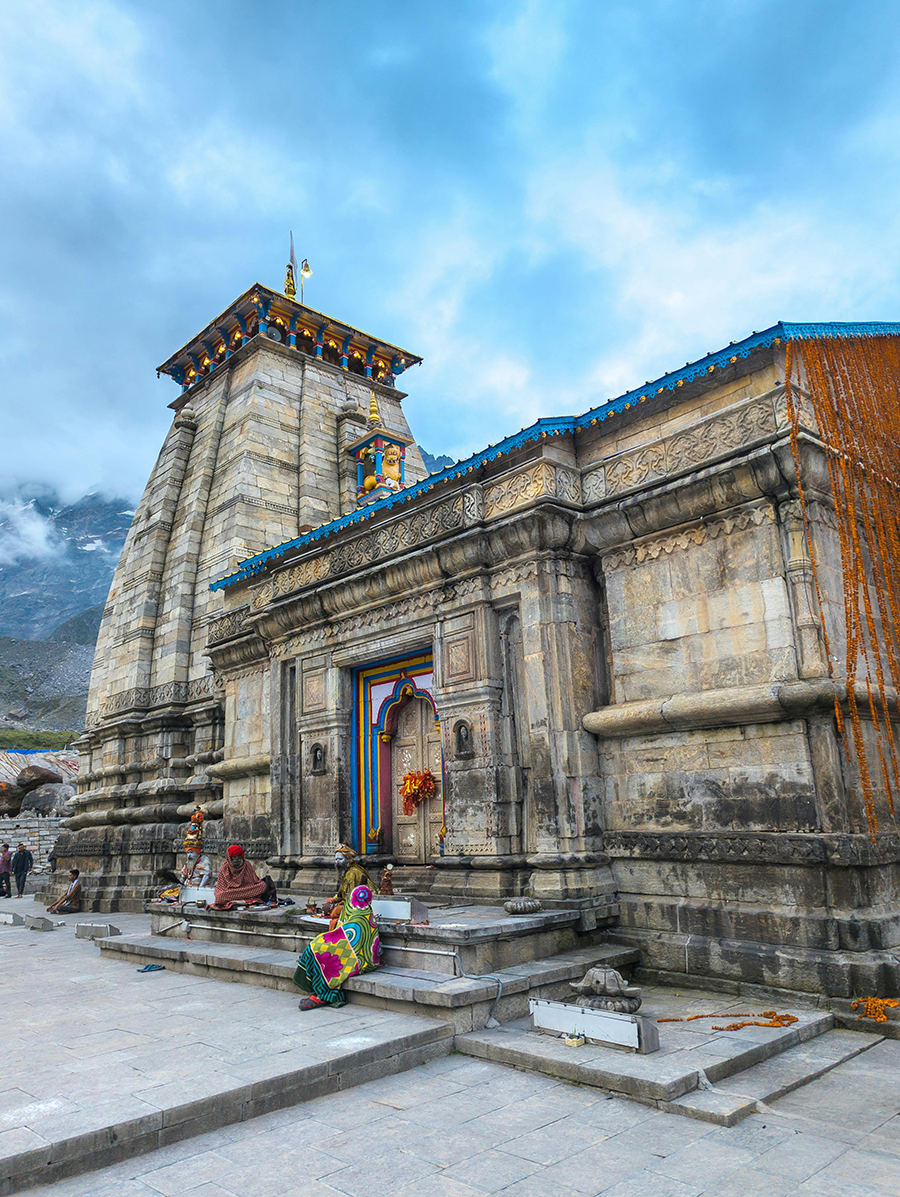
The Kedarnath Temple. Photo credit: Raj Manohar.
The mountain teaches nothing to the person who does not walk around it. Meaning does not endure because a peak stands high; it endures because the path is repeated. The circuit is walked again and again, in all weather and in hardship, until the route enters the body. Through this repetition, valleys, rivers and stones are ordered into memory.
In this thinking/method, the path is the teacher. The land is not preserved by standing apart from it, but by moving through it correctly. Where the route is walked, story remains. Where the route is abandoned, its meaning thins and breaks. The lesson is the same as at Ise: Continuity does not depend on age or material. It depends on discipline. The land remembers not because it is old, but because the work of remembering continues.
What these examples reveal is not a difference of culture, but of method. Meaning persists in landscapes where practice is continuous, and it thins where practice is broken.
Inhabiting the meaning of places
When this understanding is returned to Aotearoa, the question shifts. It is not whether the land carries stories -it plainly does and most significantly so in the tikanga of Te Ao Māori – but rather how those stories are maintained through use, or allowed to fall dormant.
Too often, story is treated as an object to be presented rather than an action to be sustained: a name fixed to a sign, a brief explanation, a gesture detached from everyday life. In these moments, story becomes descriptive rather than functional. It can be recognised, but not inhabited.
This condition is not corrected by adding further explanation. It is corrected by attending to how land is used.
Across towns and cities, daily routines already shape understanding: the paths people return to, the places where they pause, the boundaries they honour, the spaces they neglect. These actions are not incidental. They are quiet negotiations with place, through which meaning continues to be tested and adjusted, even where formal narratives have faded. The danger is not the loss of story altogether, but its reduction to surface; something remembered without obligation, felt without consequence.
For those who work with land, the implication is a modest one. Story does not need to be authored or restored from elsewhere. It needs to be carried forward.
This requires attention to repetition over display, to ordinary use over symbolic gesture, and to the slow accumulation of shared acts. A landscape remains intelligible not because it is carefully explained, but because it continues to be walked, worked, and read through practice. Where this continuity is supported, memory remains active. Where it is neglected, even the most protected ground falls silent.
If this is true, then continuity cannot be left to chance. Practice does not persist automatically, and memory does not renew itself. Where no conditions are set for return, use thins, and story decays into reference. The problem is not that landscapes change, but that they often change without requiring anyone to remain accountable to them.
If familiarity were enough, the landscape would not need renewal. We could look at it, name it, and move on. But places do not remain legible by being seen once. They endure only when each generation is required to meet them again, on new terms.
The discipline of Japan’s Ise shrine shows that continuity is not achieved by freezing a form, but by obliging people to remake it. Meaning is kept alive not by protection alone, but by return; by work repeated until it becomes memory. Without this renewal, even the most storied landscape becomes scenery.
I have seen this pattern here in Aotearoa, where familiarity is widespread but responsibility is uneven, and where places are recognised long before they are understood.
The problem Wellington faces is not a lack of landmarks, but a lack of practices that compel engagement. Too often, land is presented as something to recognise rather than something to enter, test, and carry forward. The result is a city full of places that are familiar, admired, and largely unread.
The question, then, is not how to explain a place more clearly, but how to structure it so that meaning cannot be consumed at a glance. How might a landscape demand participation rather than observation? How might it renew itself through use, so that each generation leaves more than recognition behind?
Until that question is answered, we will continue to walk past landscapes we think we know, and leave without learning at depth.
About the Author
Ananda is completing a Master of Landscape Architecture at Te Herenga Waka, Victoria University of Wellington, with graduation expected in 2026. His interests lie at the intersection of landscape, cultural memory, and storytelling, informed by sociological and historical perspectives. He is particularly interested in hands-on, design-led approaches that move beyond prescriptive interpretation, exploring how landscapes can be actively constructed to support evolving relationships between people, stories, and place. These themes align closely with his current Master’s thesis research.
Ananda was named on the Wellington Faculty of Architecture and Design Dean’s List in 2024. Please send feedback to andyacharya4@gmail.com
Further Reading
H. Porter Abbott, The Cambridge Introduction to Narrative (Cambridge University Press, 2021)
An accessible foundation for understanding narrative and storytelling, shaping how meaning and memory are structured across disciplines.
Nachiket Chanchani, Mountain Temples and Temple Mountains: Architecture, Religion, and Nature in the Central Himalayas (2019)
Explores the reciprocal relationship between architecture, belief, and landscape, offering insight into how place, ritual, and terrain co-produce meaning.Jenny Lee, “Decolonising Māori narratives: Pūrākau as a method,” MAI Review 2 (3) , 2009
A key text for understanding Indigenous storytelling as a living methodology, informing non-prescriptive and relational approaches to landscape.Fangqing Lyu, “Architecture as Spatial Storytelling: Mediating Human Knowledge of the World, Humans and Architecture,” Frontiers of Architectural Research
Examines architecture as a narrative medium through which people come to understand and inhabit the world.Linda Tuhiwai Smith, Decolonizing Methodologies: Research and Indigenous Peoples
A foundational work influencing ethical, reflective, and decolonial approaches to research and design in Aotearoa and beyond.Miyamoto Musashi, selected writings and interviews
An influence for thinking about atmosphere, restraint, and the power of subtle narrative in shaping experiential worlds.