Mana Wāhine – putting women at Unitec centre-stage
The 2025 edition of Asylum, produced by Unitec’s School of Architecture, was themed to put women in the School front-and-centre, as well as showcasing student work and the school’s many events and community initiatives.

Illustrative sketches: Isabelle Cushman, Brooke Evaga, Melissa Knight, Taina Marie, Sinead McClay, Claudia McGough-Morunga, Kerensa Mihaere, Olivia Nott, Jess Smith, Gohanne Turtal; Rachelle Bennett
Now well into its third decade, this latest celebration of architectural teaching and research was made available on ePress, Unitec’s publishing platform, as a 300 page document on 23 December 2025. It was carefully curated by a student design team of Taina Marie, Claudia McGough-Morunga, Olivia Nott and, from the Bachelor of Landscape Architecture (BLA) cohort, Rose Todd.
In her introduction, editor Anna Bulkeley stated that the latest Asylum is intended to clarify and advocate for disciplines that are shaped “not only by an understanding of design combined with technical skill, but also [by] empathy, resilience and inclusivity”.
Opening words from Professor Peter McPherson, as Head of School, emphasised the importance of “fostering environments that celebrate difference, encourage robust dialogue and value every individual’s contribution.¨ When such environments are fostered he added “the field of the built environment becomes a place where varied experiences are actively sought and supported, and where the intellectual and creative growth of every participant is prioritised”.
Featured Wāhine
Working collectively the design team held a series of conversations with wāhine who were invited to speak freely about the pressures they faced, any setbacks that shaped their careers, and the changes they believe are needed for the current generation of women to succeed.
In the design team’s introduction it was noted that the common narrative that emerged was that “despite challenges – many arising from the societal norms of their time - these wāhine all achieved amazing goals, formed lasting friendships and found deep fulfilment in their work”.
Patterns were also revealed that echoed the design team’s own experiences - “the pressure to prove ourselves, the uncertainty of entering the profession, and the resilience required to keep going”. It was noted this formed “a blueprint for courage and possibility, reminding us that our identities, cultures and perspectives are strengths to be carried forward”.
Two of the wāhine featured at the heart of Asylum were senior LA lecturer Xinxin Wang and guest lecturer Dr Diane Menzies.
Questions put to Xinxin were:
Can you tell me about the moment you first felt drawn to architecture and outdoor space?
What does being a woman in design mean to you now compared to when you began studying?
Are there moments that changed your design approach?
What strengths of perspectives do you feel women bring to the profession?
How has your experience of being a woman in the field translated to teaching?
What is your proudest moment in your time at Unitec?
If you could write a short note to women entering the field today, what would it say?
The Q&A with Diane focused on aspects of her long and impactful career. To read [PDF] copies of the responses from Xinxin and Diane see here.
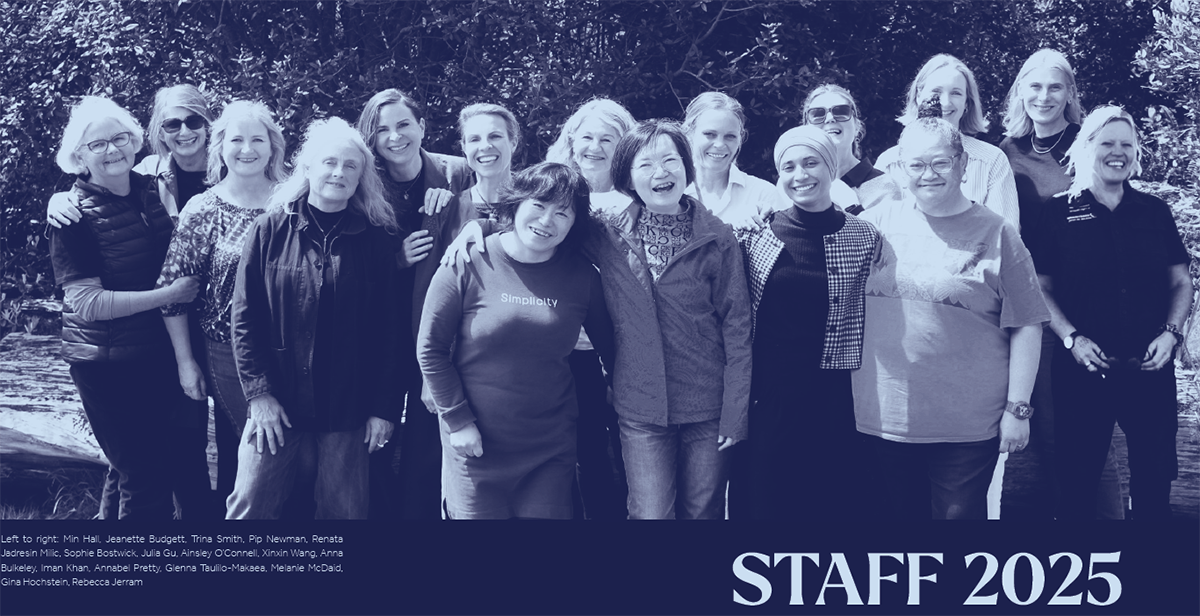
Left to right: Min Hall, Jeanette Budgett (after twenty-five years, 2025 was Jeanette’s final year of teaching at the school), Trina Smith, Pip Newman, Renata Jadresin Milic, Sophie Bostwick, Julia Gu, Ainsley O’Connell, Xinxin Wang, Anna Bulkeley, Iman Khan, Annabel Pretty, Glenna Taulilo-Makaea, Melanie McDaid, Gina Hochstein, Rebecca Jerram.
Additional staff teaching in landscape design and architecture who made contributions to the journal included senior lecturer Sue Wake and BLA lecturer Rebecca Jerram.
Sue Wake wrote: “I have been involved with Landscape Design programmes at Unitec for a very long time as both student and lecturer. I was attracted to it as a job full of interesting people and a family-friendly environment to bring up my daughter solo. I bought a small house nearby and started to make a garden that turned into a plant collection. I have always been passionate about plants and sharing this with others. Many students who have studied with us in Landscape Design over the last twenty-six years have visited my garden for plant identification, selection, design or management projects, making home and teaching somewhat seamless”.
In a response to the “ever-expanding waves of AI”, Rebecca Jerram reflected on the magic inherent in drawing and things that happen in our brain when we draw. Her lyrical piece evoked the speed with which “pencil lead can bound, leap and trail” and the imagery of an ink pen dancing “across paper with sleight of hand, joining lines, curves and shading, until landscapes emerge in wispy tendrils, swirling around dark wedges of vertical. Tap-tap stippling spreads across the page like tiny birds in flight, while brushes of watercolour melt lazily into the canvas like a sweltering Sunday afternoon”.
2025 Highlights
Another highlight of Asylum 2025 is an update from Associate Professor Dr Matthew Bradbury on the joint Architecture and Landscape Architecture Studio - described as a brainchild of Professor Dushko Bogunovich, and as having attained the status of a “venerable institution” since it began running almost 10 years ago.
Matthew writes that “over the years, students have collaborated on several joint projects that address the development of Tāmaki Makaurau Auckland and the surrounding region. These projects range from waterfront developments with mana whenua in Whangārei, to urban design explorations in Wellsford, and working with local communities in Māngere to mitigate flooding. One notable waterfront project focused on the redevelopment of the Onehunga waterfront in response to rising sea levels”.
The latest project involved working with the Avondale community to prepare alternative masterplans for the redevelopment of the Avondale Racecourse.
As displayed here five groups of architecture and landscape architecture students addressed a complex set of conditions, including major flooding and the potential for significant urban redevelopment, as well as the preservation of the Avondale Market.
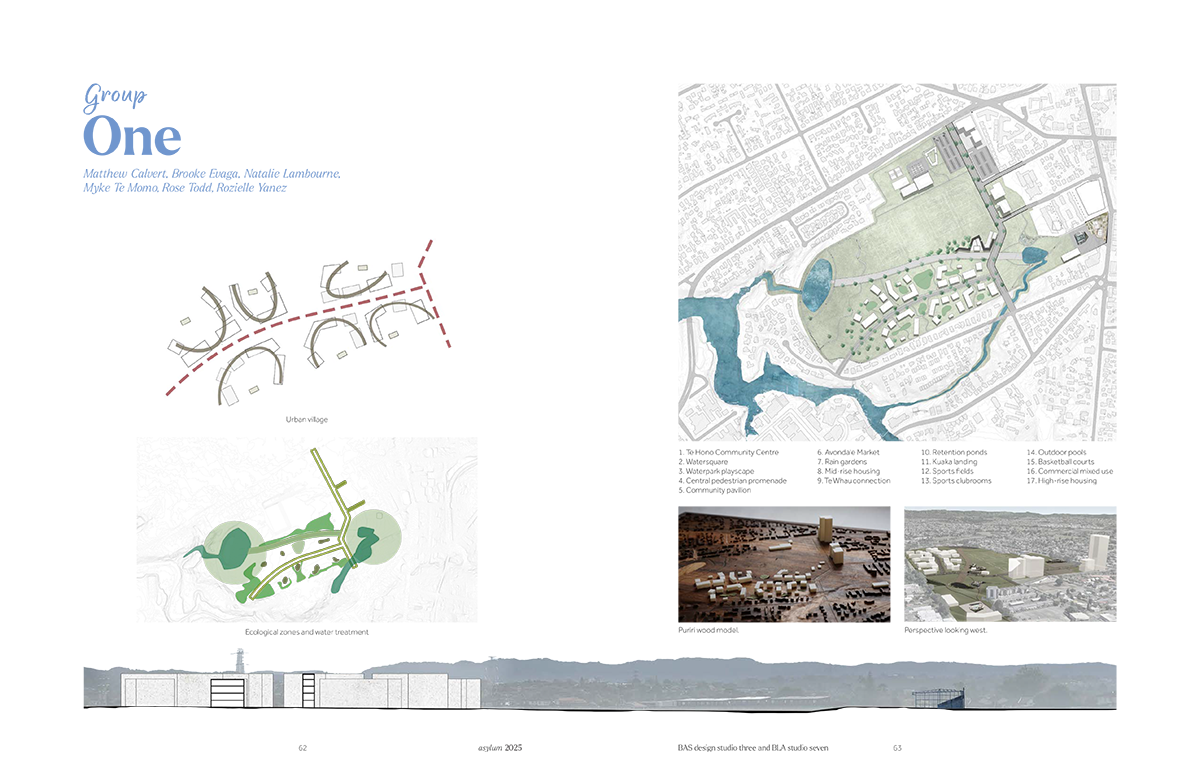
This masterplan offers a rare chance to reshape urban development by integrating ecological restoration, cultural memory and inclusive design to create a resilient future for West Auckland.
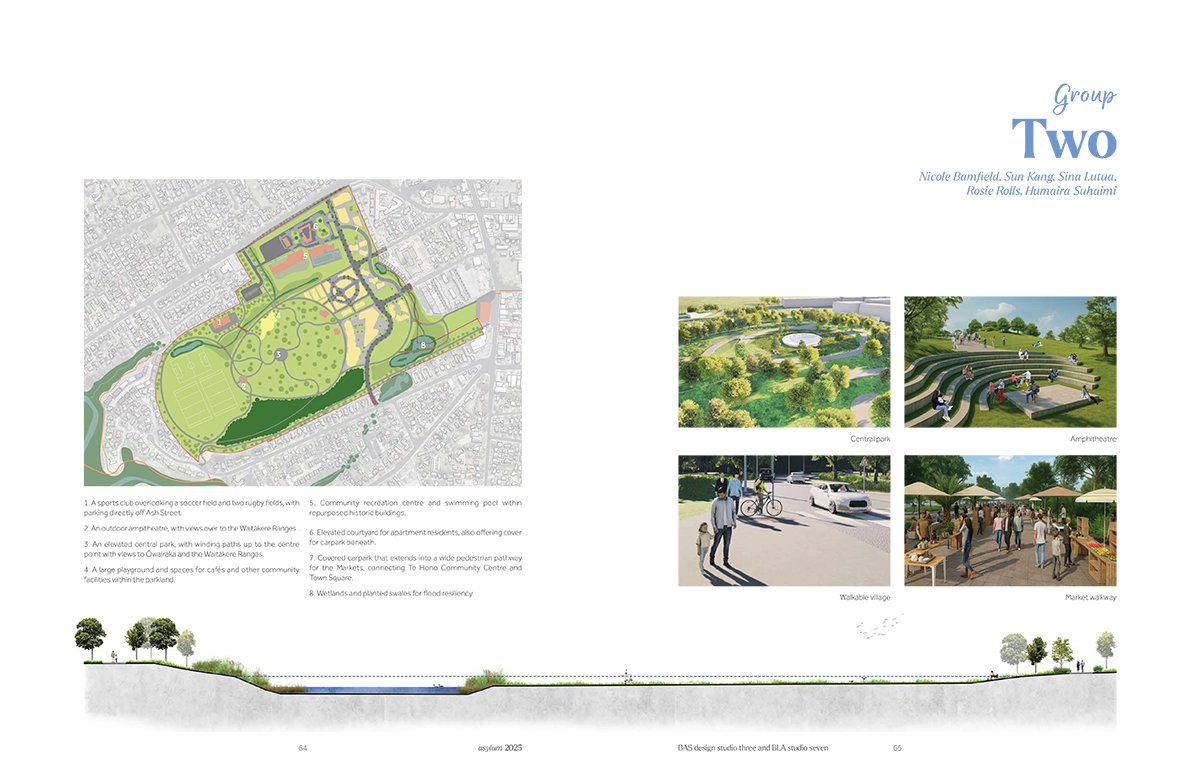
This masterplan is a socially, culturally and environmentally sustainable urban village design that welcomes all Aucklanders, integrating heritage, green infrastructure and community amenities around a central gathering space near the train station.
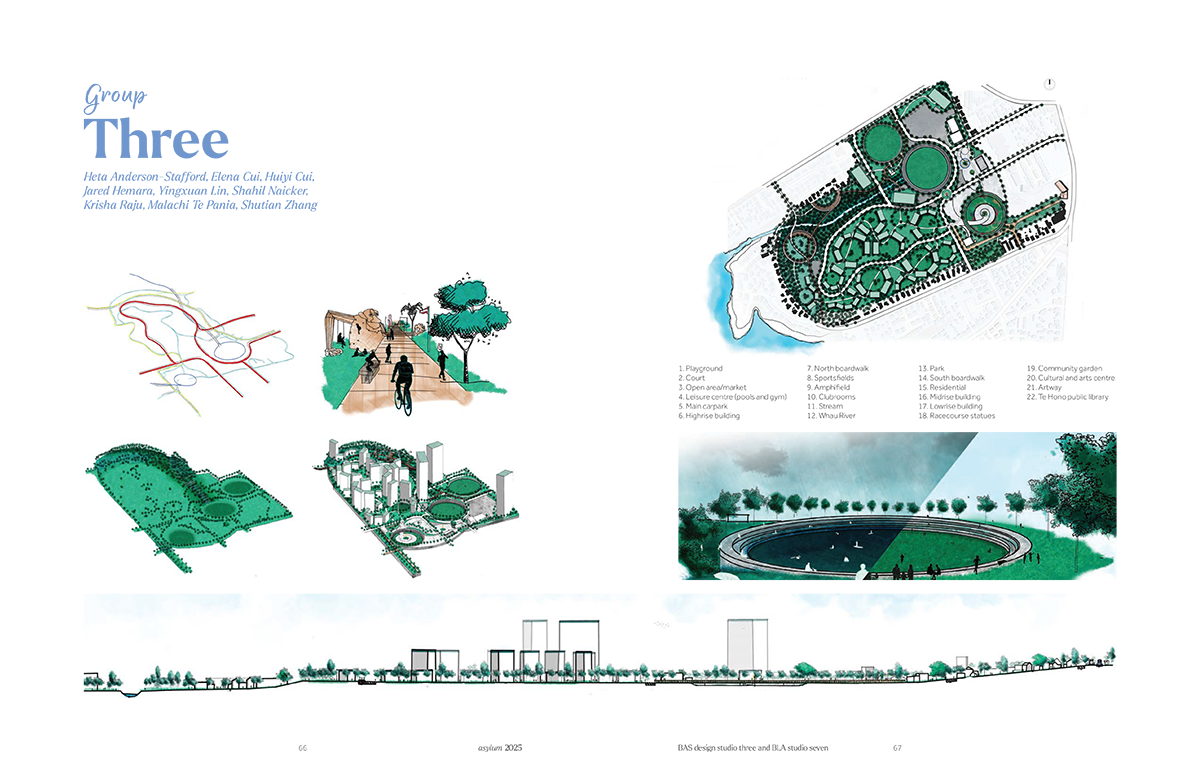
This masterplan proposes a flood-resilient, multifunctional gathering hub in the east of the site that connects residential and commercial areas with recreational spaces through green infrastructure and pedestrian access, while honouring biodiversity, cultural identity and supporting community events.
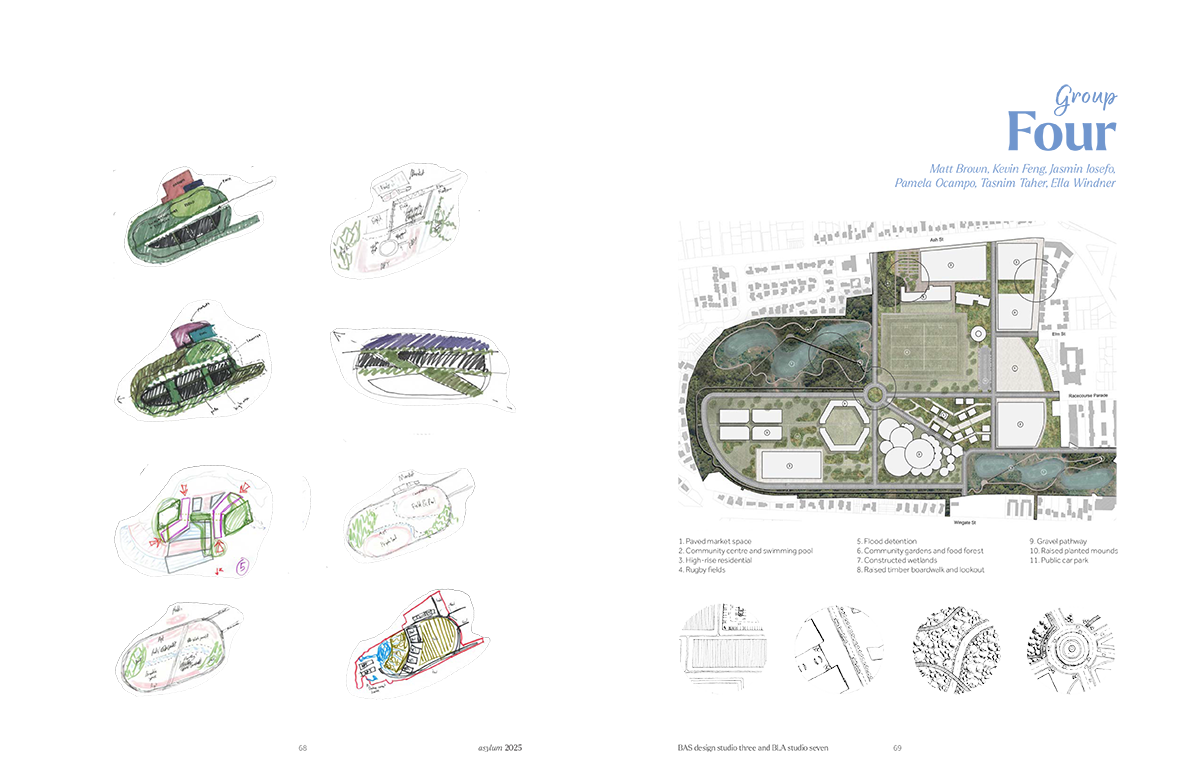
This climate-adaptive masterplan balances built form and green space to restore local ecosystems, enhance flood resilience and foster community through integrated public, residential and commercial zones that honour heritage, biodiversity and sustainable living.
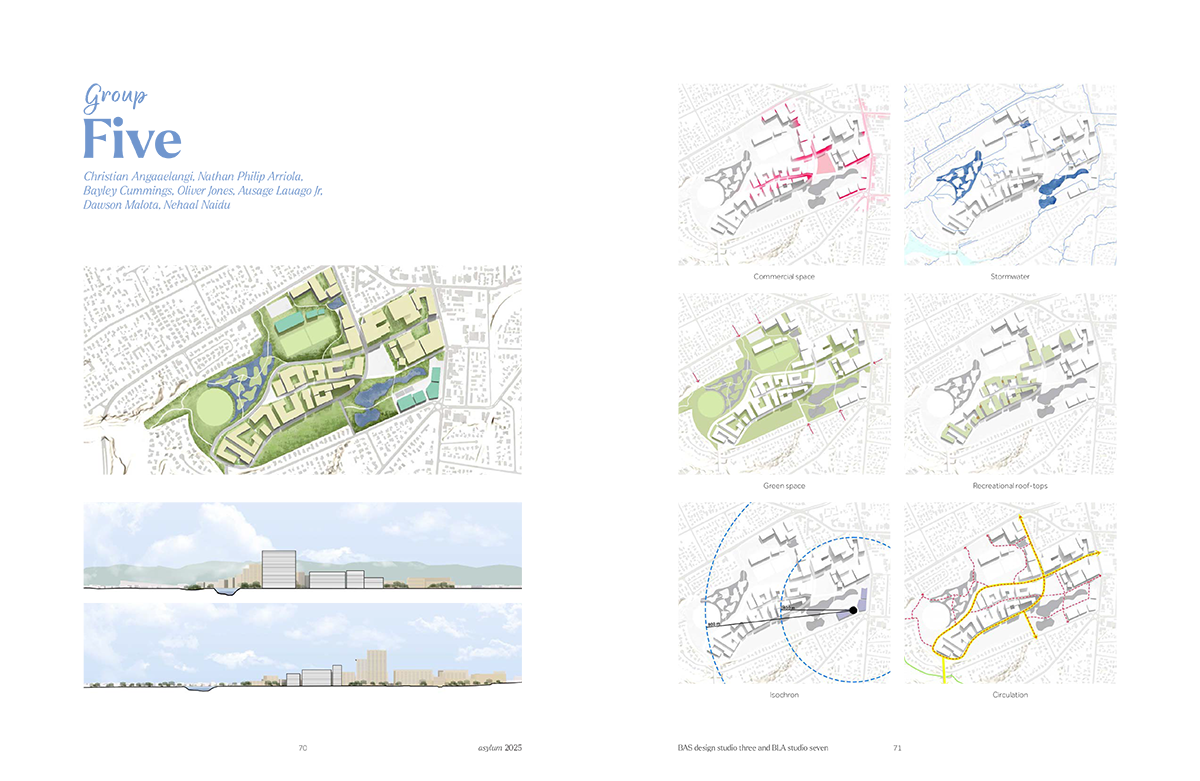
This climate-conscious masterplan enhances open space for community wellbeing, honours Avondale’s cultural and ecological heritage, and supports sustainable development through resilient design and inclusive planning.
Further notable content in Asylum 2025 are pieces on:
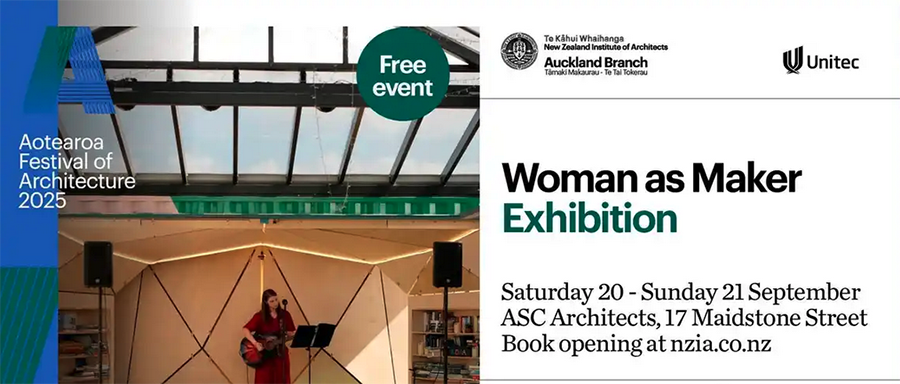
the Woman as Maker exhibition curated by Gina Hochstein as part of the NZIA Festival of Architecture.
a report on the 2025 cohort of Te Hononga Māori Studio students who travelled to Motueka on two separate visits to continue work with Te Āwhina Marae that began in 2024.
A roll Call of UNITEC students - 2025
Note: The bolding of student names indicates those students who have independent work featured in Asylum 2025.
Landscape Design | Horticulture Services: Edward Ashton, Katherine Bang, Paula Barakat-Stanage, Lucy Beveridge, Patrick Brebner, Junxiao Chen, Anthony Drent, Dion Gallagher, Sophie Henare, Morgan Huggins, Yoshua Mackerracher, Ida Moberg, Nathan Orlandini, Oscar Pivac, Luke Rewha-Lobo, Seth Trigg, Kai Zheng
Landscape Design Diploma: Daniel Ahwa, Timothy Arcus, Oliver Ball, Rachelle Bennett, Jemma Bunker, Harrison Caird, Sharon Fisk, Ainsley Foster (Ecotone - a sloped coastal site bordering Oneoneroa / Shoal Bay), Sarah Hargreaves, Haiguang He, Sean Jacobson, Claudia Knarston, Lila Kuka, Stephanie McCallum, Phil McGowan (The Gravel Garden - A west-facing suburban site in Mount Albert), Blake McIntyre, Rebecca Moldenhauer, Osi Monu, Elliott Morgan, Julia Moss, Carl Reynolds, Serin Sebastian, Carla To (Pourewa Windbreak Planting Plan), Anna Wilcock
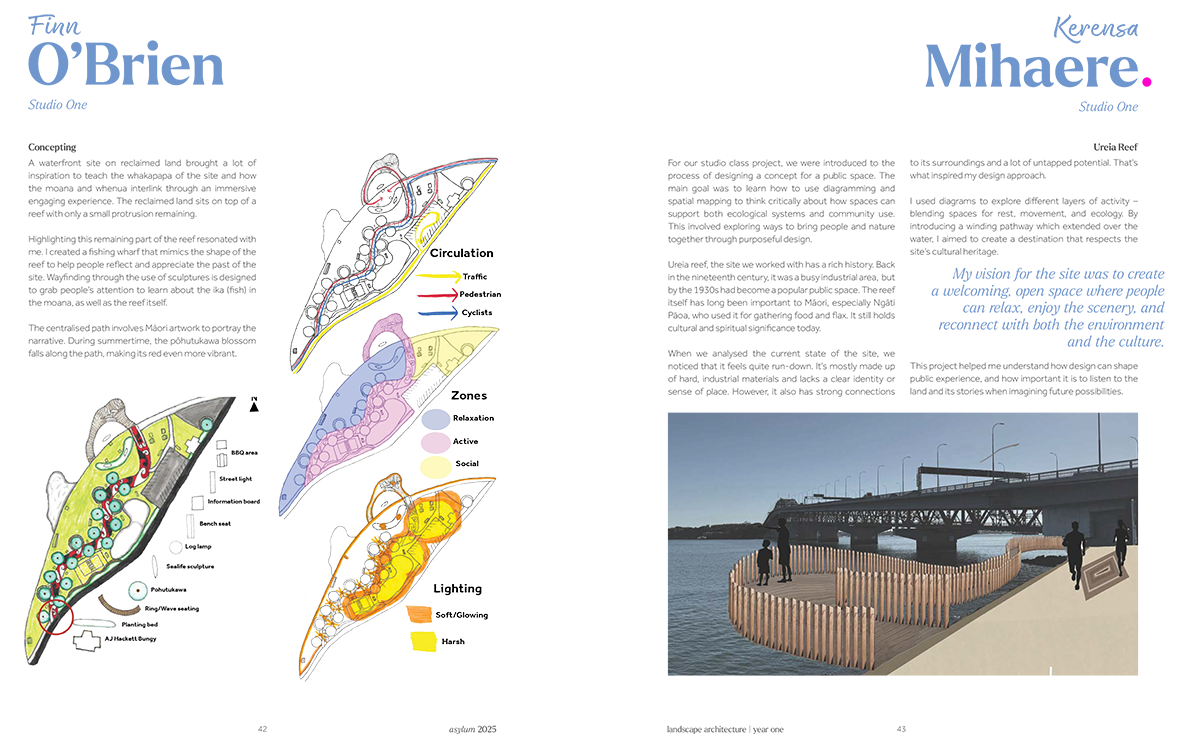
Landscape Architecture - BLA: Falemaka Afeaki, Shaymaa Al Magasees, Isla Bailie, Hannah Busby, Julianne Buys (Town Centre for Kumeū), Isabelle Cushman (Urban form in flood-vulnerable areas of Te Rewarewa New Lynn), Isaac Denny (Flood Resilience: A community-based approach), Rury Fitzsimons, Michael Head (Adaptive Strategies for the Hauraki Plains), Oliver Jones, Russell Kereru, Summer Kivits, Amelia Lawson, Ximin Li, Yingxuan Lin (Balanced Green Space in High-Density Living), Kerensa Mihaere (Studio One - Concepting), Joseph Mohi, Ben Nicklin, Jack Norris, Finn O’Brien (Studio One - Concepting), Sylvia Pedersen, Lennox Penrose, Rosie Rolls (Enhancing Ecological Activity in Te Atatū Penninsula), Brynn Salmon, Samuel Sinclair, Leighton Smith, Rose Todd, Ngoc Phuong Thao Vo, Martin Walsh, Hannah Wells, Ella Windner (Reconnecting Eden Terrace)
Landscape Architecture - MLA: Ziqi Gao (Floodable Public Space Strategies), Hunter Henson, Kuramahaurangi Kotlowski, Xinyi Lu (Sponge City Perspective: Exploring flood-resilience), Jacqueline Naismith.