A conversation with Grant Sheehan: Photographer - and film maker
As publicised on LAA last month, this year’s Resene Architecture & Design Film Festival (RADFF) will begin with the premiere of The Time Traveller's Guide to Hamilton Gardens, a documentary featuring the mastermind behind the gardens, NZILA Fellow Peter Sergel, on Tuesday 28 April - with special opening screenings in both Auckland and Wellington.
The person directing the footage is Grant Sheehan, one of Aotearoa New Zealand’s uniquely remarkable, prolific and creatively curious photographers, and the powerhouse - with partner Shelley-Maree Cassidy - behind Phantom House Books & Films. As recently as 2023 he was the subject of a film himself - Grant Sheehan: Light, Ghosts & Dreams
Grant met with LAA this month to talk about the origin points of both the book and film on Peter Sergel’s extraordinary achievements.
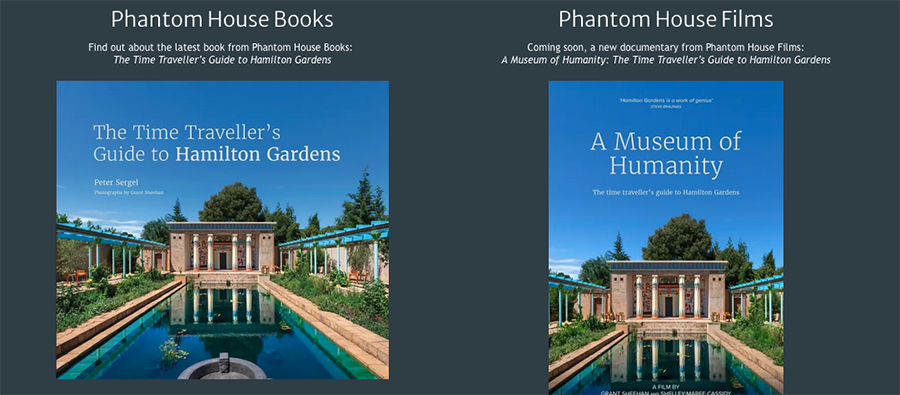
Note: The film’s title has reverted to being the same as the book, albeit ‘A Museum of Humanity’ is sometimes used as the subtitle.
Q: How long was the book in gestation?
Grant: Back in 2014, I was working on a New Zealand landscape book, in which all the images would be taken with a newly released DJI GPS capable drone. Before then, drones were quite rare, specialist and often hand-built. As a result there were very few rules and regulations surrounding them, except around airports of course .
In 2015, l was about a third of the way through the project when the CAA announced they would be introducing a series of property rules which would restrict drone usage quite considerably. They gave two months notice of this. During the two months I decided to fast track the project and complete it within that timeline.
I knew about the Hamilton Gardens at this stage but had never visited, so I decided to include it. On my arrival I was blown away by what I saw, the sheer variety of them, and the incredible detail in the buildings and overall surroundings. I photographed three of the gardens (the Tudor, Te Papapara and the Italian Renaissance Gardens) and included those shots in the drone book, which was completed a couple of months later, then released, titled Eye In The Sky: A Drone Above New Zealand .
At that stage, there wasn't a book about the Gardens and I made some preliminary approaches suggesting it would be a good thing to do. There was some interest but nothing progressed. Then, in 2022, the chairperson of the Hamilton Gardens Development Trust (HGDT) got in touch about progressing the book idea, and by 2023 we were on the way. Peter Sergel had written a very comprehensive first draft of the book, which would be published through my Phantom House Publishing company.
It was at this point I actually met Peter. After our initial meeting, and reading his manuscript, it became apparent to me that Peter considered the Gardens, rightly, as much more than an elaborate collection of gardens with historically themed buildings. Rather they were a series of statements representing the cultural epochs of human progress.
Q: Did the idea for the film follow in quick order?
While working on the book with Peter, my partner Shelley-Maree Cassidy and I started thinking about how we could film the story that he has written. We had such a good time working on the Garden book, and had developed a real affection for this remarkable place. We wanted more people to know about it and see it. Hence, first the book, and next the film...
We put together a timeline, a documentary storyboard, with Peter as the main character, and presented the idea to the HGDT. They were supportive and keen, and six months later, we were able to proceed.
Q: How much of a 'labour of love' / passion project was this?
Having spent a lot of time in the Gardens photographing for the book, I think it kind of cast a spell on both of us in some way. We wanted to showcase it to as wide an audience as possible, as we discovered that many people in New Zealand were unaware that the Gardens existed, or hadn't been there for some years so didn't know there were more Gardens to see and under development.
We wanted to feature the people who are part of making the Gardens what they are, and show 'behind the scenes', the work that goes into the presentation of what the visitor sees. So we invested a lot of time and energy to try and make the best film we could. The welcome and assistance we received from the Hamilton Gardens team was absolutely invaluable and we looked forward to seeing them each time we went. We actually became proud of the place although we had not been involved in it before the book.
Q: As a first-time feature documentary maker what lessons did you take away?
The direction of it was to follow the timeline as much as possible, from the rubbish dump to now and the future, condensing 308 pages of Peter's book to a manageable film length. Three key lessons were
the value of a storyboard - mapping out the key elements of the film, the key characters, the overall tone and manner;
the importance of assembling the right crew, from cinematographer to editors, narrators and colourists; being ready for spontaneous/ unexpected additions;
the soundscape, including finding the right music.
The key 'ins and outs' of the production were that we needed to make several visits during the year to show some different stages of growth and development, as well as make sure we could include some key people in the film. Luckily, Hamilton seems to have very good weather so that wasn't a problem!
Q: What was the highlight in terms of the cinematography of the film - and the relationship, perhaps, to your photography practice?
While there are many differences technically and artistically between telling a story with still photographs or with moving images, the power of the story remains, for me, the backbone of either medium. As we know, the power of the single image can resonate and solidify in the memory in a way film doesn’t - whereas moving images offer a wider narrative range. In spite of these differences, once we got the film rolling, the process didn’t seem all that different. It’s an extension from stills to moving pictures, and I had been doing some video work over the past few years, including drone videos.
For me, as director, it did feel weird to have a film crew capturing the actual material, and of course, adding their creativity to the mix. After decades as a photographer, doing my own book projects pretty much on my own, and covering every aspect, it was an adjustment to work as part of a team.
Q: Why should as many people as possible watch the film?
Firstly, to see what is really a unique set of Gardens that's here on our own 'doorstep', and to understand what an achievement the Hamilton Gardens are. This truly is a museum of humanity that shows so many styles of gardens over a 4000 year timeline - literally a museum without a roof! And it's a place of calmness to walk and sit, with birdsong - including the occasional peacock call! - and fresh air; an escape away from the stress of the real world...
And secondly, to celebrate Peter's landscaping, planning and persuasive skills; skills that have delivered the transformation to what is on show there now in Hamilton: a collection of Gardens that are great to visit and explore.
And last but not least, how this has happened over a period of some thirty years, with a lot of help from many people, and that there's still more to come.
Living behind the Lens
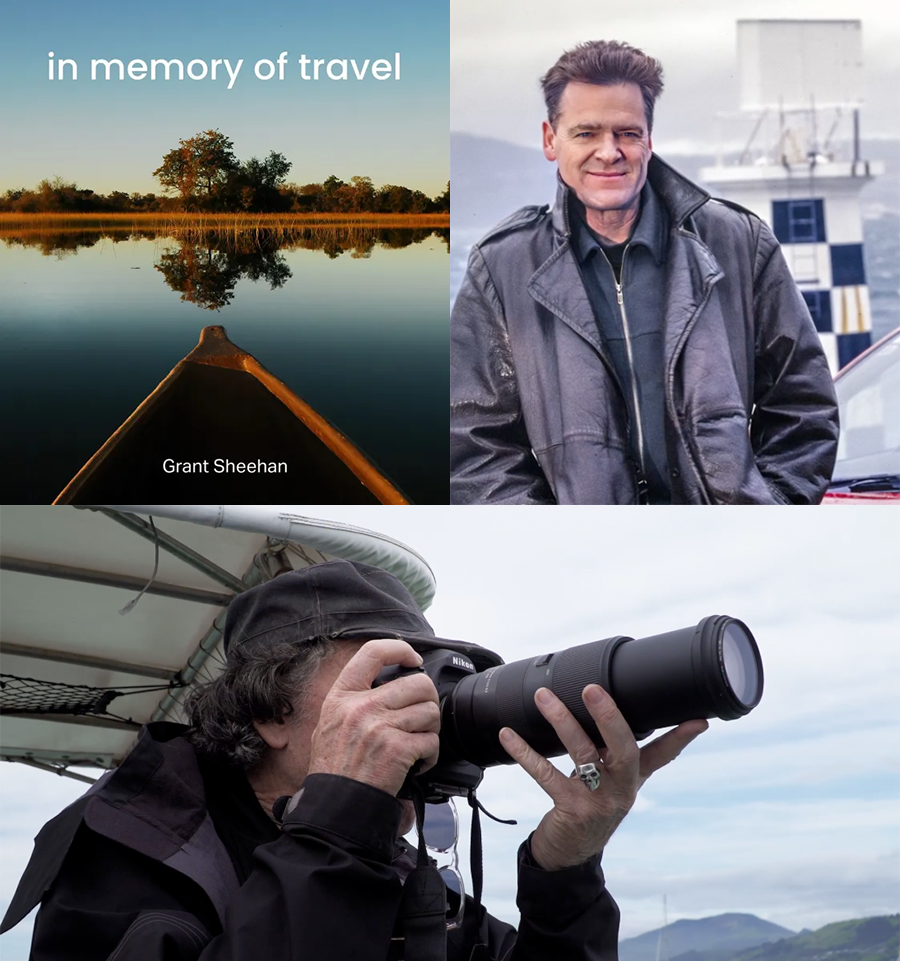
The tale of Grant Sheehan’s prismatic life behind the lens was well presented to the world by Robin Greenberg in 2023 at the Whānau Mārama: New Zealand International Film Festival - from his upbringing in Nelson and lifelong love of lighthouses and autodidactic entry to photography to his restless polymath progression from mastering one type of project to the next.
His book, in memory of travel (Phantom House Books, 2022) for instance revisits his knack for being in the right place at the right time; seeking out opportunities to explore and curate different segments of a photographic era that he values for its high-points of technology, craft and slowness, now being subsumed by the cascading and omnipresent imagery of the digital world.
Among a back portfolio of work that would take weeks to begin to take in fully, Grant has also unusually ventured into high-end, bespoke ways for visualising what a book can look like - pointedly seen in the innovative focus he applied to the AI-sphere in Does Ava Dream? (Phantom House Books, 2020).
As a consummate photographer of landscapes and nightscapes, he has been lighthouse-like himself - scanning a boundary-extending beam across what he calls a “fetish about landscape”.
The next project for Phantom House Films is a documentary that is currently in the editing suite on the iconoclastic lifework of Wellington architect Roger Walker. Given Grant’s extensive past work on documenting the built environment, going back as far as an exhibition at the Wellington City Gallery in the early 80s and his freelance contributions to books like Michael Fowler’s Wellington Celebration (Brick Row Publishing, 1983), it represents another turn in a colourful career that has always kept people guessing.
See also Grant’s appearance in Hot Pixels’ NZ Landscape Photographer series.