An 'end of the Earth' memorial design competition is now open
The Sixth Extinction - a global event that has happened, is happening, and is also yet to happen - is a reality.
As Australian landscape architect Richard Weller (1963-2025) famously wrote: "For many plant and animal species today, humans are now the greatest threat to their survival".
Calling out the role of the human then as "nature’s self-appointed executioner" by running a competition for designs for a physical memorial of any size, sited anywhere, in response to the Sixth Extinction - without it being about us (the human subject) - is a bold and challenging idea. Indeed, ideas to be focused on like this don't come any bigger.
The competition bounces off Richard Weller's conception that humans have “chewed their way through the megafauna of most continents and now, by grinding down their habitats for farms and cities, seem intent on extinguishing the rest".
In his book To the Ends of the Earth: A Grand Tour for the 21st Century (Birkhauser Verlag, 2024) Weller set out a provocation that while creating safe havens for threatened animals and plants through protected areas is not an insubstantial form of mitigation there are two problems.
"The first is that protected areas do not map accurately onto the world’s most threatened biodiversity [as per the ‘grim ledger’ that is the IUCN Red List of Threatened Species] and the second is that where they do the land areas are not large enough to facilitate the movement of species as they now seek to adapt to global warming".
In 2022 188 nations at the United Nations Biodiversity Conference (COP15) agreed to a new target of placing 30% of the earth’s terrestrial area under protection. But who's taking notice? How do we speak up as loudly as we can for Earth’s plants and animal species?
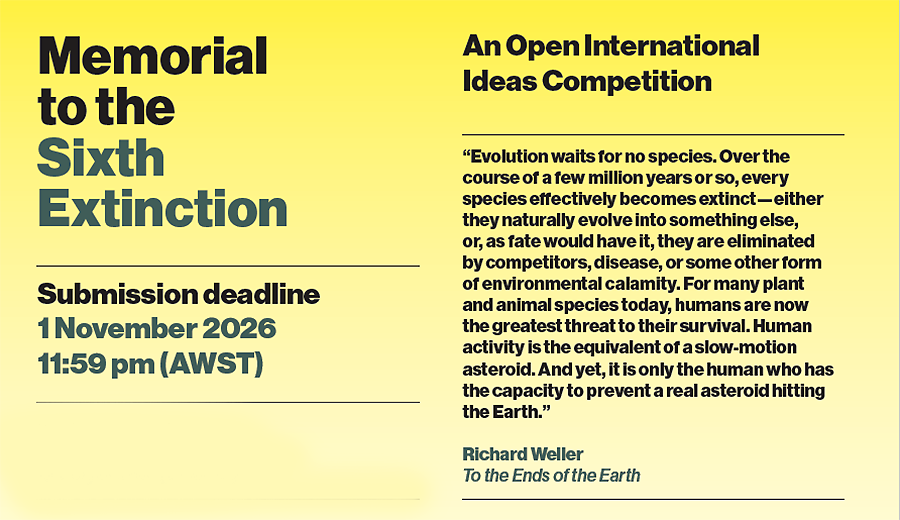
Entries for Memorial to the Sixth Extinction, an international competition, are now open until 1 November from individuals or from teams of up to six participants. Tertiary students currently enrolled in an undergraduate or postgraduate program at a university or technical college are eligible to enter, as well as faculty and working professionals of any level of experience.
Multidisciplinary teams are welcomed, and while it is anticipated most entrants will come from the fields of landscape architecture, architecture, urban design and fine arts, the competition is wide open to other relevant disciplines. There is no fee for entry. A prize pool of $15,000 (AUD) will be split among winning entries and up to 10 honourable mentions will also be awarded.
The judges will be looking for conceptual rigour, research, novelty, ingenuity and how well the design answers the brief of the Memorial to the Sixth Extinction competition. Entries will be judged anonymously.
The Jury Panel consists of:
Julian Bolleter, Director, Australian Urban Design Research Centre, the University of Western Australia (Jury Chair)
Laurie Olin, Founder of OLIN and Professor of Practice, University of Pennsylvania, USA
Jacky Bowring, memorial design specialist and Professor of Landscape Architecture, Lincoln University, New Zealand
Catherin Bull, Emeritus Professor of Landscape Architecture, University of Melbourne and Adjunct Professor, Queensland University of Technology
Peter England, Tony Award-nominated theatre and live production designer
Sara Lynn Rees, Palawa woman descending from the Trawlwoolway people of north-east Tasmania, Lecturer at Monash University and Co-Chair of the Australian Institute for Architects First Nations Advisory Working Group
The competition is funded by the Kevin Taylor Legacy and hosted by the Australian Urban Design Research Centre (AUDRC) and the University of Western Australia’s School of Design. This grant programme is itself a memorial to one of Australia’s leading landscape architects and was established in 2014 by the Australian landscape architecture firm, T.C.L. Kevin died in a car collision fifteen years ago in August 2011.
As noted in the competition brief, a significant chunk of Richard Weller’s enduring legacy may well be found in his research and writing on global flashpoints between biodiversity and urban growth, published in National Geographic, Scientific American and documented on the web-based platforms Atlas for the End of the World, The World Park, and The Hotspot Cities Project, where he makes a compelling case for the critical role that designers can play in protecting the Earth’s biodiversity and pursuing a more sustainable future.
At one level this competition is essentially a way to memorialise and advance his work.