Looking back on The Landscape (1)
by Alicia Keating, guest curator
2026 marks the 50th anniversary of the inaugural publication of The Landscape, the starting point of NZILA’s public voice.
In marking the contribution made to the profession by The Landscape, we will be running a small series of articles looking back on a selection of the content it published that continues to stand out for its insights and enduring interest.
The Landscape ran from 1976-1994 when it transitioned into the commercial stable of AGM publishing for an extended period, and then eventually its current life as Landscape Architecture Aotearoa (LAA) from 2016.
The life of The Landscape began with three goals; providing contact between members, active discussion about landscape philosophy, and wider dissemination of information about the profession.
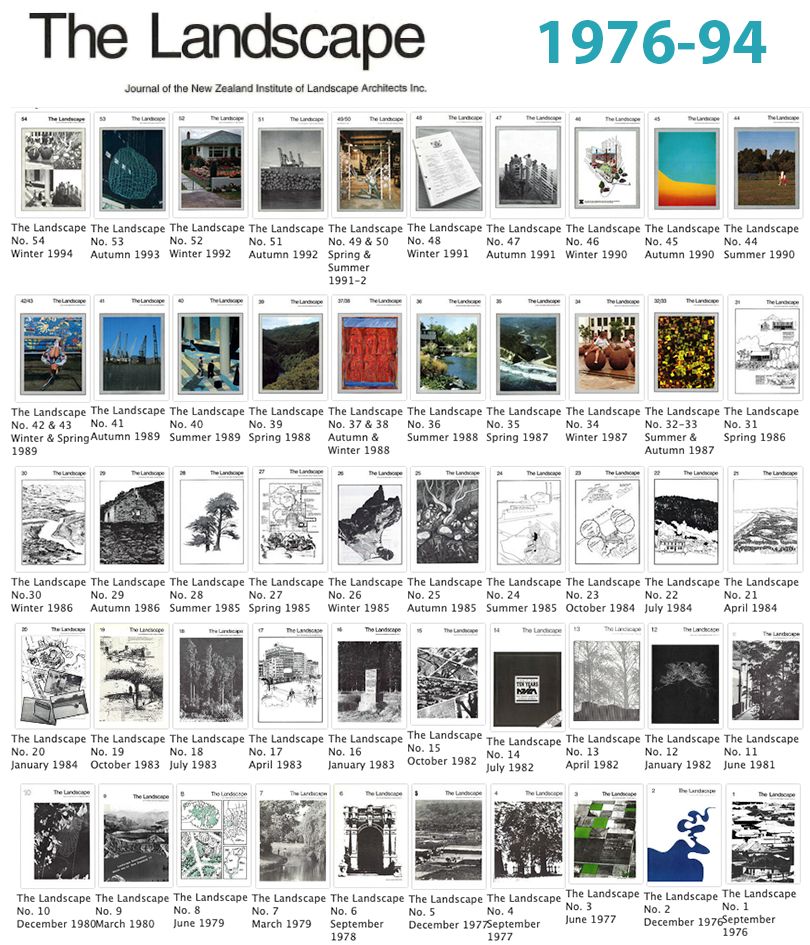
The journals themselves are typically 20-30 pages with a few double issues here and there. They are easily accessible at Lincoln University’s Living Heritage Archive
For the first few years the content was aligned under themes - such as water, housing, power, etc - with the seeming intent of taking a stance as a profession on a given issue, or later towards defining an overarching philosophy for informing the practice of landscape architecture. Over time it moved away from some of the rigidity of that approach and moved into more flexible content streams and topics, including:
Unpacking and commenting on contemporary policy
Highlighting recent and ongoing projects
Planting design pieces
Importance of wetlands
Client perspectives
Celebrating designs which didn’t move forward
Urban plazas in Aotearoa and beyond
The Landscape stands out as a record of a small, engaged professional community working in real time to articulate and evolve the identity of landscape architecture in New Zealand. While some of the specifics now sit firmly in their time, the underlying questions and debates retain some striking relevance today.
In a 1982 article for instance, Graeme Robertson championed the programmable calculator as a tool for practice, framing emerging digital technologies as an investment in efficiency and cost savings. He encouraged firms to consider how they might adopt these tools, even suggesting the appointment of an in-house ‘expert’ to lead their use. This has a parallel with the current introduction of AI in practice.
Other pieces, while less contemporary in their specifics, carry messages that feel more urgent than they perhaps did at the time.
A 1977 article warned that “Sooner or later New Zealand must face the alternative energy question; sooner, by choice with more flexibility, or later by necessity, we will have to develop the means to supply energy sources. […] Unless we conserve our resources, curb our rate of consumption, and limit our growth, we are going to face catastrophic changes in 30 to 50 years” (N.J. Cherry).
The article goes on to outline the potential of various alternative energy sources as long-term solutions. While not all of its predictions proved accurate, its central argument now reads less as speculation and more as an argument that was easy to overlook at the time, but harder to dismiss in hindsight.
Beyond general content, the publication is well worth the read to revisit writing from almost every Life Member of the New Zealand Institute of Landscape Architects. Each edition is teeming with commentary on ‘the issues of the day’-- from a piece on Open Space Planning and Management by Di Menzies to Neil Aitken’s approach to The Landscape Detailing of a Small Office Building.
Alicia Keating is a recent Te Herenga Waka - Victoria University graduate who has also contributed to campus life as a research and teaching assistant. You can read more about Alicia here: Finding connection through landscape architecture