Hamilton Gardens brought to life at the 2026 RADFF
Seeing the multi-layered story of Hamilton Gardens writ large on the cinema screen on 28 April confirmed the diligent genius of Dr Peter Sergel, the driving force behind the Gardens and its first Director from 1995-2020.
'The Time Traveller's Guide to Hamilton Gardens', now available both as a book and this new documentary - both steered into the world by Grant Sheehan - is a triumph of landscape design and architecture that deserves to be celebrated.
It's fitting that the film begins with shots of Peter flipping through concept sketches he made from as far back as the late 1970s, and that Grant's affinity for aerial drone perspectives - of the concrete results so far - are shown to great effect throughout.
Screenings are now rolling out around the country as part of the Resene Architecture & Design Film Festival
An Uplifting Review
Like many people who made it to the movie's earliest screening, Stuff reviewer Graeme Tuckett couldn't say he'd seen the gardens firsthand but left the theatre feeling uplifted and motivated to get there a.s.a.p.
Structured almost in chapter form, this local doco constitutes a leisurely and immersive tour, outdoor room by outdoor room, of what is a living history lesson of the seismic shifts in garden typologies across the centuries.
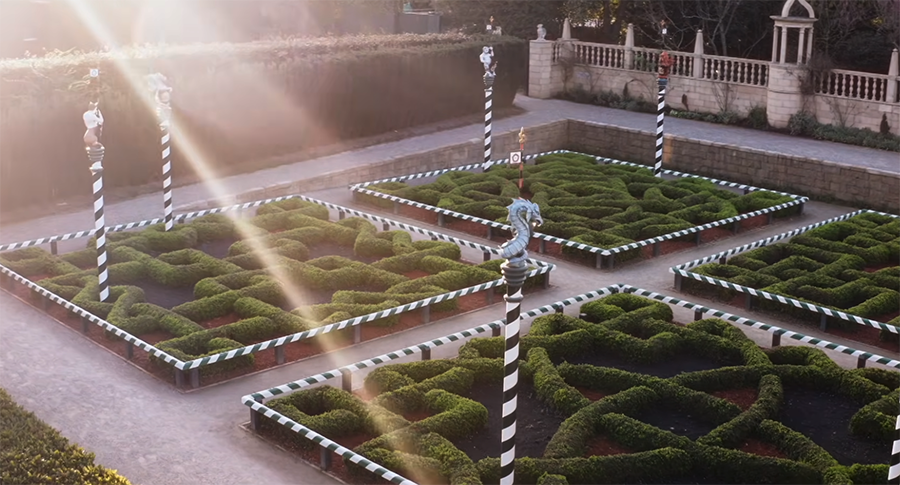
As well as the gorgeous visuals produced by Phantom House Films and noted by Tuckett, it has a soundtrack that would easily make a working week joyfully float by, punctuated by the relaxing aural interludes of chirping birds.
Tuckett: "Beyond the visuals and the fascinating backstory, there is another, quieter narrative running through the film - and the place".
The narrative he refers to is the astonishing ability of gardeners - "through plantings, landscapes, statuary and whatever else a gardener can muster" - to create well-thought-through spaces that "can be a conduit to earlier beliefs, and, maybe, to a simpler, better way of just being human".
Even more, he praises gardeners who, by their creations, somehow "conspire to keep a society sane - and in touch with its actual values".
Amidst the drifts of colour and texture, the lesson side to the movie is to drop in well-scripted commentary about the qualities that different eras of garden added to the mix, be that acting as places for intellectual retreat (ancient China), or refuge and meditation (Japan), or of sanctuary, healing and contemplation (the monastic Middle Ages), or allowing the privilege of living with the faithful imaginings of distant lands (epitomised by Chinoiserie).
The creation of the Hamilton Gardens has been a team sport, and in his review Graeme Tuckett comments that an added bonus is that the people featured in the film who have been bringing Peter Sergel's ideas and vision to fruition are all "genuine good sorts".
A Movie Overview
Mark de Lisle of Peddlethorp Architects pays respect in ‘The Time Traveller’s Guide to Hamilton Gardens’ to the mahi invested season-by-season by all the workers who tend to the gardens, both the hand crafted construction thereof and the intense maintenance conducted via carefully located service lanes that sit behind the wow factors and surprises that visitors see. To quote Peter Sergel: "It is difficult maintaining the gardens, it's like asking an orchestra to play any kind of music from any era".
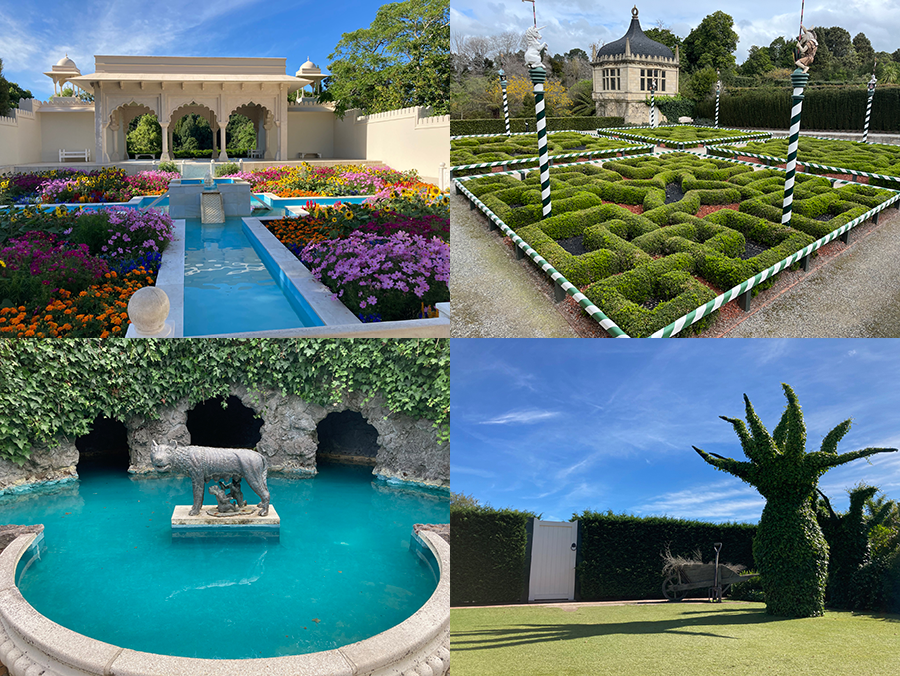
A selection of images taken by visitors Lucy Barker and Amelia De Lorenzo
Using the term 'carpet ride' to describe the experiential element of the Hamilton Gardens, the current director Lucy Ryan remarked that there is a balance of whimsy that means the staff, Trust and Council are not burdened with a need for it to be an encyclopedic experience. Her job, as Lucy expresses it, is to keep building on Peter's footprint and legacy through the site's embedded connection to mana whenua and growing the community and visitor value of activating events such as the annual Arts Festival and its literary component HamLit.
Lucy: "What's good for the city is good for the gardens, and what's good for the gardens is good for the city. Those things work in tandem ... it brings people to Hamilton and it gives something to Hamiltonians".
Peter Sergel's well-paced and placed presence in the film is erudite and eloquent.
He doesn't shy away from the fact that many of the theatrical portals were typically only open to opulent ruling classes - be that a Roman or Tudor or Baroque era - and wryly remarks "I don't think they were trying to hide their wealth and decadence, it went with their job really."
The underpinning philosophy that he returns to is that a collection of gardens like this serves to embody periods of sizeable societal transformations.
Peter: "If the pattern of the past is any guide, major changes lead to new forms of garden. The question, I suppose, is what will the major transformations occurring now - rapid climate change and AI - create in the future?"
He predicts that structural gardens will have a big part to play in exploring a hybrid ecology in the future, with a potential for gardens to be like nothing we've imagined.
"Nature is not some prissy artefact, it's constantly recoding itself and adapting ... (and actions like) having lots of vegetation in a city in order to lower temperatures will be life saving".

Peter, an Honorary Fellow of the NZILA, knows there are many hectares still available to Hamilton Gardens to round out the 30 projects envisioned and a ring of indigenous biodiversity that will surround them. Rather than naming a favourite garden ("it's usually the next one") he takes comfort that his life's work is indeed worthy of being called "a serious artform", on a par with and even exceeding other conventional artforms.
Peter: "Its not what you see, it's what you help other people see".
Thank you Peter! This is a profound way of looking at garden design and landscape architecture, and well worth the price of admission.
Note: LAA is keen to receive thoughts from movie-govers about this documentary and/ or reflections from anyone who has spent time at the Hamilton Gardens absorbing everything it has to offer. We'll feature a selection in our next e-bulletin to subscribed readers. Email laaotearoa@nzila.co.nz
AFTERNOTE
Whether you're a garden history afficiando or new to landscape architecture there is something for everyone at the Hamilton Gardens. Not all of the dimensions covered are by any means only historic in content or focused beyond the shores of Aotearoa.
The Te Parapara garden is a star, as are the practical learnings of the Kitchen and Sustainable Backyard gardens, the Surrealist garden with its menacing 'Trons' (inspired in part by the paintings of British artist David Inshaw) and the homely colonial Mansfield Garden.
As for the roses, you could not help feeling they understood that roses are the only flowers
that impress people at garden parties; the only flowers that everybody is certain of knowing.
A quote from Katherine Mansfield's famous short story The Garden Party.
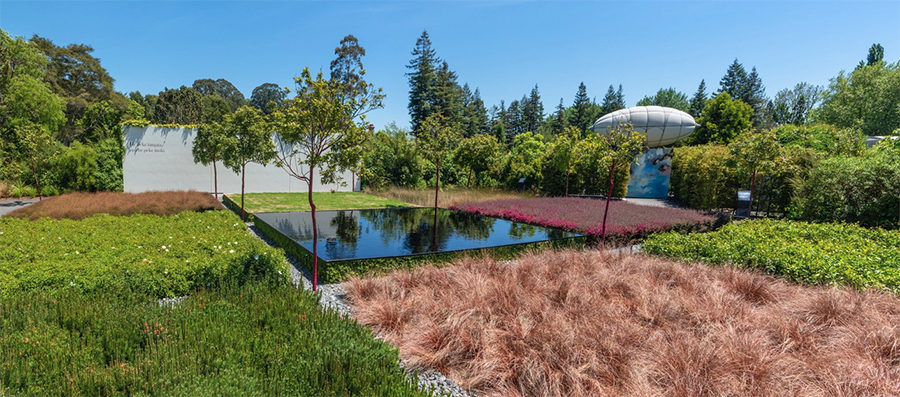
The whakataukī on the far wall reads: He peke tangata, apa he peke titoki - The human family lives on while the branch of the titoki falls and decays. Another nearby proverb reads: Whatungarongaro te tangata toitu te whenua - As man disappears, the land remains.
The Concept Garden (above) warrants special mention for its accompanying whakatauki and the abstraction it makes of school atlases of the past by mirroring the map legend utilised to indicate land uses, represented here by nine square 'plots':
Pasture is represented by the grass
Native bush represented by Muehlenbeckia astonii
Urban areas represented by White Carpet roses
Horticultural represented by citrus trees
Tussock grassland represented by Carex buchananii
Coniferous forest represented by Pinus mugo
Scrubland represented by Leptospermum scoparium
Wetland represented by Apodasmia
Water bodies represented by the central pool