Where will landscape architecture be sitting in 2051?
What might it take over the next 25 years for landscape architects to evolve their identity from designers of individual places into integrators of nature, communities and development in an increasingly complex world? Guest contributor Yash Sharma shares his evolving thoughts on this vital question.
From Designers to Integrators
– Limitations, Responses, Pressures, Responses and Tensions
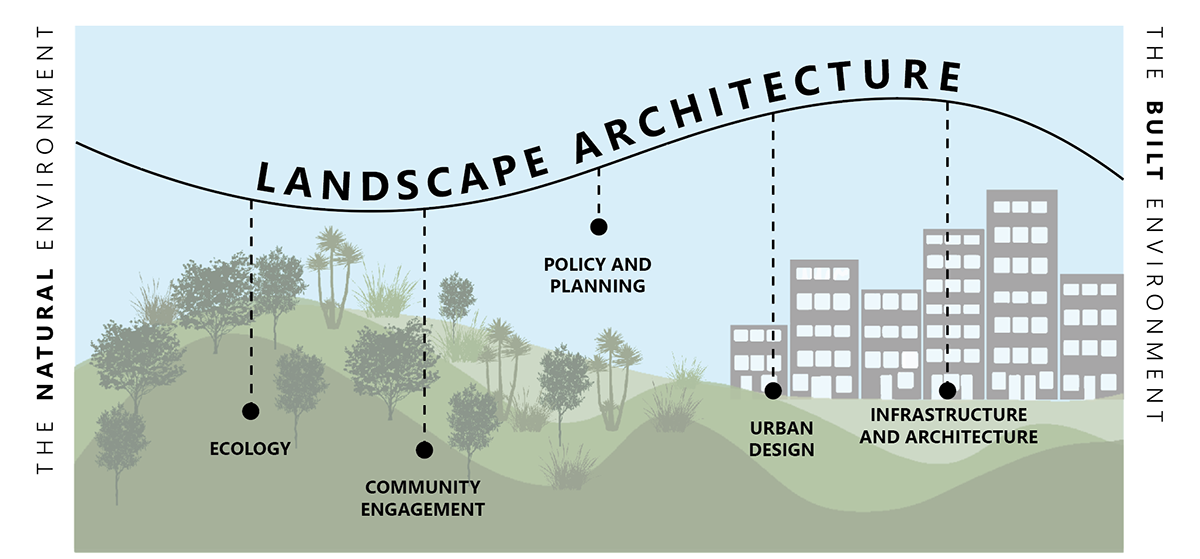
Schematic by Yash Sharma. This represents Yash’s interpretation of the profession’s contribution within the built and natural environment spectrum.
by Yash Sharma – MLA student, Lincoln University
Limiting landscape architecture only to its visible outcomes – parks, streetscapes, gardens and green or open spaces – really doesn’t represent the full profession’s contribution to shaping the built and natural environment; taking in, for instance, work across urban design, planning, ecology, policy, infrastructure and community engagement.
In developing my own sense of where the profession starts and stops, I came to a conclusion that traditional perceptions of the profession can stand in the way of it attaining a wider appreciation and understanding outside of specialist design circles.
One of the points that helped with my thinking on this was Josh Hunt’s article here on LAA from April 2025, titled RMA Reform: A shift in language – but not in relevance; particularly the passage sub-titled ‘Reframing the Narrative’.
As I’ve learnt from wider related reading, landscape architects may possess the capacity to influence strategic decisions, yet their involvement is frequently dependent on how clients, organisations and adjacent professions define the scope of their contribution. And as environmental and social challenges become more complex, the profession’s need to work across disciplines and influence strategic outcomes becomes crucial.
Stepping into the real world for my studies in the last semester of this year, I interviewed Dave Charnley, Senior Urban Designer & Landscape Architect at Palmerston North City Council. Practical insights from Dave’s industry and local government experience aided and informed my thinking, set out below, including his observation that landscape architects have the greatest influence when involved early in shaping project direction, policy and strategic decision-making.
Limitation: A Seat at the Decision-Making Table
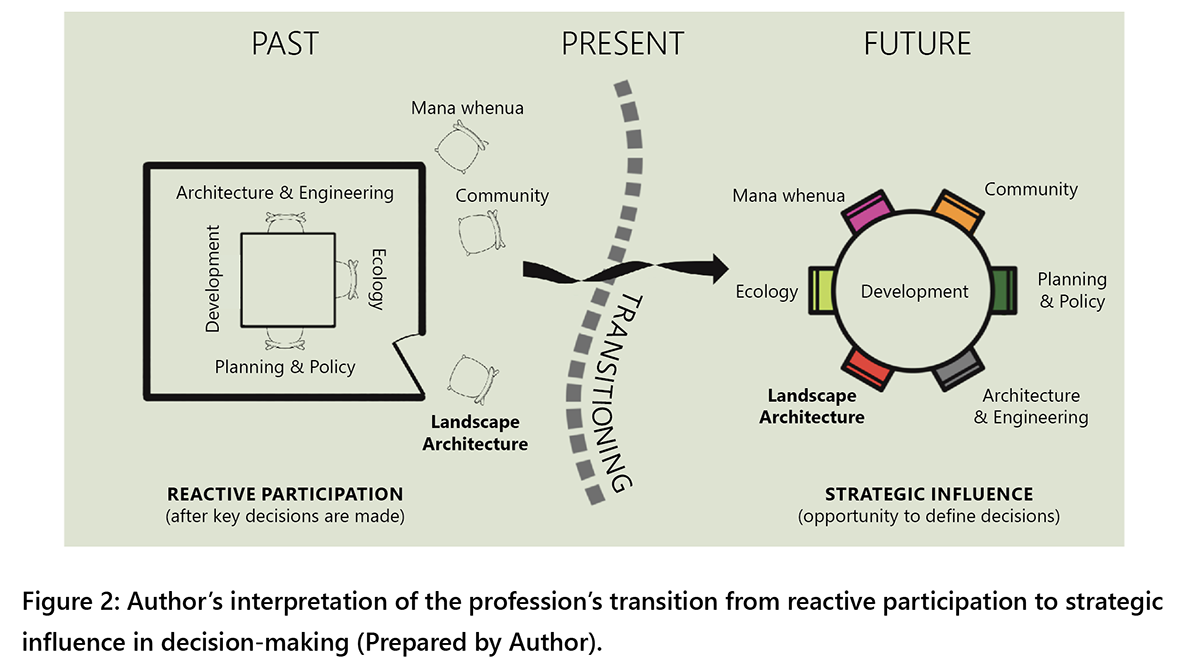
In articles about the maturing of the profession it becomes apparent that on top of its breadth of knowledge and skills the profession has sought to strengthen its credibility through evidence-based practice. However, greater technical credibility does not necessarily translate into greater strategic influence, reducing the profession’s role to refining decisions rather than helping define them.
The profession’s interdisciplinary nature, as affirmed in Aotearoa by the New Zealand Institute of Landscape Architects Tuia Pito Ora, is one of its greatest strengths, yet it can also make the profession difficult to define and communicate. As a result, its contributions beyond physical design are not always fully recognised.
This issue was also a recurring theme gleaned from my interview with Dave Charnley, who expressed the view that landscape architects often possess a systems-based perspective capable of integrating environmental, social and spatial considerations.
In an ideal world, the profession could exert the greatest influence when it is involved in setting policy, shaping strategy and establishing project direction before detailed design begins. It can be argued that the causes for that not happening aren’t ones of capability but of visibility and influence.
This distinction is important because improving the profession’s future relevance may depend on ensuring existing capabilities are recognised within strategic processes. Without a seat at the table, the profession risks remaining confined to a reactive role rather than a strategic one – as I have tried to present in this interpretative diagram.
Pressure: A Future Demanding New Forms of Leadership
The issues facing landscape architects in Aotearoa New Zealand over the next 25 years extend beyond individual sites. Climate adaptation, urban intensification, biodiversity loss and evolving expectations around cultural partnership are creating an interconnected ‘playing field’ that no single profession can address alone.
These are problems and challenges that require adaptive and resilient approaches beyond traditional professional practice, including long-term thinking, collaboration and the integration of ecological knowledge, community input and cultural values into decision-making processes
For Dave Charnley this problem-solving has been grounded at “a very everyday level” through work such as rain gardens, swales and open detention areas that manage stormwater while also supporting biodiversity.
As is well known, applying these features in an urban green space helps to regulate temperature, complement engineered systems and contribute to climate resilience, wellbeing and equity. Landscape architects can redefine them as essential infrastructure rather than optional amenities by actively influencing policy and decision-making.
At the same time, Aotearoa New Zealand faces pressure to accommodate housing growth while maintaining environmental quality and liveability. As cities intensify, tensions emerge between development objectives and the protection of vegetation, biodiversity and public open space.
Research in Christchurch, particularly by David Pedley and Justin Morgenroth, has demonstrated the potential conflict between residential intensification and the retention of urban tree canopy, and this was also well canvassed in a recent Christchurch Conversation event on Urban Heat.
It is within these competing priorities that landscape architects are well placed to hold an increasingly important role, helping to identify opportunities for development that do not treat environmental quality as something to be considered only after the objectives for growth have been established.
For Dave Charnley, operating as he does in the uncertain midst of the now newly enacted Planning and Natural Environment laws, the shift from an effects-based planning framework to a property-rights-based one will likely remove many of district plan provisions that have historically given landscape architects a formal role in resource consent processes.
In his view, this points to a potential “dialling down of the quality of our built environment” in the short term, with a correction back toward landscape and amenity considerations only once those costs become apparent. This is a significant caveat to the integrator narrative: the profession’s regulatory foothold may shrink before any strategic repositioning has time to rebuild.
Over an extended period of time, recognition of Te Tiriti o Waitangi and meaningful partnership with mana whenua has been reshaping professional practice, requiring deeper forms of collaboration and shared decision-making.
Collaborative processes can also challenge existing institutional structures and assumptions about professional authority. The challenge is not simply recognising the importance of partnership but determining whether existing professional education and practice structures adequately prepare landscape architects to participate in relationships involving shared authority.
As expectations around participation and co-design continue to grow, it has long been anticipated that relationship-building will become as valuable as technical design expertise.
Integration cannot simply mean bringing different perspectives together; it must also require landscape architects to recognise when they do not hold authority and when leadership must sit elsewhere.
Dave is confident that landscape architects have already shown leadership in working alongside mana whenua, describing the profession as well placed in this space.
It’s an assessment that is difficult to reconcile fully with the wider literature. Collaborative processes involving shared authority are frequently undermined by the institutional structures professionals operate within, and there is little evidence that landscape architecture education systematically prepares graduates for relationships of shared rather than delegated authority. One practitioner’s confidence in his own profession’s leadership may reflect the strength of individual practice rather than structural readiness across the profession as a whole.
These are not separate pressures but one interconnected problem. Housing growth can reduce vegetation. Infrastructure investment can prioritise short-term efficiency over ecological performance. Meaningful cultural partnership can challenge conventional assumptions about who holds decision-making authority.
Each of these conflicts poses the same underlying question: who is positioned to hold competing priorities together long enough for a workable outcome to emerge? This essay argues that landscape architecture is one of the professions well positioned to sit at that intersection by providing the foundation for the rise of the integrator.
Response: The Rise of the Integrator
As put forward by leading academics like Carl Steinitz, landscape architecture has never been confined to a single scale or discipline. This has sometimes created uncertainty about the profession’s identity, but it may also represent its greatest strength.
The ability to work across disciplines, however, is not exclusive to landscape architects. Planners, engineers and environmental specialists also increasingly claim similar capabilities. Becoming an integrator is not enough on its own so the profession still has to demonstrate what distinguishes its form of integration.
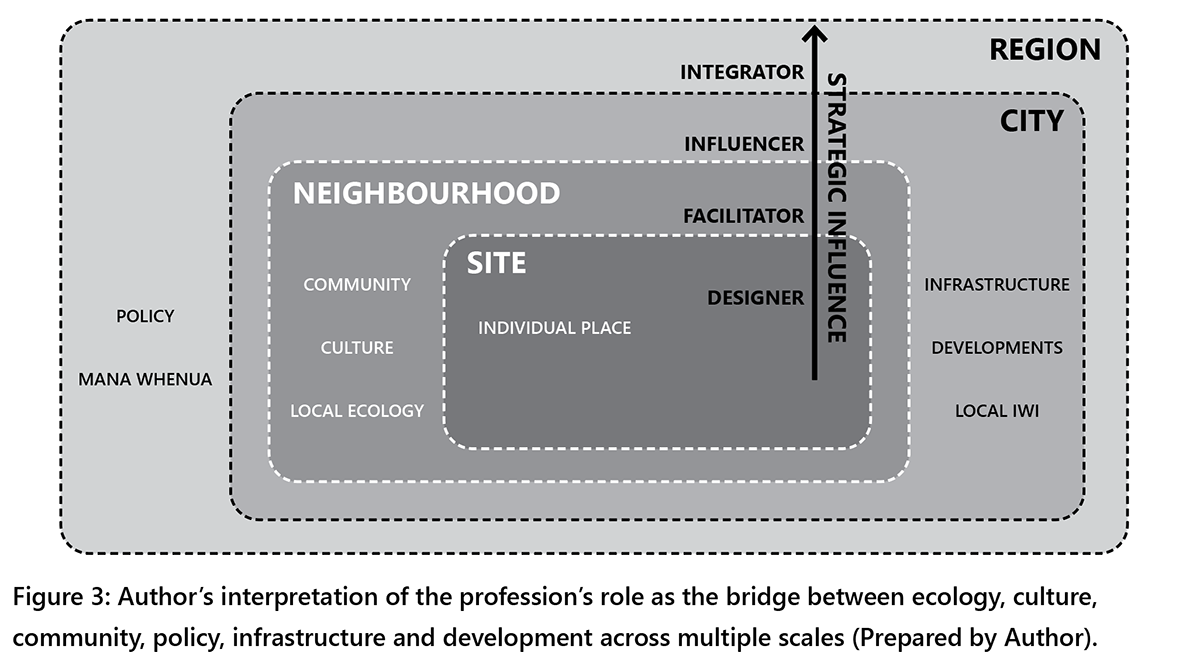
It can be argued that this potential distinction lies in connecting ecological processes with how people actually experience the place, while maintaining an ability to move between physical scales.
Dave Charnley’s career reflects this diversity, spanning landscape architecture, urban design, planning, horticulture, arboriculture and local government. It suggests that the profession’s value lies in understanding how environmental, social and design systems intersect, beyond operating in a narrowly defined territory.
In the coming decades, rather than focusing solely on a single site, landscape architects may increasingly be required to understand how environmental processes, infrastructure networks, cultural values and community aspirations interact across regions and cities. Where it hasn’t already, their role may increasingly extend towards shaping the conditions in which positive outcomes can emerge.
This does not mean the profession will cease to design. Rather, design may increasingly operate as one aspect of a broader role of negotiation, evidence, engagement and strategic coordination.
Dave Charnley’s evidence for Palmerston North’s medium-density housing plan change (PCI) illustrates this in practice.
Responding to the National Policy Statement on Urban Development, his landscape evidence embedded specific standards, including site planting and permeable areas split into front, rear and mandatory specimen trees, written directly into the rules developers must comply with. This is a working example of the “designer to integrator” shift this essay describes. The influence is not exercised through refining a design after the fact, but through shaping the regulatory conditions under which future development within that spatial area or zone occurs.
There is also the fact that digital tools and Artificial Intelligence (AI) are increasingly being used to accelerate aspects of drafting, visualisation and option generation.
Dave’s own use of AI illustrates both its value and its limits. When a colleague on the infrastructure team needed quick low-cost ideas for a street where cars were parking on the kerb, he used an AI tool to generate a conceptual image from a photograph of the site, adjusting it over several prompts before presenting it as a discussion starting point. He is clear that AI cannot be treated as a source of finished answers. Similar to an initial draft, its output has to be questioned, tested and fine-tuned utilising the practitioner’s own grounding in design principles.
Graduates who understand landscape architecture’s fundamentals, in other words, will be able to direct AI more critically than those who do not.
Tension: The Battle to Be Heard
The emergence of the landscape architect as an integrator is not inevitable.
While the profession possesses many of the skills required to navigate complex environmental and social pressures, its ability to secure a more influential role relies on whether it can overcome longstanding barriers to recognition and influence. The visibility problem does more than limit recognition: it leaves the door open for others to step in.
As long as landscape architects remain publicly associated with planting design and open space alone, adjacent professions have little reason to make room for them at the earlier strategic stage of a project, which is the very point at which Dave believes landscape architects have a lot to contribute.
To echo Josh Hunt again, communicating that value more persuasively to decision-makers, clients and the wider public is therefore a defence against losing the capability to contribute.
Future influence therefore rests not only on retaining a strong role in smaller-scale design, but on demonstrating a distinctive ability to connect environmental, socio-cultural and physical considerations within larger strategic decisions made across disciplines.
In his contribution to the book Garden and Metaphor: Essays on the Essence of the Garden (Birkhäuser, 2024) Carl Steinitz notes “sometimes we will lead, and sometimes we will not … We must not allow the profession to become limited by the scales and scope of its competences.”
This suggests the profession’s future lies less in leading every process and more in contributing a distinctive perspective wherever complex landscape decisions are being made.
By 2051, the most influential landscape architects may no longer be recognised primarily for the sites they design, but for the systems they help shape through this distinctive perspective.
The rise of interdisciplinary practice also creates a paradox. If integration becomes the defining capability of landscape architecture, but adjacent professions increasingly claim the same capability, the profession cannot rely on its interdisciplinary approach alone to justify its future relevance.
Its best point of distinction may instead lie in the particular lens through which it integrates knowledge: one that connects ecology, community, culture and place within larger strategic decisions of development. The profession must also confront an ongoing question of identity. As landscape architects expand into policy, strategy and leadership, they must articulate a clear purpose while retaining the flexibility that has long defined their practice.
The challenge is not simply to gain a seat at the table, but to demonstrate why that seat matters.
Holding the Threads Together
The transition from designer to integrator is not guaranteed. Landscape architects must continue to strengthen their visibility, demonstrate their value and secure greater influence within the processes that shape towns, cities and regions.
The profession is certainly uniquely positioned to respond to these challenges because of its ability to understand relationships between ecology, development, culture and community across multiple scales of decision-making.
Reflecting on the insights I gained from Dave Charnley and wider related reading, I’ve concluded that the profession’s long-term value may not be determined by what it exclusively owns, but by what it is able to connect.
The integrator is understood not as a new professional title but as a mode of practice in which landscape architects are the bridge between ecological processes, cultural values, spatial conditions and development priorities across multiple scales.
By 2051, landscape architecture is likely to remain a design profession, but its most influential practitioners may operate earlier and across a wider range of decisions than today, contributing to policy, strategy and interdisciplinary governance in addition to designing places.
As Dave Charnley put it to me, the profession’s task may increasingly be one of keeping people “married to the natural world”.
Furthermore for landscape architecture to be a discipline that holds the threads together – to move from designer to integrator – it needs to bridge communities, mana whenua and development in a way that no purely technical role can.
Further reading
Editor’s note: For more exact references download a copy of Yash’s original essay here . It was originally submitted for LASC 612 Advanced Practice in Landscape Architecture (Project 2: The Profession) and received an A+ grade.
BOOKS
The deliberative practitioner: Encouraging participatory planning processes. (MIT Press, 1999)
Indigenous Māori knowledge and perspectives of ecosystems, from Ecosystem Services in New Zealand (Manaaki Whenua Press, 2013)
The landscape imagination: Collected essays of James Corner, 1990-2010. (Princeton Architectural Press, 2014)
Landscape as Urbanism: A General Theory. (Princeton University Press, 2022)
Thinking About the Future of Landscape Architecture, from Garden and Metaphor: Essays on the Essence of the Garden (Birkhäuser, 2024)
ACADEMIC PAPERS
A change of plan: Collaborative ambitions meet institutional realities for the Waikato River, in New Zealand Geographer, 78(1) – 2022 | Paterson-Shallard, H., Blue, B., & Fisher, K.
Design in science: Extending the landscape ecology paradigm, in Landscape Ecology, 23(6) – 2008 | Nassauer, J. I., & Opdam, P.
Evidence-based landscape architecture: The maturing of a profession, in Landscape and Urban Planning, 100(4) – 2011 | Brown, R. D., & Corry, R. C.
From fail-safe to safe-to-fail: Sustainability and resilience in the new urban world, in Landscape and Urban Planning, 100(4) – 2011 | Ahern, J.
Green vs growth: The effect of residential intensification on urban tree canopy loss in Christchurch, New Zealand, in Sustainable Cities and Society, 130 – 2025 | Pedley, D., & Morgenroth, J.
Landscape ecological urbanism: Origins and trajectories, in Landscape and Urban Planning, 100(4) – 2011 | Steiner, F.
Multiple Roles of Green Space in the Resilience, Sustainability and Equity of Aotearoa New Zealand’s Cities, in Land, 13(7) – 2024 | Blaschke, P., Pedersen Zari, M., Chapman, R., Randal, E., Perry, M., Howden-Chapman, P., & Gyde, E.