Voting for 2026 Tree of the year / Rākau o te tau extended to 8 July
Voting for the 2026 Tree of the year / Rākau o te tau at treeoftheyear.co.nz opened on Arbor Day, 5 June, and the closing date has been extended to Thursday 8 July.
Voting opened on Arbor Day, 5 June, and the winner will be announced on 5 July.
This year’s contenders are:
Ancient Pūriri (New Plymouth)
Mighty Old Mataī (Macandrew Bay, Otago)
Kissing Tree (Christchurch)
The Bucket Tree (Tawa)
The Sango Survivor (Pukekohe, Auckland)
Old Goff (Hobsonville, Auckland)
This campaign is organised by the NZ Notable Trees Trust, with two supporting partners, the New Zealand Arboricultural Association and Heritage New Zealand Pouhere Taonga.
LAA will be sure to publish a follow-up item on which of our many-limbed friends above is named Rākau o te tau/ Tree of the Year. Past winners can be seen here.
For anyone needing a reminder that trees are a vital component of sense of place, LAA has had permission to reproduce an excerpted chapter from Tree Sense: Ways of thinking about trees (Massey University Press, 2021) written by Jacky Bowring, Professor of Landscape Architecture at Lincoln University.
You can also read, or re-read, our story about Tree Sense and its follow-on companion Capital Trees from March 2026. Earlier this year we also featured the European Tree of the Year results and the passionate connections it generated.
On that note, if you happen to have some recollections or photos of trees that have taken root in your memory and heart that you’d like to share, LAA would love to hear from you at laaoteaora@nzila.co.nz
Tree Sense of Place
by Jacky Bowring from Tree Sense: Ways of thinking about trees (Massey University Press, 2021)
What are those intangible, emotional bonds that tie us to place? Even in the face of disruption, change and threats, our connections to place can form aspects of identity and belonging. Sense of place is increasingly being recognised as a significant component of people's health and well-being.
The significance of place is seen most intensely when people are removed from their familiar landscapes, or when those landscapes are threatened or changed. Changes to the landscape can induce feelings of powerlessness and loss. Some changes are the direct result of human actions, such as mining and urban sprawl. Other transformations result less directly from human actions, such as the impacts of climate change through increasing risk of wildfires, floods and extreme weather. And nature itself is also a change-maker, with natural disasters such as earthquakes dramatically transforming places.
The dislocation of people from place is sometimes termed 'root shock", described by American social psychiatrist Mindy Fullilove as 'the traumatic stress reaction to the destruction of all or part of one's emotional ecosystem. It has important parallels to the physiological shock experienced by a person who, as a result of injury, suddenly loses massive amounts of fluids. The idea of root shock makes a direct connection between people and trees, the distress of people echoing the shock experienced by the roots of plants when they are transplanted and when the changed conditions can be severely damaging. The resonances between humans and trees are fundamental to a 'tree sense of place'.
Trees are a vital component of sense of place, for they 'gather places around themselves. Their roles as part of place range from acting as structural elements — behaving like walls and thresholds — through to being human-like characters and storytellers. The longevity of trees embeds them deeply into feelings about place; they become, as English writer Fraser Harrison puts it, 'landmarks, milestones and other points of reference by which each person can take his or her own bearings in time and place’.
The value of trees is made most vivid when they are threatened or removed, when all of the roles they play suddenly become even more apparent. Greg Moore, chair of the National Trusts of Australia Register of Significant Trees Victoria committee, describes how trees are core to our relationships to place, and that ‘people tend to understand that they're important, even if they haven't articulated or rationalised their attitude'. He adds, ‘Trees are markers and totems in our lives and in our landscapes most of us have some sort of connection with them.’
There are many examples of the way in which the significance of trees to sense of place is made tangible. In Christchurch's post-earthquake residential red zone, for example, the trees structure and enfold the sense of place, even after the buildings have gone. Other types of natural disaster, such as fires and tornadoes, can mean the complete loss of trees, and their absence speaks volumes about their significance for orientation and for grounding in place. Felling or even the threat of felling also intensifies our affection for them.
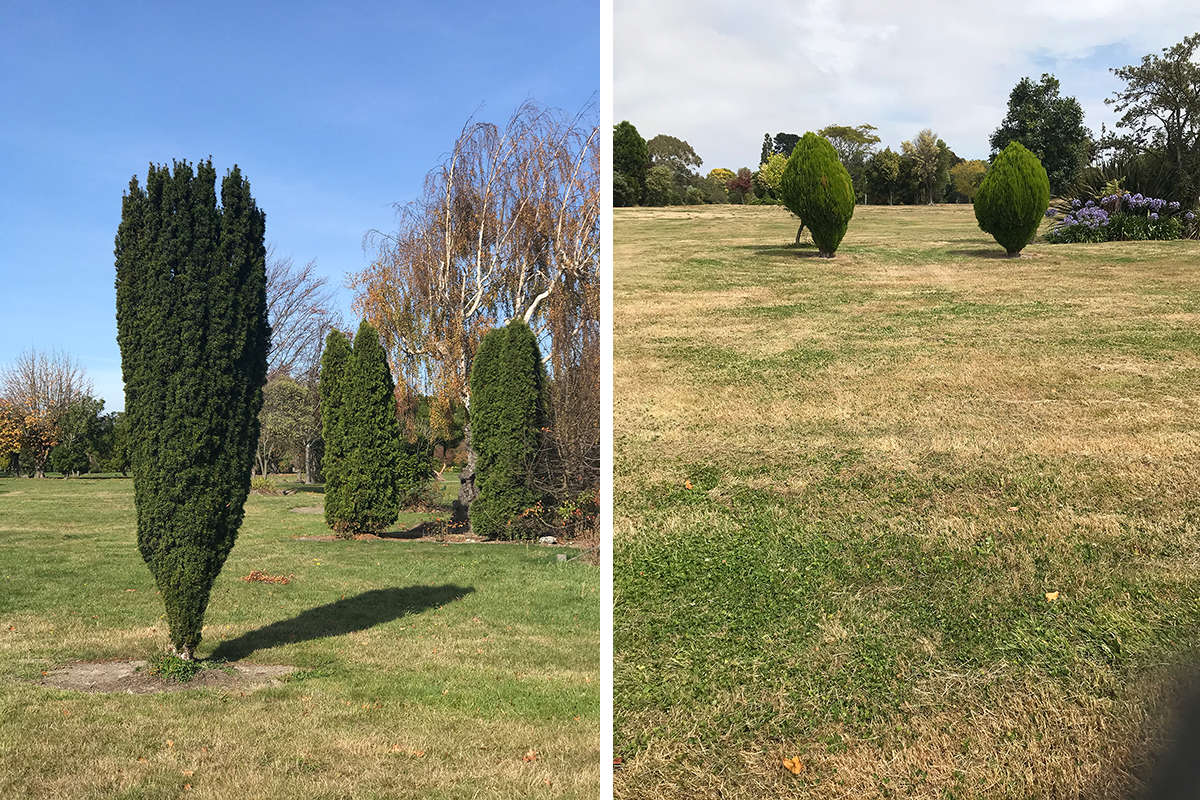
The role trees play in sense of place is, in part, related to the way they fulfil specific functions: to structure space, as something to climb, to shelter under and, importantly, to provide food. Christchurch's 600-hectare residential red zone is a clear illustration of this. The red zone is the result of the demolition of more than 7000 homes following the series of earthquakes that began in 2010, with the most damaging on 22 February 2011. The soil in the red zone is prone to liquefaction, and so large areas of the city's eastern suburbs were ruled no longer suitable for housing. The removal of the homes here created an enormous green park, and intense debates over how the land should be used followed.
The houses were cleared, but the trees remained. They have since been recognised as having important roles; many of them are survivors from domestic gardens, planted for their productive value. An interactive 'smart map' plots the location of a wide range of trees, including fruit and nut trees, and foraging has become a common practice in the city. In recognition of the value of these red zone survivors as food producers, olive, apple, walnut, quince, pear, apricot, almond and peach are among the publicly accessible trees identified on the smart map.
The functional contribution trees make to place is also spatial, as landmarks and shelter. With the removal of built elements following earthquake damage in Christchurch, trees took on the roles of buildings. Artist Holly Best has observed that ‘Trees are shelter and refuge; they reveal our desire for ownership, privacy, territory’. In Christchurch's city centre, too, the trees endured the quakes, while around them 80 per cent of the buildings collapsed or were later demolished as a consequence of the damage they had sustained.
Comparisons were made with cities in war-torn areas — even London after the Blitz — but the defining difference in Christchurch was the trees. Unlike many natural disasters, earthquakes do not significantly affect trees. In 2011, the year of the most damaging earthquakes, a heavy snowfall in July, rather than the earthquakes themselves, caused the loss of trees in the Christchurch Botanic Gardens.
With the buildings in the city centre gone, strange new vistas opened up. City residents found themselves disoriented by the loss of familiar building as landmarks and began searching for street signs in order to navigate; trees began to emerge as significant new markers. Stoically holding their places within the urban landscape, the trees were familiar waypoints.
The remarkable Poplar Crescent was now much more visible, and it seemed to have grown in stature. In Latimer Square, which had been the base for search and rescue teams from around the world during the disaster response, the trees provided a kind of open-air, built form, defining the edges of the spaces and creating large outdoor ‘rooms'. The trees along the Otakaro Avon River provided a green spine that could be seen from afar, providing a pathway and point of reference. Tī kōuka were traditionally used by Ngãi Tahu to navigate through the landscape, and in the post-quake city trees emerged again as an enduring wayfinding system.
Two powerful metaphors contribute to the role of trees in sense of place — trees as buildings, and trees as humans. The metaphor of trees as buildings draws upon their spatial qualities; as architectural proxies trees have a long legacy, extending back to the myth of French architectural philosopher Marc-Antoine Laugier's Primitive Hut as the origins of building. In 1755, Laugier, who was a Jesuit priest, described how ‘Some fallen branches in the forest are the right material for his purpose; he chooses four of the strongest, raises them upright and arranges them in a square; across their top he lays four other branches; on these he hoists from two sides yet another row of branches which, inclining towards each other, meet at their highest point. He then covers this kind of roof with leaves so closely packed that neither sun nor rain can penetrate. Thus, man is housed.’
In Christchurch's red zone the individual sections, or lots, remain marked by boundary plantings, and the grain and scale of humans living in place is very legible. Like Laugier's concept of a building made from trees, here are whole suburbs constructed only with vegetation: paired trees, lines of trees, tree corridors and tree archways, all representing the ways in which trees are metaphorically similar to buildings, constructing a sense of place.
Trees as humans — as us— is one of the most ancient analogies. Trees and humans share temporal and figurative qualities. The life cycles of humans and trees echo each another in a temporal sense, and we sometimes use trees as a datum for our own lives, moving slowly through to maturity. Figuratively, trees and humans both have trunks and limbs, and the resonances are sometimes uncanny, but even beyond these metaphorical dimensions are the comparisons of the characters and temperaments of trees with those of humans.
Japanese master carpenter Tsunekazu Nishioka praised a 2000-year-old cypress tree for its response to place. The tree had responded to its dry conditions by driving its roots down through the rock to get water, and ‘It was precisely because of these harsh conditions that it had lived for 2000 years. It is the same with human beings. If they are indulged... given anything they want, they do not turn out well. Trees are like human beings.’
British sculptor Andy Goldsworthy echoes this shared connection between humans and trees, recounting: 'One of the most powerful images I have of New York was staying in a hotel on Broadway. My room was high up in the building, I think on the 17th floor. I looked out of the window of my room and I saw a tree that had seeded itself, growing out of the side of the building opposite. It was for me a potent image of nature's ability to grow, even in the most difficult circumstances.’
The metaphorical image of the resilience of Jews during the Holocaust was the inspiration for Goldsworthy's memorial at the Museum of Jewish Heritage in New York, where he planted trees within hollowed-out boulders.
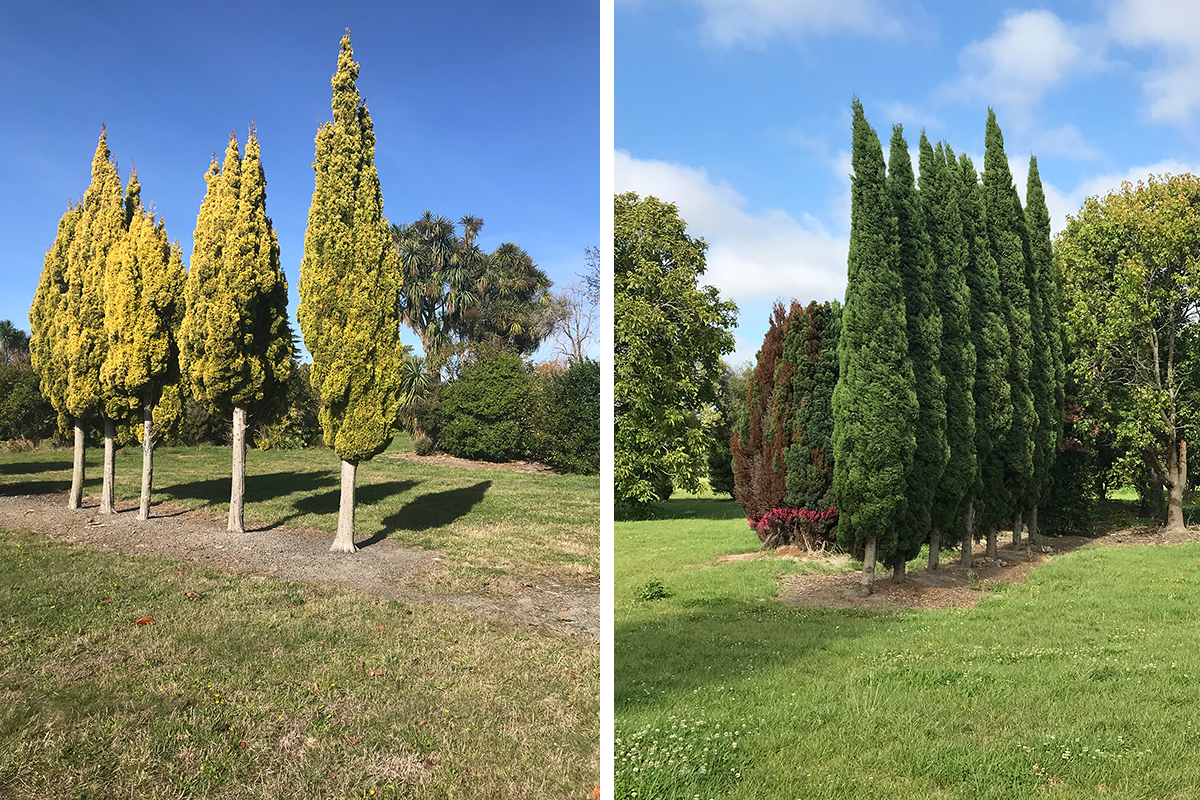
Trees are sometimes conceptualised as observers or witnesses of the landscape, emphasising their sentience. As journalist Will Harvie has written of his wanderings through Christchurch's abandoned and vacant eastern suburbs, the trees have witnessed the area's evolution: ‘The trees were the great gift of the red zone. Off Fleete Street, in Dallington, a proud pair of willows dominated the landscape. Nearby, a delightfully pruned conifer was witness to decades of care by somebody. Way north in Brooklands, gum trees were so large they must have been planted long ago by farmers. In Kaiapoi, an elm shimmered lime green in a pleasing sunset and slight breeze. Everywhere were clumps of cabbage trees’.
Trees are containers of meaning; they hold the narratives of place. Across the red zone, the patterns of trees tell small, intimate stories of the streets and neighbourhoods: avenues, twinned trees marking gateways, the trees of churchyards where the church has gone. Some trees have what look like the graves of pets at their bases.
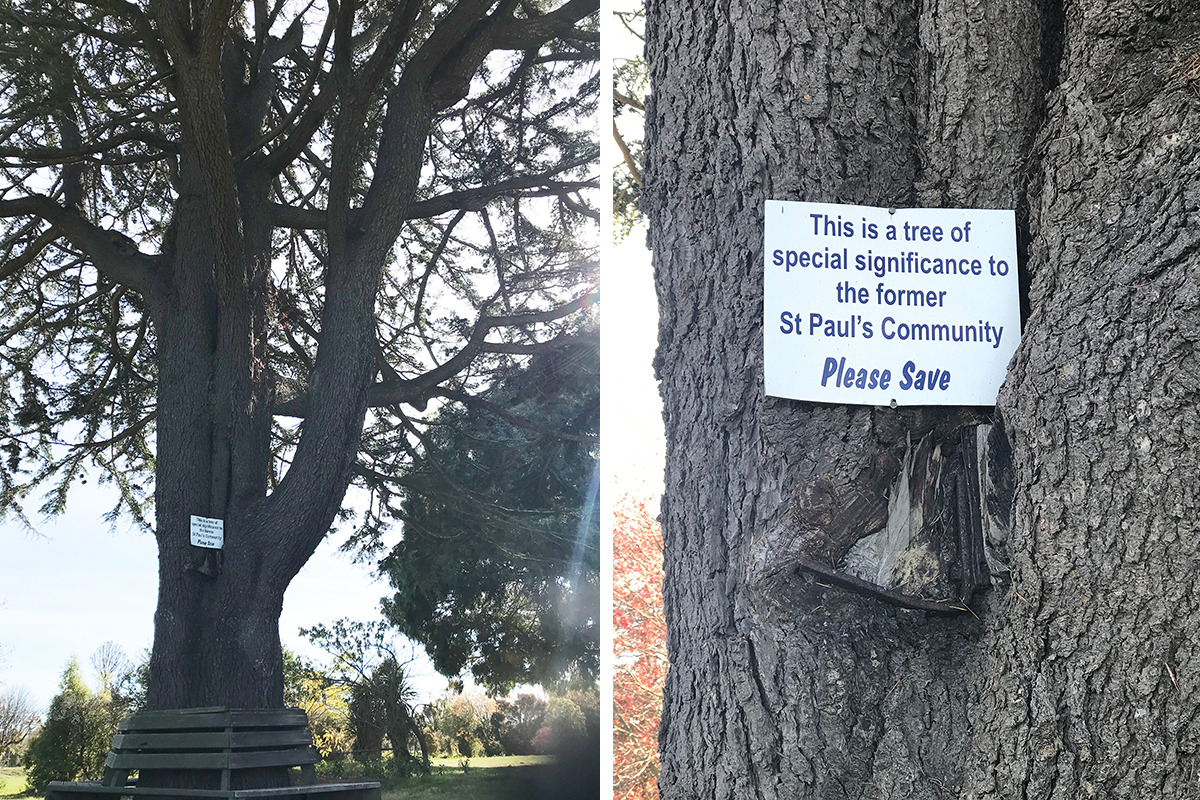
A blog on the suburb of Dallington, one of the areas most affected by red-zoning, recalls the cedar tree that stands on the grounds of what was St Paul's church and school. It now stands alone, and the writer, anthropologist Annette Wilkes, comments how the tree is: ‘A place to stop, sit and contemplate. This iconic tree is important to the St Paul's community and to Dallington as a whole. To me it represents a tangible link to our past, to the many thousands of people in our community who spent parts of their lives on this site, learning, celebrating, spending time together. It remains to anchor our memories when the bricks and mortar of buildings cannot.’
The interwoven narratives of people, place and trees are emphasised by the trees at St Paul's, which include a legacy of the 1980s, when the school's pupils were amongst those who celebrated Arbor Day with tree plantings. Many trees surviving on this site were planted and tended by young children who are still watching them grow.
Wilkes, a former resident of Dallington, is one of the so-called Quake Outcasts who battled authorities and insurers over the red-zoning of her property, which she felt was unjustified. Her family had deep roots in Dallington, going back to 1884, and the place is part of her identity. In particular, she had close bonds with two memorial trees: one marked the place where her dog was buried and the other, a tōtara, was a memorial to her father. Wilkes was an active voice in trying to retain the trees as an important part of the red zone's identity.
She noted that her perspective as a social anthropologist meant weighing the trees in a very different way to the red zone arborists, who were evaluating them according to their stature and proportions as they made their decisions about which trees would be retained.
The potency of trees as storytellers is also recognised by artist and writer Simon Palenski, who described a visit to his father's red-zoned property in the east of Christchurch: 'Standing out in the open, where our yard used to be, he gave me a rundown of each tree and when he had planted it: paperbark maple, tarata Lemonwood, houhere lacebark (his pride and joy)... When my parents left this house, they took from their garden whatever they could dig up and replant at the new one. His trees had to stay.’
For her Master's research into how the experience of the earthquakes impacted residents' sense of 'home', Kelli Campbell carried out 29 interviews. Participant 24 in Campbell's research describes the trees in the red zone as 'markers', and how it was the trees that maintained a sense of connection, a tethering to place once the house was gone: ‘My dad lived five houses down and... he has a bıg karaka or something and so his house has gone now... all that is left is that [tree] and that is the reference point now and there is no other geographical reference point now. There is just that big tree, and me and my sister were even talking about it the other day that we are going to have to realise that the two cabbage trees are the fence line [to his home] on that side and the beech tree if it still stays there is... where the garage was. And you know everything else will be gone.'
And Campbell's Participant 18 recalls: ‘Hopefully when they get rid of all the other houses [in the red zone] they will just smooth the land out around the trees that were there and make it a big open reserve and let people wander through and go "Oh, my apple blossom is still there" ... I had an apple blossom and it was beautiful... [W]e got it when it was small and it cost us a lot of money and I am hoping when they knock the house down that they don't kill the apple blossom and the other trees... [W]e had in around our place some beautiful rhododendrons and camellias and things and they are getting really big and I hope that they would leave them there. Just remove the fences and then let the people of the town enjoy some of those expensive trees that people had in their yards. It would be lovely to wander through.’
Attachment to place is fundamentally about an emotional bond, and bound up with this is the role trees have in the sense of place. The emotional bonds and affection for trees are vividly displayed when people are wrenched from their homes and from their tree sense of place, or when the trees are threatened. The loss of trees in North Carolina during Hurricane Hugo in 1989, for example, was devastating. A local journalist wrote, ‘Next day, driving around town was like going to a friend's funeral', and others echoed that it was like the 'death of someone close'.
In Christchurch's residential red zone, plaques have been placed on trees by those who used to live there. These markers are moving, emotional illustrations of how important it is for people to feel rooted in place and how they try to hold on to those roots even when they are displaced.
Our high emotional investment in trees often comes to the fore when they are endangered. Following the signing of a new road-maintenance contract in 2012, up to 36,000 mature street trees in Sheffield, United Kingdom, were threatened with felling. There were protests by locals, and some were arrested. The episode was examined by Matthew Adams, a psychologist who writes on environmental and social issues, who suggested that the fate of the trees illustrated a blunt financial approach by the authorities: 'Chopping down trees and replanting saplings elsewhere is apparently a lot cheaper than looking after mature trees and working around them’.
The threat to the Sheffield trees revealed the long-held and deep attachments locals had to them. Their powerlessness to stop the felling was intensified by emotions of loss and grief, and they compiled tree stories' to express their feelings. One campaigner, Joanna Dobson, described street trees as 'quotidian landmarks', but those same familiar and ordinary quotidian qualities can mean that trees can easily be taken for granted. ‘To rip them out, as our council is doing, is to destroy not only the tree, but also something profoundly important to the identity of our city and to those of us who call Sheffield home, Dobson wrote.
The loss of trees in a landscape can erase the sense of place. When a hurricane in 2011 wiped out the urban forest in Joplin, Missouri, it was the end of 'the everyday landscape that refreshed residents on a daily basis and contributed to a local sense of place’. When a tornado hit Goderich, Ontario, in the same year, many of the mature trees that helped make Goderich 'Canada's prettiest town' were lost. Locals spoke of how devastating that loss was, how ‘it does something to your soul, to be in this place when it's so smashed. And part of the thing that is missing is that - it was the trees.’
Groups soon mobilised to replant them — to 'self-advocate, initiate, and accomplish as much as we can to heal our landscape'. Trees were seen as a vital part of a ‘reorientation' strategy that responded to the disorientation within the town and the damaged sense of place and well-being their absence caused. As testament to the significance of the therapeutic aspect of trees and of place attachment, geographers Amber Silver and Jason Grek-Martin have explained how, in Goderich, 'the monument erected to commemorate the one-year anniversary of the disaster was cast in the form of a broken tree showing signs of regrowth'.
Greening is a recognised therapeutic aspect of rebuilding after disasters. Both the physical experience of working with nature and the mental benefits of doing so underlie the ways in which trees can help us get over things. The research of anthro-ecologist Keith Tidball illustrates how the act of planting brings positive outcomes and can re-establish place. Following Hurricane Katrina in 2005, the trees of New Orleans came to hold strong symbolic significance ‘contributing to identity and sense of place’.
The trees of Christchurch's residential red zone have offered their own quiet therapy steadfastly maintaining the pattern of the cultural landscape now that there are hundreds of hectares of vacant land, their familiar forms offering some solace. In other red-zoned areas of the city, trees have played more active roles in the well-being of residents, in some cases protecting their houses from rockfalls during the earthquakes or providing shelter in the aftermath.
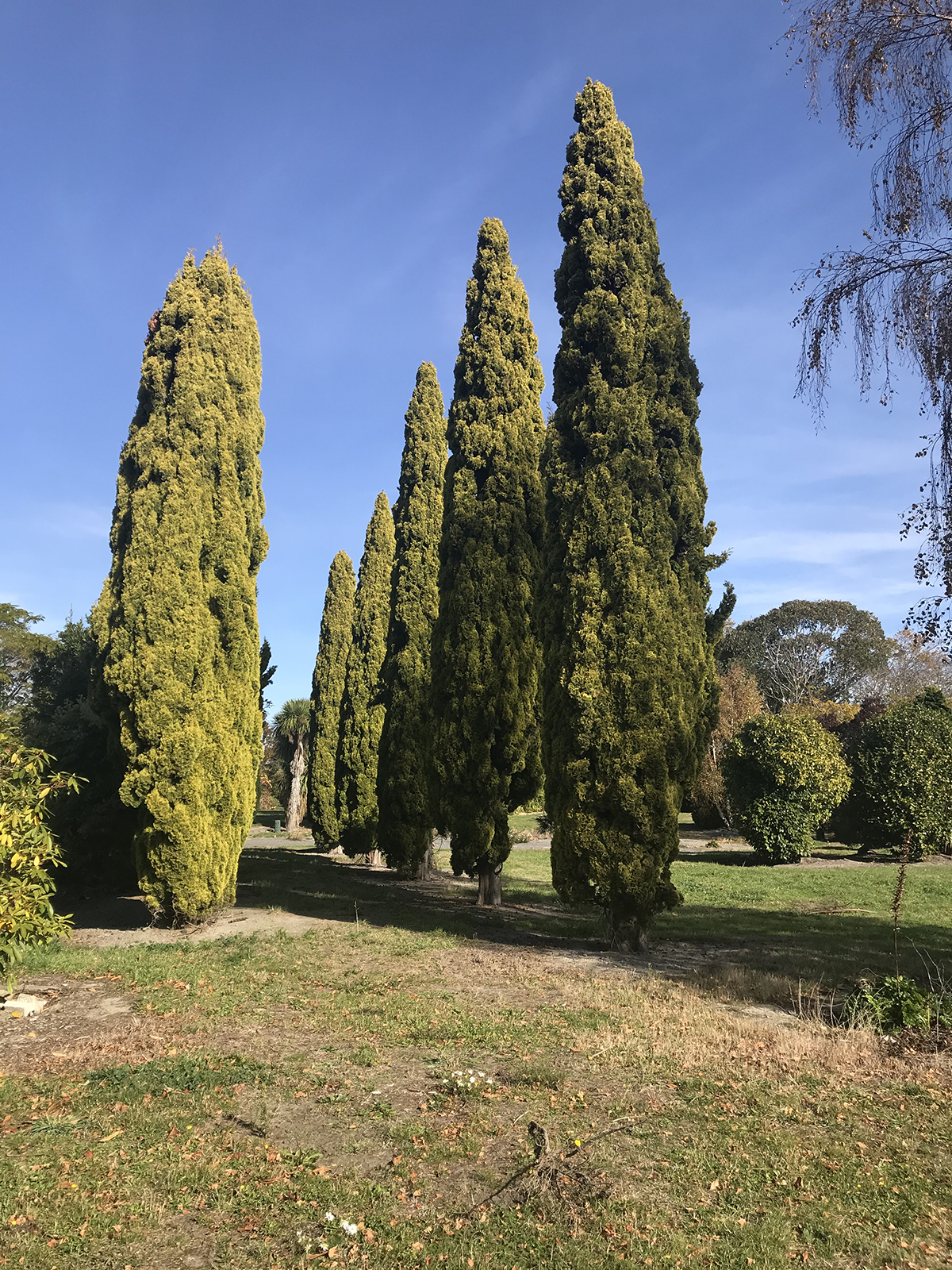
The intertwined nature of trees and place ties an emotional knot that binds us to landscapes. Sense of place is the rooting of meaning within a location, and with that our sense of familiarity, identity and belonging. Trees are a vital marker within this. As geographers Paul Cloke and Owain Jones have explained, ‘Trees can construct places and vice versa. Many of the attributes of trees form common currencies in our understandings and appreciation of place; their size, rich materiality, their interconnectivity, their life cycles and seasonal cycles all offer qualities which are readily and vividly drawn into... concepts of place'. This construction of place includes the functional, metaphorical, narrative, emotional and therapeutic roles that trees play.
While decisions are made about what to do with the land, the fate of the red zone trees in Christchurch remains in the balance. Planning for the zone's future involves a range of scenarios. Holly Best has described how ‘Trees where they naturally belong are growing strong but are vulnerable to the city's Plan — waiting to be bestowed with the plastic tape allowing them to stay’.
In Sheffield, 5500 trees had been felled by 2019, when the programme was halted in the face of the protests. Writing about the event later, Matthew Adams observed that ‘Collective resistance and articulation of loss and melancholy also appear to have revived localised, creative expressions of love of place and reminded residents of the value they place on trees and our more-than-human companions’.
Tree sense of place embraces how trees contribute to making places — how they become indispensable parts of our familiar environments and the objects of our affections. Trees offer practical, functional contributions to the landscape, they feed us and they shelter us. Storytellers, they embed the narratives of place as markers and totems. Trees resonate with our sense of place, our feelings of home and even with our selves.
Editor’s note: A full set of footnote references and recommended reading for this excerpted chapter is available in the physical book.