From Wānaka to Aitutaki and back again: Pacific co-operation kicks into action
by Garth Falconer, Reset
Long called a ‘Jewel of the Pacific’, Aitutaki is a small chrysalis shaped island set amongst a luminous turquoise lagoon fringed with a series of small motu.
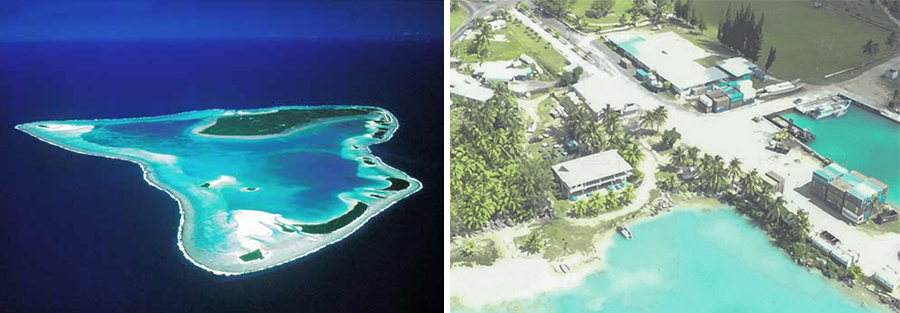
Lying 240km north of Rarotonga in the Cook Islands, this fragile island ecosystem is increasingly exposed to the pressures of growing visitor numbers and dependency on imported foods and goods.
In response, the Aitutaki Island Council/ Government in 2020 commissioned Reset together with the late Romani Katoa (1932-2025), a local architect, to compile via an extensive public engagement process Te Papa Tau O Araura, the first Spatial Plan for integrated planning and development of the entire island.
Addressing environmental degradation was a key priority and it was identified that the island’s waste management was in need of huge improvements. The waste recycling scheme in place had residents dutifully separating their plastics, glass and aluminium waste but unbeknown to most it was all dumped together in a large landfill hidden away down a dead-end road. With the landfill liner broken, contaminants were leaching into the subsoil. Other approaches had to be looked at and urgently.
Grassroots work
We only had to look as far as Aotearoa New Zealand for best practice exemplars, in the form of Wānaka Wastebusters and their great grassroots work to minimise waste through a community-driven approach to reduction, reuse and recycling. Formed in 2000 as a charitable trust, the high-energy social enterprise is a proud Lvking Wage employers wityh a staff of around 50, turned over close to $4m per annum mainly from the sales of used goods and had reduced landfill by over 50%.
From a highly conspicuous recovery centre and website Wānaka Wastebusters had developed networks and partnerships with businesses, ran constant events and education schemes to raise awareness and build community skills. They had formed a viable business that demonstrated it was possible to work towards sustainability through waste minimisation. They published audits and their results annually to show progress and to develop confidence in their quest for zero landfill and zero carbon.
Taking stock of working in Pacific countries as a designer is, I feel, both a privilege and a responsibility. So with no budget available I held a charity exhibition of my oil paintings of landscapes to raise funds to commission Wānaka Wastebusters to form a report, to be shared with their recommendations.
Hearteningly friends and business associates stepped up to help and the newly elected Mayor of Aitutaki, Nick Henry (grandson of Sir Albert Henry, the first Premier of the Cook Islands), was super supportive and arranged further sponsorship. It took over a year in preparation, and then in November 2025 I returned to take the story of Wānaka Wastebusters and their experiences back to Aitutaki.
A reality check and the response
The quick reality check on waste management is that the Cook Islands like many Pacific island nations faces huge challenges with a small farflung population and increasing reliance on imported processed food and goods. Clothes are used until they are threadbare, whilst parts for appliances are non-existent and plastic non-compostable nappies are a big waste component. There is no container return scheme in place and governance is split among several agencies.
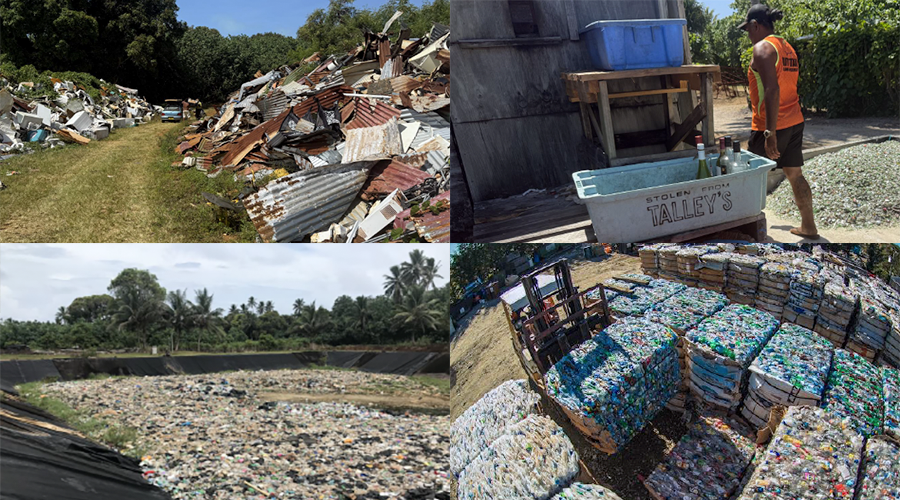
Back on Aitutaki, I met with the supervisors of the waste facility, the National Environment Service and the Island Government. Discussions were very open with a realisation of the enormous task. Together we toured the waste facility to witness diggers compressing the unsorted waste to extend the life of the landfill a few more years past its design life which expired in 2024. In the five years since I last visited the mounds of metals had grown into ominous mountains, most equipment was in poor condition and budgets woefully inadequate.
The Island Council appreciated the tailored recommendations drafted by Wānaka Wastebusters and its suggestions that Aitutaki should form a similar social enterprise, with a purpose designed recovery centre, a focus on reduction at source and extending an education programme - especially to the young.
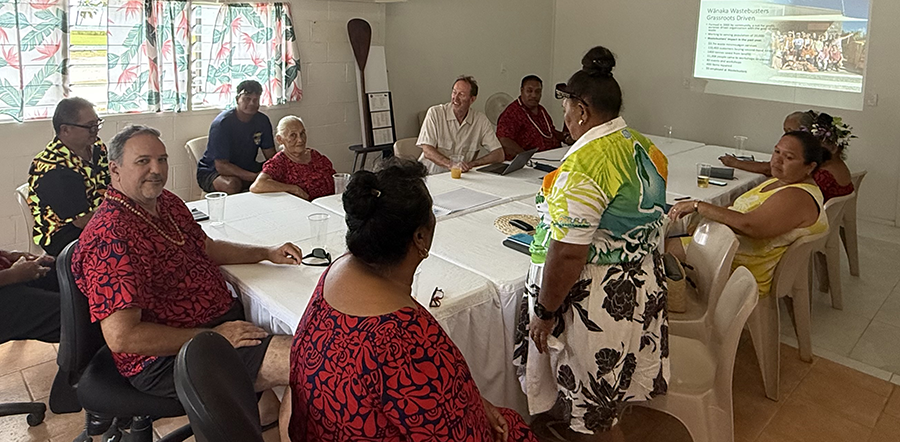
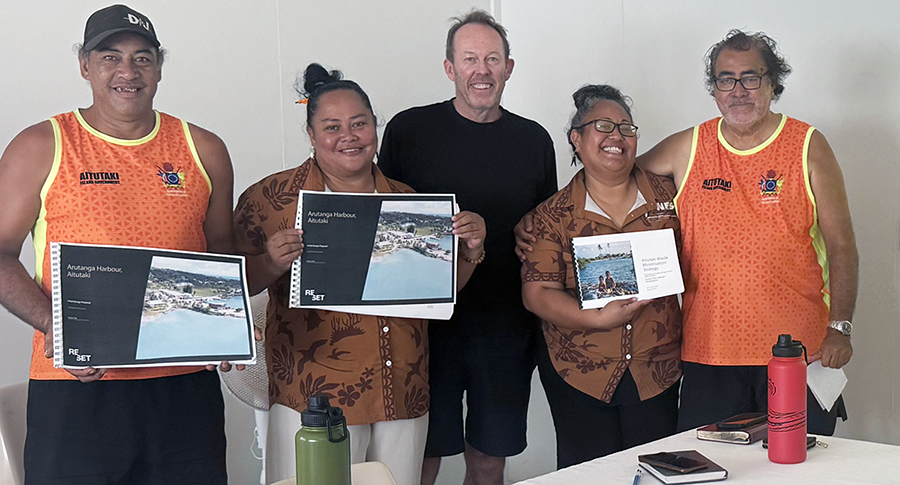
Garth Falconer (above centre) at meetings that have taken place in Aitutaki.
The discussions at the Island Council have started with a focus on going forward with a range of quick wins. They identified several do-able measures to be developed including repairing the landfill liner and restricting the entry of glass beer bottles in favour of aluminium cans which could be coordinated with the island’s hotels. The legacy stockpiles of metals have been separated with a plan to stack these into 6 metre containers and shipped offshore to specialised recycling facilities.
Following on from the assessment last year, the Island Government has implemented several measures, including a reduction of fire risk by compacting and covering all existing waste with a layer of soil and installation of pipes to help emit the methane build up. Cardboard, deemed to be a fire risk, and compostable waste is currently not being accepted.
“Garth’s visit and report created a sense of urgency for us. For decades our ‘dump’ has been out of sight out of mind. It was with confidence that I was able to take our Prime Minister Mark Brown to visit the Aitutaki recycling centre in January this year to see the young people sorting, recycling and reusing to save our island” - Mayor Nick Henry.
The team has created sorting bays for plastics, aluminium and glass. A small glass crusher is now working and local builders are accepting this crushed glass as aggregate or fill in domestic foundations. Also an aluminium can crusher is back in action and cubes of aluminium are being stored for shipment overseas. The Island Government is currently looking for a plastic shredder to reduce plastic waste and prepare this for shipment.
Executive officer Paepaerei (Junior) Pauka has amended the organisational structure and allocated an additional four staff at the Aitutaki recycling centre. In addition waste collection around the Island is happening three times a week.
Whilst just another step in the journey this humble initiative is also exploring an exchange programme being established between Wānaka and Aitutaki where two employees from Aitutaki could go to Wānaka to work for several weeks, to bring back further lessons and to really build on this reciprocal relationship.
The big picture, all agreed, was the changing of values to move from a linear process to a circular system and economy which would enhance and respect the environment.
Nick Henry adds: “To further this point we now have a ‘pick a part’ area of the recycling centre, which includes bicycles, whiteware appliances, and vehicles. In recent weeks we had an Island wide clean-up to reduce mosquito breeding spots and this resulted in old whiteware and vehicles in backyards being collected and sorted at our recycling centre”.
This cross-exchange of best practice and support across nations, and particularly in the Pacific, is where the good work of design in its widest sense can demonstrably excel.
See also:
Reset Urban Design wins two IFLA awards (LAA, September 2022)
Securing the wellbeing of an island paradise (LAA, March 2022)