The LAA book column: No Place for a Tree?
Landscape Architecture Aotearoa continues its occasional ‘book column’
with an appreciation of Susette Goldsmith’s Tree Sense (2021) and Capital Trees (2025).
[Similar contributions from LAA readers are welcome to laaotearoa@nzila.co.nz ]
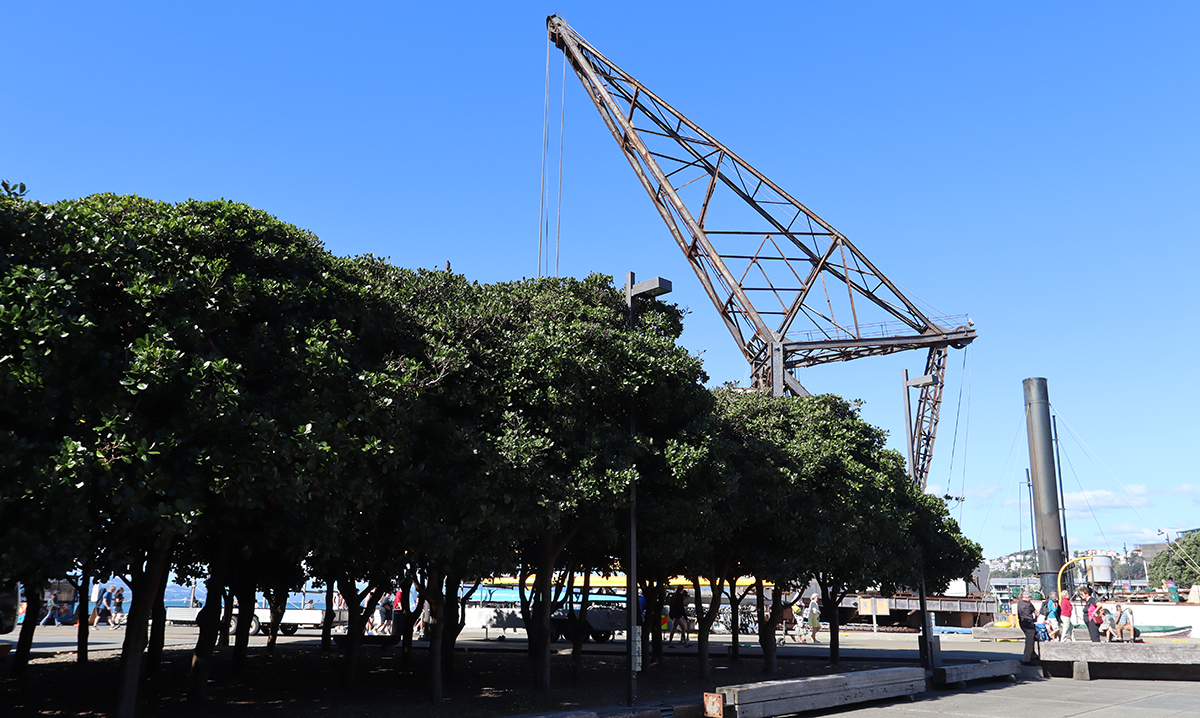
"Picture a typical city wharf: robust, flat, barren, grey, essentially concrete. A utilitarian site, once an instrument of shipping, a restless, risky platform of loading and unloading, comings and goings. Now a foot and cycle route - sea to city, city to sea. Exposed to sun and wind, salt laden. No room for nature: no place for a tree. How is it, then, that Wellington's Taranaki Street Wharf is home to a thriving grove of leafy karaka? Why are they there? Whose idea was it? What do they mean?"
So opens the closing essay in Tree Sense, a miscellany of genius loci contributions conceived of by Susette Goldsmith and published by Massey University Press.
Appearing as it did during pandemic times there is a sense that Tree Sense is still finding an audience for its arboreal assemblage of compelling content.
This ranges from a poem by Elizabeth Smither to the photographic resonance of Anne Noble and to well-woven essays penned by landscape architecture professor Jacky Bowring, plantsman Glyn Church, curator and heritage advisor Meredith Robertshawe, prolific author and botanist Dr Philip Simpson, equally prolific NZ Geographic co-founder Kennedy Warne, applied researcher Dr Colin D. Meurk, artist and researcher Dr Huhana Smith (Ngati Tukorehe/ Ngati Raukawa) and environmental activist and advocate Dr Mels Barton - and Susette herself.
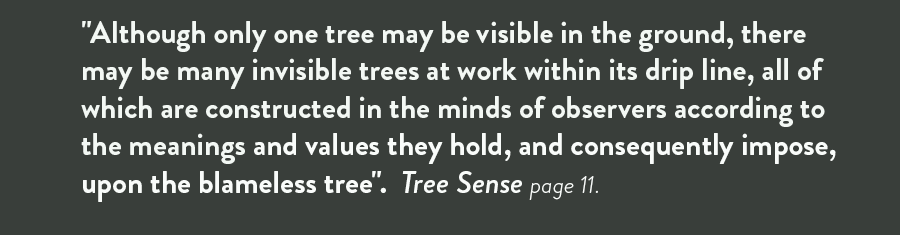
As Susette lays out in her intro to Tree Sense, her deepened sense or lens on trees was grafted into her life in part by events such as a common-or-garden neighbourhood encounter with suburban-style tree pruning and local council reactions.
When Tree Sense took root, Susette envisaged it would fall into two well titled thematic parts - 'Needful Dependency' and 'Greening the Anthropocene' - and so it did. And yet, it also left her knowing there was much more to say.
Hence four years later a sibling arose, Capital Trees, published this time by MUP's sister publishing house Te Papa Press to accomplish a compact duology.
Running to around 250 pages each, the illustrative elements of both books extend the lineage of artwork by the remarkable Nancy M. Adams (1926-2007) - with added credit to designer Megan van Staden - and are accompanied by handy glossaries, highly readable notes and expansive but succinct reading lists.
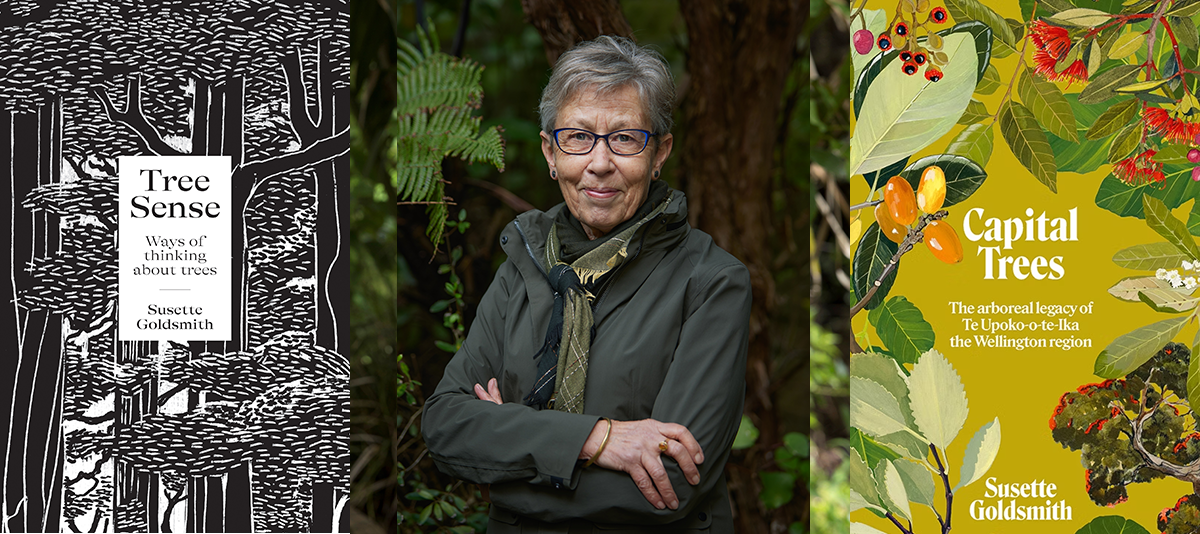
Dr Susette Goldsmith, side by side with her arboreal ‘handbooks’.
When LAA met Susette at Wellington's Bond Street Deli in February to discuss her books, it was no surprise to learn that her enquiring mind has been applied to both secondary school teaching and a career in journalism, leading on to a dedication to bringing non-fiction works to life as an independent editor and writer.
Of Ngāti Māhanga and Pākehā descent, Susette ascended the higher branches of academic research when she successfully completed a PhD within the Museum and Heritage Studies programme at the Stout Research Centre in Wellington, where she is now an Adjunct Research Fellow.
Her accessibly written doctoral thesis, titled Natural monuments: rethinking arboreal heritage for twenty-first-century Aotearoa New Zealand, says a lot about just how deeply her tree-centred lines of interest, enquiry and scholarship have occupied her.
The 2018 thesis abstract notes that "while the acknowledgement of arboreal heritage can be regarded as the duty of all New Zealanders, its maintenance and protection are most often perceived to be the responsibility of local authorities and heritage practitioners".
The validity of the evaluation methods currently employed in the tree heritage listing process, tree listing itself, and the efficacy of tree protection provisions are questioned, and a multiple case study presented of discrete sites of arboreal heritage that are all associated with a single native tree species, karaka (Corynocarpus laevigatus) - in Te Awanga, Hawke's Bay, the Massey campus in Palmerston North and Brooklands Park, New Plymouth.
A timely commitment
In their own ways bothTree Sense and Capital Trees have stemmed from the actionable kaupapa of this thesis, and amply show the timely commitment Susette has brought to gathering together many different angles on the living heritage of the trees of Aotearoa.
In Capital Trees, she reveals layers of knowledge that are grounded in the city/region level of Wellington. Whether you're a layperson who has never heard of 'fake native trees' or a landscape architect who might well be in like-minded accord with the notion of trees as placeholders of national memory, it is a diverting, engaging and educative pleasure to read.
Books that hero trees - their hidden life, their songs, their social life, their meaning and power - have been flourishing here in Aotearoa and internationally.
In her bespoke work, Susette is hopeful that there can be a recognition that trees need all the support they can get. She would encourage emergence of other similar books, and is especially keen on advocating for groups of people who could join regional registers for banding together to protect trees when and wherever they are at risk; people with influence such as planners, lawyers, botanists, landscape architects and enthusiasts.
Capital Trees closes with a monumental pātai to heed:
Could we, in the face of our current existential crisis and the contemporary challenges of densification, infill, urban renewal, and development, shift the dial and individually and collectively take a more proprietorial view of our Capital Trees beyond the rules and requirements of officialdom and fiercely protect what we already have? I like to think so.
Long may Susette Goldsmith’s love for the karaka abide, and long may she have her head in the trees!
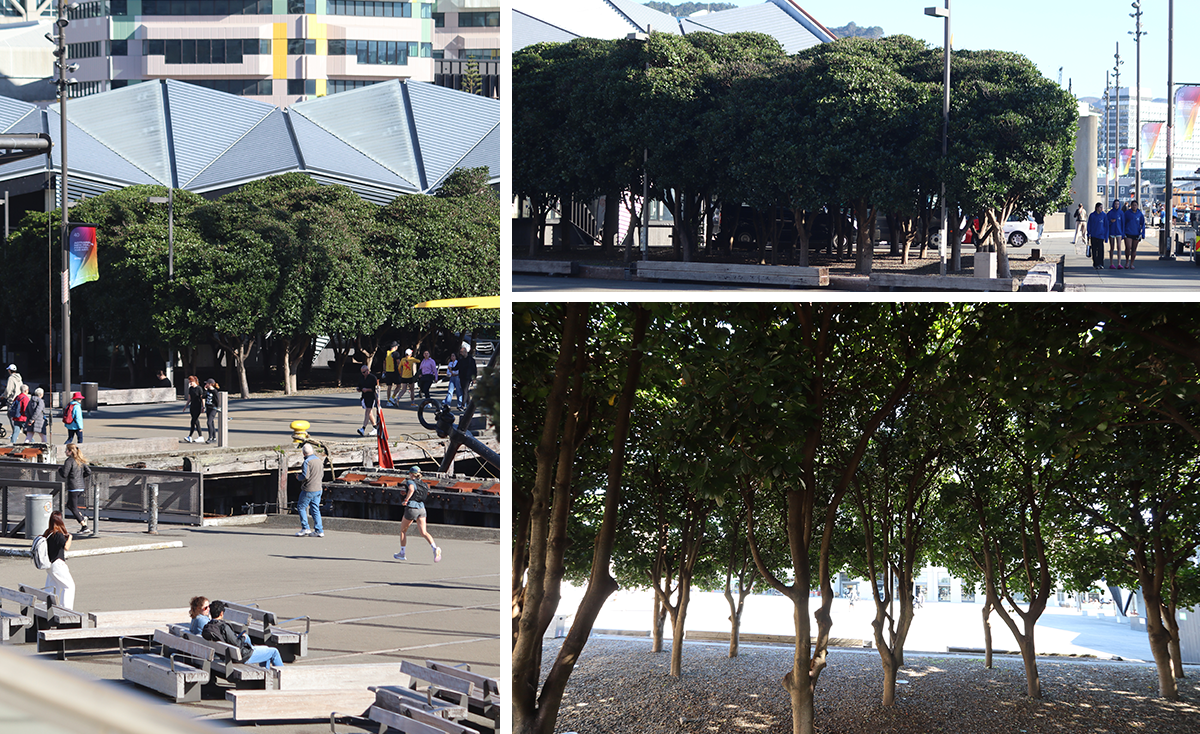
Photo montage: Stephen Olsen
Footnote: Amongst the natural and social histories scribed by Susette are The Gardenmakers of Taranaki (Ratanui Press, 1997), Tea: A Potted History of Tea in New Zealand (Reed Publishing, 2006) and Suzy's: A Coffee House History (Quill, 2010). As well as contributing articles and regular columns for diverse publications, she has edited numerous museum, art gallery and scholarly books, essays and monographs, including The growing world of Duncan and Davies: A horticultural history 1899–2010 (Sir Victor Davies Foundation for Research into Ornamental Horticulture, 2011) by Alan Jellyman.
See also: