Edge Reprised: A long-form read from Landscape Review
This essay by Sean Burke from Landscape Review Vol 21 No 1, guest edited in 2025 by Hannah Hopewell, reviews relationships towards the land-sea interface in the currency of professional landscape practice in Aotearoa New Zealand. With changing climates and failing infrastructure there is urgent demand to repair, yet further, to reframe and reposition how landscape practice engages in such modification. At stake is the necessity for repair to be in service of relationships across the many life worlds past and present that move with and through the coastal edge.
See also:
Edge Reprised
by Sean Burke
I am not a mariner, nor do I draw a living from the sea other than as it relates to my practice as a landscape architect.
On Waiheke Island, where home is, the sea is never far from mind— we smell it, watch it, cross it, play in it – and in that sense, my relationship with the sea is personal and normalised. I write as a practitioner, backed by my everyday experience, and share my reflections from my involvement in a significant edge reclamation project providing resilience and access. The moana of Tāmaki Makaurau Auckland and Te Whanganui-a-Tara Wellington have been a major component in some of my key projects over the last 20 plus years.
In this paper, I consider my relationship to this activity, the acts of seascape modification, hoping for care and intent rather than any wholesale approach. I note the tension between subtlety and deftness in landscape architecture as a design practice. In places, I touch on the technical knowledge held by other disciplines and therefore have positioned these technical aspects as what I know or understand imperfectly rather than as absolutes. I have done the same with matters relating to te ao Māori (the Māori worldview), which I have written about from my limited understanding and interpretation as tangata Tiriti (non-Māori) and have kept my comments at a high level for that reason.
Project discussion
Auckland, it is said, has four seasons in a day, and has been desired for centuries for its fertility and mild subtropical climate. Petone in Wellington, some 600 kilometres to the south, is also subject to ‘four seasons in a day’ weather.
I know this from the many months spent working at the foreshore site office as urban design lead for Te Ara Tupua Alliance, an Alliance formed to deliver Ngā Ūranga ki Pito-One resilience and access project along the western harbour edge. At Petone, the squalls roll through from the Southern Ocean as strong bands of clouds, wind and chop. Sun, rain and sun again, great light and strong landscape, green, blue and grey, the harbour cinematic and powerful. In my opinion, the best view in Wellington is from the navel of the beach – Pito-One – it feels like birth and hanging on at the same time. My father is from Petone, and through him my connection to place and the incidental personal journey this project affords.
From Petone, the outlook to the south connects to oceanic vastness, making the mountain ranges and harbour feel primeval. From this positioning I have a certain sense of the subantarctic islands, though I have never been in the glug of the tide, the curve of the bull kelp in the water, and the smell of the ocean. Wellington, where everything is on the edge and there is a power in it. The ferries battered and bruised by the sea, rust streaks on white hulls, strange plays of scale and light, moving islands of people ever closer and further away, trains and cars buttoned in.
Into a faint opening, we as designers inserted a proposal to solve a resilience and access problem, imagining the fit of new space and utility in a tenuous battle between leap of faith and self-belief. It is not possible, though, to take something from nothing; the trade between land and sea is almost always inequitable, usually in this context in favour of land. In the back of mind are echoes of the past reclamation heyday with an elementary pragmatism that suited colonial utility, or at least its 20th century successor, a blind spot to the impact on the original inhabitants, the creatures and plants of the edge above and below the water and in the air.
There is huge cultural experience on the edge of Te Whanganui-a-Tara – and ‘huge’ as a word likely does not do justice to the lived experience of Taranaki Whānui ki Te Upoko o Te Ika (mana whenua or tribal authority over land). The origin story of the harbour and its Tupua creators is imbued with memories of phenomenal events. The detail of these events is well recorded in a cultural framework and worldview that explains the changes and experiences of the landscape in way that is together accurate and poetic – as I understand it from the outside. As tangata Tiriti (non-Māori), I could be well off beam. This is also true of the annual, monthly and daily phenomena associated with the ocean around Aotearoa, a rich field for designers and artists, but one that others with legitimate ownership of such knowledge are better positioned to share should they wish to.
I enjoy working on the coastal edge; these are the landscapes of my youth but equally are not experiences unique to me as we have in many places – built suburbs on the edge. There is a dynamism in the coastal edge not found elsewhere; tide is a big contributor along with the variability of weather and light. Shifting qualities and the ever-present sense of potential.
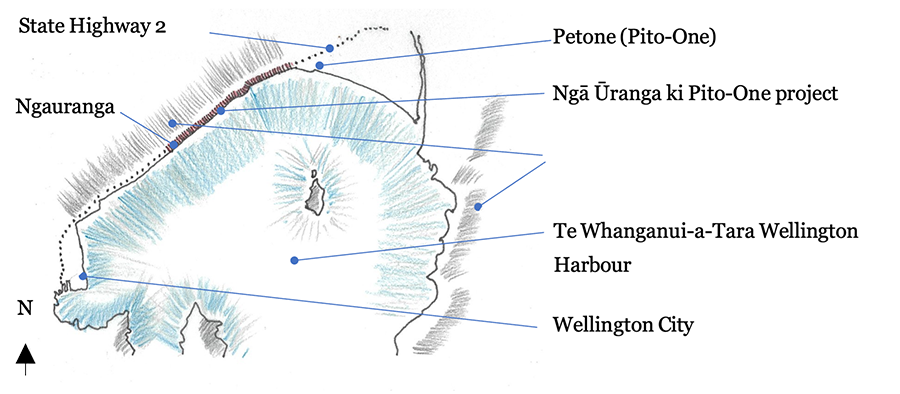
The section Ngā Ūranga ki Pito-One, within the wider Te Ara Tupua project, runs along the top left (west) edge as indicated (sketch by author based on an earlier Isthmus figure, 2024).
The Ngā Ūranga ki Pito-One project that this discussion circulates around ‘reclaims’ a strip of land from the sea, a piece of seafloor not yet uplifted by tectonic activity. Its primary ambition is to protect land not yet submerged by sea-level rise, and infrastructure not yet destroyed by climate change supercharged storms.
The project was prompted by a weather event that in part washed out the commuter rail line. Such a synopsis, however, ignores the strip of life obliterated in the act of reclamation, and presupposes the replacement is of equal quality, in so far as it creates the ability to support life comparable with the former condition. though, to be fair, it is not all high-value seafloor, having been long exposed to sediment and other unwanted anthropogenic influences.
The reclamation also provides for public access via a dedicated path for active transport modes to improve accessibility and safety by providing an alternative to the road corridor. In an urban sense, the project is a game changer, catalysing safe journeys to and from the capital; worthy of consideration, as the granting of consent identifies.
Progressed under the COVID-19 fast track process, the project gained consent for a series of ūranga (buildouts) for rest and gathering, lengths of rock revetment to support the path, and seawalls so the project can avoid cobble beaches and important bird-feeding areas.
Footprint or plan view of the ūranga looked to mimic the form of the adjacent escarpment features to convey a sense of fit and continuity with those landforms. The approach did not, ride roughshod over coastal rock outcrops and underwater reefs, so alignment to the escarpment is not absolute. With ecological input, the proposed ūranga avoid high-value seafloor habitat as much as that habitat could be inferred initially, before it was confirmed with underwater cameras and diver footage.
This process demanded adaptability throughout the design process, including in the detailed design when a stand of bull kelp was identified in a proposed ūranga footprint. After consideration of the issue led to governance consensus, the buildout was moved to avoid the existing kelp and the habitat it provides for other marine organisms. To a designer, that is a simple enough solution, an iteration to refine outcomes when more information is known. The design process is endless, and – to borrow a principle from project management – ending is the hardest part.
Reclamation is to be avoided under the New Zealand Coastal Policy Statement 2010 (part of the Resource Management Act 1991 cascade of policies that manage activities in our coastal marine area), and consent is difficult to achieve. However evolving wave data showed it would be challenging to achieve the natural rock revetment between ūranga within the consented footprint.
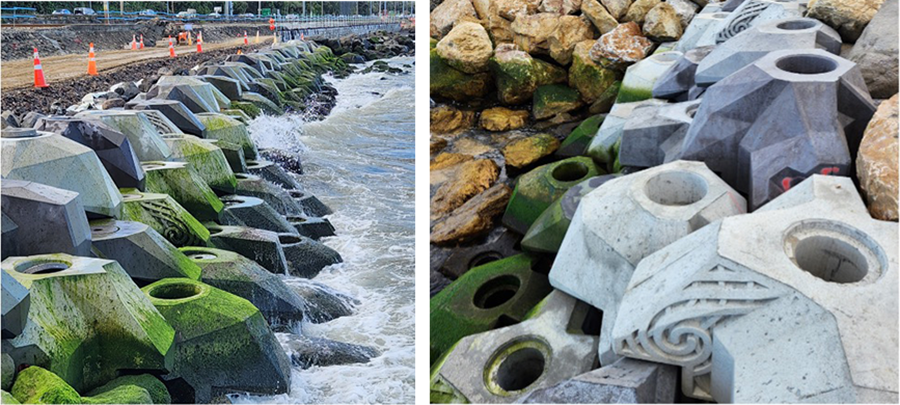
Ecological Xblocs integrated with cultural artwork. While functionally above the tide, the artwork provides an important conceptual link between sea and land for mana whenua (image by author, August 2024).
Another solution was therefore required to avoid the need for further reclamation consents and impact on seabed habitat. The solution was to use modular concrete units developed in the Netherlands, which could achieve steeper slopes than quarry rock, allowing a fit within the consent footprint. Despite this, the fast-track process had not contemplated the form and effects of these units so a variation to the consent was still required, albeit of a lesser nature. In response, a concept was developed to modify the base unit form and colour, adding coastal character (figure 6), or at least approaching an equivalency of sorts with the consented solution of natural rock revetment. The units are not the same as natural rock, yet they do address matters of landscape in offering visual, experiential and perceptual outcomes along with character.
The layering in of biodiversity drew on a cultural narrative proposed by mana whenua, through which their esteemed artist Len Hetet made visible the guardianship or custodial responsibilities that mana whenua have to the sea, the coast and all entities within these environments. This responsibility is real and vital for the project and the relationships therein.
The narrative is understood to refer to the breath of the sea as expressed by the tidal rhythm, and as such to the sea as a living and ancestral entity and source of life and sustenance. Artwork applied through formwork carefully considered negative and positive spaces to enhance ecological value, creating varied niche opportunities to attract a range of species. Thinking grew from the habitat qualities of bull kelp ‘holdfasts’, expressed as running perpendicular to the cultural pattern to create pockets within the concrete of differing depths.
An iterative design process with multidisciplinary review ensued between artist, scientist and designer to get the best fit from all perspectives (Bell et al, 2023). The complexities of construction drove further changes to the design, including shifting of the pattern from the inside to the outside faces so that the formwork could be removed.
Constructor input was crucial; indeed, early solutions undertaken without it were abandoned, even though design in that sense is never really abandoned – just adapted and built on. Prior to progression, the coastal engineer required that ecological and cultural enhancements would not undermine the structural competency of the modular unit revetment. Similarly, it was essential for the ornithologist to be confident that kororā (blue penguins) could easily make their way up under the units to nest boxes at crest level without being inadvertently trapped and killed, with consequences for their breeding and viability in the harbour.
Straddling both land and sea, this in-between space (as above) is important to the cultural narrative, a stitch between the truly sea (anything subtidal) and truly land (above inundation by the tide). There is a gradient across the intertidal zone expected to be colonised by sea life in a multitude of plant and animal forms, from the microscopic level where barely touched by sea spray through to larger and more varied organisms as wetting becomes more permanent. It is an exercise in human care and responsibility for the environment while at the same time extracting a function.
With many collaborators, it can be hard to identify the role of the landscape architect as designer in this piece. Landscape architecture certainly is the stuff of glue, pen holding and creative problem-solving; however, it is clear each collaborator leads for their discipline in terms of expertise, understanding and outcome priorities.
More broadly, the design process and landscape architecture intent filtered by constraints and future proofing can lead to open-ended consequences.
Early pre-consent sections developed by coastal engineers for a resilience scenario included rock revetment benches that are understood to reduce wave impacts. With the addition of natural rock clusters as high points and the introduction of troughs and ‘guts’ such as might be found along a rocky shoreline landscape, sections were prepared over the functional design. Here, considering user perception and sense of fit, the landscape architecture is intended to visually and perceptually work with natural rock outcrops, providing roosting habitat for birds and a resting place for visiting seals. Conceptually it is not dissimilar to earlier constructed work Isthmus undertook for Taumanu Reserve in Auckland but it is applied differently for the different landscape context.
Concerns about the proximity of these structures to the walkway and therefore an entourage of people and dogs – perhaps accompanied by some reticence around constructability – amplified the ecological role over character.
This reflects the priorities under the Resource Management Act 1991, which in my opinion are correct, although, thinking purely of design, somewhat frustrating. These concerns pushed the bird habitats offshore with required footprint and resilience parameters that, while protecting the intent, made subtle execution more difficult.
Nonetheless, where connected to land, the design strikes a balance to avoid a functional cross-section as a singular experience extruded along the ūranga rock revetments. A clustered approach with accent rocks retains the general landscape architectural intent of the concept. Concrete tide pools add to the welcome, ecologically driven outcome and visual richness, along with the possibility of multilayered life. While they are an offset in this design, they hold potential and purpose.
Within this project, landscape architects lent weight to an opportunity to develop an offshore artificial reef to regenerate life in an area of seafloor that is of low ecological value. The inclusion of seafloor as a component of landscape, despite escarpments obviously bounding the harbour, is a hard argument to make without a strong regulatory requirement. A tendency exists outside of landscape architectural practice, to privilege the visual despite its implications for the ‘out of sight’ landscape.
Could the concept of underwater landscape be argued more strongly on an intellectual level? Absolutely. Landscape in the Aotearoa New Zealand context is accepted as physical, associative and perceptual (Lister et al, 2022, p 72). The seafloor is ‘known’ in this way, particularly with intergenerational experience and knowledge. In a similar way, terrestrial landscapes do not cease to exist on moonless nights and can be traversed by muscle memory or the shared knowledge of the group. As a practitioner, it can be a hard to advocate for what seem abstract concepts to others. Nonetheless a successful offshore underwater reef will be a game changer by promoting life in a currently barren area of the harbour while helping with water quality.
For longer-term consideration is the question of whether the artificial reef is valuable ecological infrastructure, given that it adds more human presence and intervention on the seafloor. However, experience in Australia with fish aggregating devices and artificial reefs weighs the outcome strongly in favour of its value and gives confidence in this approach. If its success is proven, it opens the opportunity for using further well-thought-through interventions judiciously and in appropriate locations across coastal zones of Aotearoa New Zealand.
Certainly, the perceptual problem is real and could lead to future removal. Yet the perceptual problem will also diminish with the project’s success, and therefore much rides on it for the future of similar initiatives in this country. Of course, it is no silver bullet, but with improvements to management on land to protect our harbours as receiving environments, and other mechanisms to reduce pressure – such as personally limiting fish, shellfish and crustacean take to a sub-regulatory limit – the dial can shift to better outcomes. In the same way, the support of mana whenua and local government partnership initiatives are important to reduce marine pests and increase biodiversity, as is respect for any marine reserves existing already or created in the future. A large emphasis, I think, is on personal responsibility for building back abundance – not necessarily always involving abstinence but certainly thoughtfulness in the act of taking.
As I write, installation of revetment modular unit sections is under way, and these to high-tide level have attracted a skin of bright-green algae. It feels encouraging as evidence of life, a weathering into place of this intervention on the edge. The designer in me is waiting for any sign that this is the right thing to do and marks the beginning of a broader colonisation of marine organisms across the project. It is understandable that interventions like this are difficult to consent after the reclamation excesses of the past. Conversely, I can see the pragmatic thinking and likely cost constraints at play that drove past decision-making and accept that they remain drivers even as solutions are now more ecologically considered. Yet an open mind is needed in assessing against the regulatory framework so that we can access the tools to design back abundance in degraded environments, either as standalone initiatives or as offsetting scenarios: a ‘right tool, right place’ approach.
Nonetheless, the coastline of Aotearoa is littered with demolished construction material used as armour to protect eroding beaches or to front reclamation of the past. In places are concrete seawalls, originally solid structures but since demolished by the waves over decades of impact. The detritus is jarring and a constant reminder of the eventual redundancy of intervention where thinking is more short term than long. The conditions today show what we have in front of us to rebuild the country’s edge, but to do so purposefully and with care – augmenting where necessary, repairing, and creating substrates to support life as much as function and experience.
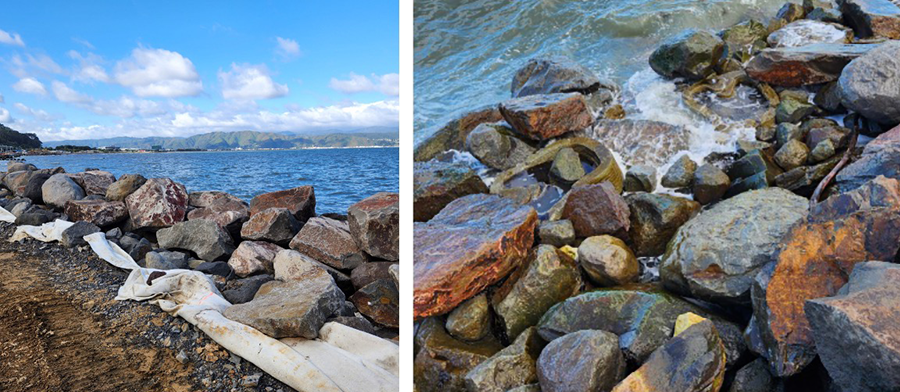
Construction phase. At right, tide pools required for ecological mitigation provide variability, enrich experience and exhibit a duty of care to build back opportunities for life (image by author, August 2024).
For the project, over and above the trajectory we have imagined, designed and consented, time will tell what success looks like.
To a large degree, this success relies on the more dynamic nature of the coastal edge in comparison to other environments, noting nothing is truly static in any landscape condition. We know there are issues. Kororā management, for example, is ongoing and at the forefront for the project.
My observation, contrary to what I might have thought otherwise, is that the constructors are serious about avoiding and minimising impacts on kororā – from a regulatory perspective certainly, but also to ensure positive relationships and reputations are maintained and, through engagement and education, to care for the birds themselves.
As pressure comes on to complete the project, these positive cultures are important to avoid adverse outcomes for kororā. Nonetheless, resilience of the transport corridor for all travel modes is a necessity for a functioning city. Additionally, with an abundance of life as a project outcome, we have the opportunity to prove the equitable idea of exchange between land and sea – rather than one over the other – and so to offer a compelling precedent for the designed edge.
Reflection
There is an understandable wariness of reclamation and other sensitive environment interventions within contemporary Aotearoa New Zealand.
Forest and Bird successfully appealed the granting of consent for an infrastructural project, Auckland’s East West Link (Environmental Protection Authority, 2024), in a case that centred (as I understand it) on weighing the aggregated benefits approach against the New Zealand Coastal Policy Statement policies to avoid reclamation. The Supreme Court has recently returned the project to the drawing board and, helpfully for the discourse, provided guidance on interpretation.
Linking this outcome back to design, challenge like any other constraint can be good for innovation and creative outcomes due to the focus of thinking it forces. I acknowledge here also that I provided design support for the East West Link, albeit in 2017, and the determinations are real and relevant for my practice. Within landscape architecture, most practitioners have a high regard for natural values and systems even in remnant form. Ecology and ecosystems in the scientific sense are universal threads in our work in aspiration, though not normally our core expertise. Along with its emphasis on climate change, expert messaging is increasingly about impending catastrophic loss of biodiversity from human and human-induced activity (Ministry for the Environment, 2019).
Our modified environments press in on indigenous ecosystems, particularly where we occupy an edge for functions that primarily serve us, directly competing with endemic species for space. Nonetheless, humans are part of nature inherently, even if our presence in places like Aotearoa New Zealand has been comparatively short, and binary or similar separation is causative and problematic. Our modifications could in some arguments be construed as an expression of nature even if that proposition is loaded with existential risk and, for that reason, of limited practical use. Such an argument, I think, is not really what we mean when we say nature is us; it is rather that there is no ‘them and us’.
In Aotearoa New Zealand, there is certainly interleaving of remnant ecosystems and imported organisms into environments modified by humans, and it is fair to acknowledge these elements do bring day-to-day benefits to human wellbeing. But the quality of execution and sometimes reliance on a happy accident approach could be more well rounded with respect to broader outcomes.
For landscape architects challenged by ecologists on the one-dimensional nature of planting (without habitat), the message can be hard to hear. Somewhere between full protection and complete permissiveness is the opportunity to look at creative solutions to build back better for robust biodiversity, cultural outcomes, good urban form, health and wellbeing benefits and infrastructure resilience, particularly when dealing with the coastal edge. If we are going wide in a design process, then all options should be considered on merit before focusing more specifically on effects, both positive and negative.
Where alternatives have been considered in depth and discounted (for good reason), part of the toolkit in that process should be considered reclamation and other interventions to achieve, where needed, resilience, urban form or other outcomes.
Where they are used, the right balance between subtlety and deftness is needed. Design should be backed by good data and tempered with self-doubt. In that regard, the builder’s adage of ‘measuring twice and cutting once’ makes sense as it is easier to intervene than go back, but the right cut is necessary for the right outcome.
It is my expectation that Ngā Ūranga ki Pito-One will be a success and become an example within Aotearoa of the building back of biodiversity in a considered and empathetic way for ecological (and landscape) values. I am not arguing for this approach as a model per se; rather that this occasion of design process demonstrates land-based tactics can have a place among the broad set of tools available to landscape architects to consider.
As to providing a high-quality experience, the project discussed here is blessed with a powerful and variable context within which to work. Buildouts provide places to rest, gather and contemplate and to achieve proximity.
With an outlook dominated by a landscape in which scale and environmental dynamics mute the human-influenced components, it is possible to forget peripheral ‘city noise’ with focused landscape architecture and in so doing, from a user perspective, gain the opportunity for formative experience and reconnecting to this coastline. The elements will be real, sometimes too much so.
With an outcome layered with life, should that be established as expected through careful analysis and design, it may even be possible to imagine the subantarctic in the gulls, seals and bull kelp on certain days and envisage some future visit to those wild islands.
About the author
Sean Burke BSc BLA(Hons) NZILA Reg is a Principal Landscape Architect at Isthmus and is based in the Tāmaki Makaurau (Auckland) studio and lives on Waiheke Island where his family have grown up. Sean has 24 years of experience in practice, building on an initial degree in earth sciences from the University of Waikato followed by a degree in landscape architecture from Lincoln University. Sean has interests in design, history and natural sciences and is an NZILA Registered Landscape Architect. Projects Sean is involved in are across a variety of scales; however, some of the larger projects typically unfold over several years. Sean’s involvement in Ngā Ūranga ki Pito-One began in 2016, when he worked on the consent design, and continues with the design and construct portion of the project programmed for completion in 2026. Similar coastal projects include the Beachlands Maraetai Walkway, Taumanu Reserve and Ngā Hau Māngere Bridge in Tāmaki Makaurau Auckland. Sean is a working-week commuter cyclist, ferry user and pedestrian and takes a multi-modal approach.
REFERENCES
Bell, J.; Bull, L.; Miller, A. (2023) Greening the Grey: Incorporating ecological enhancement into the Te Ara Tupua pathway. In Proceedings of the Australasian Coasts and Ports 2023 Conference, Sunshine Coast, QLD, Australia, 15–18 August. Accessed 30 April 2025. LINK
Department of Conservation (no date) Healthy Nature Healthy People. Accessed 10 April 2025. LINK
Environmental Protection Authority (2024) East West Link. Accessed 10 April 2025. LINK
Lister, G.; de Lambert, R.; Titchener, A. (2022) Te Tangi a te Manu: Aotearoa New Zealand Landscape Assessment Guidelines, Auckland: New Zealand Institute of Landscape Architects. Accessed 29 April 2025. LINK
Ministry for the Environment (2019) Theme 1: Our ecosystems and biodiversity. In Our environment 2019, Wellington: Ministry for the Environment. Accessed 29 April 2025, LINK
Waka Kotahi (2020) Te Ara Tupua: Ngā Ūranga ki Pito-One: Cultural & Environmental Design Framework (CEDF), Report prepared by Isthmus for Waka Kotahi. Accessed 29 April 2025. LINK