The Landscape: "Urban Vegetation" - is it real?
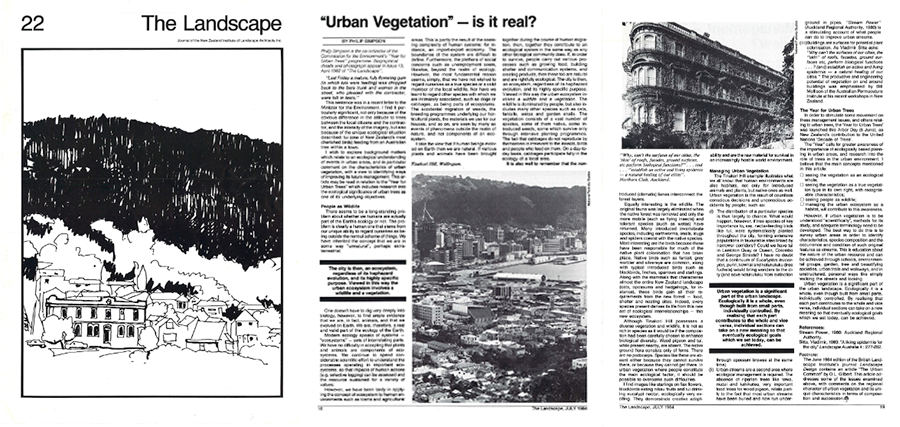
[This article, by Philip Simpson, is reproduced from issue 22 of The Landscape, as published 42 years ago in July 1984. Philip was the co-ordinator of the then Commission for the Environment's Year for Urban Trees programme. This continues a small series LAA is running called Looking back on The Landscape, curated by Alicia Keating].
by Philip Simpson
"Last Friday a mature, fully flowering gum (in which tuis were feeding) was chopped back to the bare trunk and women in the street, who pleaded with the contractor, were left in tears. "
This sentence was in a recent letter to the Minister for the Environment. I find it particularly significant, not only because of the obvious difference in the attitude to trees between the local citizens and the contractor, and the intensity of the imagery, but also because of the unique ecological situation described: tui (one of New Zealand's most cherished birds) feeding from an Australian tree within a town.
I wish to explore background matters which relate to an ecological understanding of events in urban areas, and in particular comment on the characteristics of urban vegetation, with a view to identifying ways of improving its future management. This article may be read in relation to the ‘Year for Urban Trees’ which includes research into the ecological significance of urban trees as one of its underlying objectives.
People as Wildlife
There seems to be a long-standing problem about whether we humans are actually part of the Earth's ecology or not. The problem is clearly a human one that stems from our unique ability to regard ourselves as being outside the normal scheme of things. We have inherited the concept that we are in some way "unnatural", perhaps extraterrestrial.
One doesn't have to dig very deeply into biology, however, to find ample evidence that we are, in fact, animals, and that we evolved on Earth . We are, therefore, a real and valid part of the ecology of the Earth.
Modern ecology speaks of systems - "ecosystems" - sets of interrelating parts. We have no difficulty in accepting that plants and animals are components of eco- systems. We continue to spend considerable scientific effort to understand the processes operating in important eco- systems, so that impacts of human actions (e.g. selective logging) can be assessed and the resource sustained for a variety of values.
However, we have been tardy in applying the concept of ecosystem to human en- vironments such as towns and agricultural 16 areas. This is partly the result of the seeming complexity of human systems: for instance, an import-export economy. The boundaries of the system are difficult to define. Furthermore: the plethora of social concerns such as unemployment seem, likewise, beyond the realm of ecology. However, the most fundamental reason seems, simply, that we have not wished to regard ourselves as a true species or a valid member of the local wildlife. Nor have we learnt to regard other species with which we are intimately associated, such as dogs or cabbages, as being parts of ecosystems. The accidental migration of weeds, the breeding programmes underlying our horticultural plants, the materials we use for our houses, and so on, are seen by many as events of phenomena outside the realm of nature, and not components of an eco-system .
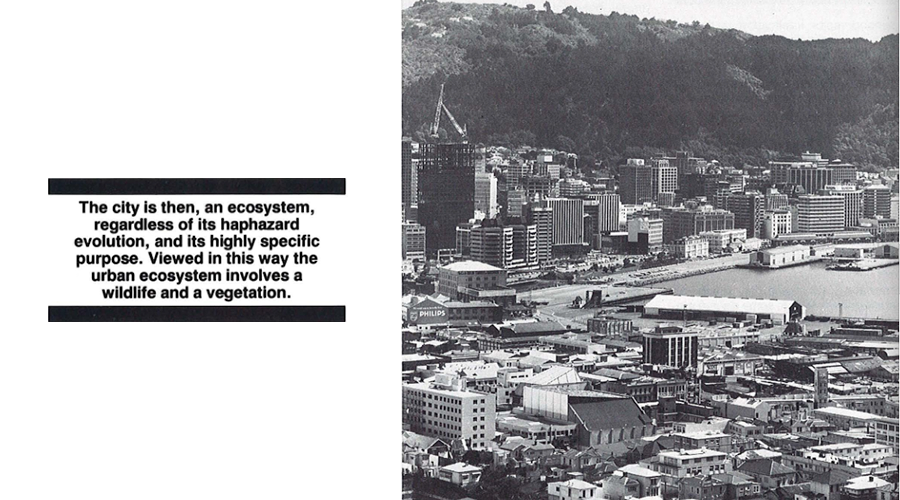
I take the view that if human beings evolved on Earth then we are natural. If various plants and animals have been brought together during the course of human migration, then, together they contribute to an ecological system in the same way as any other biological community does. If, in order to survive, people carry out various processes such as growing food, building shelter and communication systems, and creating products, then these too are natural and are rightfully ecological. The city is then, an ecosystem, regardless of its haphazard evolution, and its highly specific purpose. Viewed in this way the urban ecosystem involves a wildlife and a vegetation.
The wildlife is dominated by people, but also includes many other species such as cats , fantails, wetas and garden snails. The vegetation consists of a vast number of species, some of them native, some introduced weeds, some which survive only through intensive planting programmes. The fact that cabbages do not reproduce by themselves is irrelevant to the insects, birds and people who feed on them. On a day-to- day basis, cabbages participate fully in the ecology of a local area.
It is also well to remember that the non-material needs of people, such as the need to perceive beauty, are just as important, ecologically, as material needs. Non-material needs are a survival necessity for our culture in terms of an adequate quality of life. We do not live by bread alone, as the saying goes.
I would also hasten to add, in introducing the concept of "quality", that ecosystems which evolved in the absence of human influence have special features which require careful management because of their uniqueness and the ease with which they can be modified. In contrast, human ecosystems can tend to be rather uniform regardless of where they occur on Earth. Of course, if we look closely, we find that there are differences between one urban ecosystem and another, even in adjacent cities within New Zealand. It is this very fact of diversity within urban ecosystems that underpins the need to understand them individually so that overall management contributes to the diversity rather than the uniformity. As I shall comment later, however, the ecological necessity is the linking together of diverse features into a functional system , not the mere presence of a diverse range of features. I am reminded again of the tui and the gum tree .
Urban Vegetation
A description of vegetation, uninfluenced by humans, would include a number of different factors: the species present and their biogeography, the appearance of the vegetation (whether forest, grassland etc.), the geology and landforms of the area, soils, climate and wildlife .
These same factors are relevant to a description of urban vegetation, although their relative importance is altered. About half of an urban area consists of non-vegetated buildings and roads, landforms created by people , and is of great importance to urban wildlife. Reclamation creates new lithologies, and urban soils may possess unusual physical and chemical composition. Local climate and local drainage patterns may be altered substantially.
One particular element of the wildlife - people - has profound influence on both the vegetation and other wildlife. People largely control the species composition and the overall appearance of the vegetation. People also influence the species composition of wildlife. For example, a high population of cats is characteristic and, because cats are predators , the occurrence of other species, such as native forest birds, is influenced.
My intention is to describe some of the characteristics of urban vegetation viewed as a true vegetation type, a whole inter- relating set of components. I am hindered somewhat by the fact that urban vegetation has qualities not usually encountered in non-human systems, and consequently the terms used may not be entirely appropriate.
Urban vegetation consists of a number of different components which interrelate as a whole. These components may include: - very rarely, remnants of original native forest, swampland or duneland; - developing secondary native and/or exotic forests and woodlands (including riparian areas); - treelands and shrublands (parks, gardens and open spaces); - herbfields (ornamental and vegetable gardens, weedlands); - lawns; - houseplants, and other miscellanea.
Urban vegetation has a high species diversity. Most of the species are introduced and most do not reproduce by themselves. In New Zealand, most urban areas are surrounded by exotic grassland with low species diversity. Urban areas are "islands" of diversity.
The component species have been brought from many regions of the world. The assemblage could be termed "cosmopolitan" but has a New Zealand flavour through the particular origin of New Zealand people, and the presence of native species. New ecological inter- relationships have been established .
Different components exist side by side in a very complex mosaic. For instance, lawns, gardens and woodlands can form a repeating pattern based on a property size of 0.1 - 0.2 ha.
Urban vegetation is associated with a large number of non-vegetated areas - buildings and roads. Numerous "islands" of vegetation occur, from extensive green belts to isolated plants. These isolated areas can become important refuges for wildlife.
Urban vegetation is a seral community. In other words, it remains in a somewhat juvenile condition through continual disturbance. It is managed to ensure that other human needs are maintained . Humans control the thinning and regeneration processes. Age of the oldest vegetation tends to coincide with the age of associated buildings. The vegetation of a suburb matures as a unit.
Species composition changes over time as the fancies of people change. Recent plantings have a greater proportion of native species than early New Zealand planting which concentrated on deciduous trees, conifers and eucalypts.
Some species are very common, either through regeneration or because a large number have been planted. Conversely, a high proportion of rare or unusual plants is found. Public and private gardens are an important source of endangered plant material. For instance, the survival of the "living fossil" Ginkgo is said to relate to its traditional use around Chinese and Japanese temples; it is now widespread throughout urban areas of the western world.
Although several factors influence the distribution of a particular species, the variables are so numerous that distribution is complicated and unpredictable. Consequently, there can be large gaps between individuals of the same species.
In native vegetation , the pattern of plant distribution is controlled by events which take place within the physical environment, and also between the various members of the biological community. In urban vegetation physical events, like windstorms and frost, likewise play an important role, but the factor of overwhelming significance is human activity. People control plant succession; for instance, by removing or trimming plants when they get too big. Regeneration through seedling and seedling establishment takes place within those areas outside direct human control, but is substituted by replanting of nursery-grown stock for most species within controlled areas. Annual plants are very common in urban vegetation but are rare in native vegetation. In a wild environment new surfaces are created mainly by earth-moving associated with building, roading and reclamation. Fires can also be important in rejuvenating urban shrublands like gorse. Together, these intentional or accidental human activities create an environment which supports a highly distinctive vegetation (and wildlife).
Although urban vegetation could be easily recognised anywhere in the world, its exact expression depends on a variety of factors including the physical environment, the degree to which native vegetation is represented, and of course, the types of plants people have introduced. It is the relationship between the native and introduced components that adds a great deal of interest to this ecosystem and creates distinctive local character.
Tinakori Hill: A Wellington Example
On Tinakori Hill the original lowland rain forest was destroyed by fire during Polynesian and early pakeha time. Before 1900 the hill was farmed, but early this century parts were planted with pines, macrocarpa, eucalypts, maple and oak, as well as a variety of natives such as pohutukawa, mangeao and beech. Since then the vegetation has been largely left to regenerate by itself. Today it is mainly forest-covered with a great mixture of species. Beneath the exotic trees a dense understorey of native species, not all of them local in original distribution, has developed, including mahoe, five-finger, kawakawa, coprosma and tree ferns. Native ferns have colonised the forest floor along with introduced herbs like Tradescantia, and fungi such as fly agaric, Amanita. Both native (bush lawyer, pohuehue) and introduced (clematis) lianes interconnect the forest layers.
Equally interesting is the wildlife. The original fauna was largely eliminated when the native forest was removed and only the more mobile (such as flying insects) and tolerant species (such as wetas) have returned . Many introduced invertebrate species, including earthworms, snails, slugs and spiders coexist with the native species. Most interesting are the birds because these have been responsible for much of the native plant colonisation that has taken place. Native birds such as fantail, grey warbler and silvereye are common, along with typical introduced birds such as blackbirds, finches, sparrows and starlings. Along with the mammals that characterise almost the entire New Zealand landscape (cats, opossums and hedgehogs, for instance), these birds gain all their requirements from the new forest - food, shelter and nesting sites. Indeed, every species present derives its life from this new set of ecological interrelationships - this new ecosystem.
Although Tinakori Hill possesses a diverse vegetation and wildlife, it is not as rich in species as it would be if the composition had been carefully chosen to enhance biological diversity. Wood pigeon and tui, while present nearby, are absent. The native ground flora consists only of ferns. There are no podocarps. Species like these are absent either because they cannot survive there, or because they cannot get there. In urban vegetation where people constitute the main ecological factor, it should be possible to overcome such difficulties.
I find images like starlings on flax flowers, blackbirds eating nikau fruits and tui drinking eucalypt nectar, ecologically very exciting. They demonstrate creative adaptability and are the raw material for survival in an increasingly hostile world environment.
Managing Urban Vegetation
The Tinakori Hill example illustrates what we all know: that human environments are also habitats, not only for introduced animals and plants, but native ones as well. Urban vegetation is the result of countless conscious decisions and unconscious accidents by people ; such as:
(i) The distribution of a particular species is thus largely to chance. What would happen, however, if tree species of key importance to, say, nectar-feeding birds like tui , were systematically planted throughout the city, forming extensive populations in favourable sites linked by narrower corridors? Could we have tui in Lambton Quay or Queen, Colombo and George Streets? I have no doubt that a continuum of Eucalyptus leucoxylon, puriri, kowhai and kotukutuku (tree fuchsia) would bring wonders to the city (and save kotukutuku from extinction through opossum browse at the same time).
(ii) Urban streams are a second area where ecological management is required. The absence of riparian trees like tawa, matai and kahikatea, very important food trees for wood pigeon, relate partly to the fact that most urban streams have been buried and now run under-ground in pipes. " Stream Power" (Auckland Regional Authority, 1980) is a stimulating account of what people can do to improve urban streams. ~
(iii) Buildings are surfaces for potential plant colonisation . As Vladimir Sitta asks: "Why can't the surfaces of our cities, the " skin " of roofs, facades, ground surfaces etc, perform biological functions . .. ? (and) establish an active and living epidermis - a natural healing of our cities." The productive and engineering potential of vegetation on and around buildings was emphasised by Bill Mollison of the Australian Permacuture Institute at his recent workshops in New Zealand.
The Year for Urban Trees
In order to stimulate some movement on these management issues, and others relating to urban trees, the 'Year for Urban Trees' was launched this Arbor Day (5 June) 1984, as New Zeaiand's contribution to the United Nations 'Decade of Trees'.
The "Year" calls for greater awareness of the importance of ecologically based planning in urban areas, and research into the role of trees in the urban environment. I believe that the main concepts mentioned in this article [namely]:
seeing the vegetation as an ecological whole
seeing the vegetation as a true vegetation type in its own right, with recognisable characteristics
seeing people as wildlife
managing the urban ecosystem as a habitat, will contribute to this awareness.
However, if urban vegetation is to be understood "scientifically", methods for its study and adequate terminology need to be developed.
The best way to do this is to survey urban areas in order to identify characteristics, species composition and the occurrence and condition of such original features as streams.
This is education about the nature of the urban resource and can be achieved through schools, environmental groups, garden, tree and beautifying societies, urban trails and walkways, and in unstructured, personal ways like simply walking the streets and looking.
Urban vegetation is a significant part of the urban landscape. Ecologically it is a whole , even though built from small parts, individually controlled. By realising that each part contributes to the whole and vice versa, individual sections can take on a new meaning so that eventually ecological goals which we set today, can be achieved.
References: Stream Power, 1980: Auckland Regional Authority; Sitta, Vladimir, 1983: "A living epidermis for the city" Landscape Australia 4 : 277-282.
Footnote: The June 1984 edition of the British Landscape lnstitute's journal Landscape Design contains an article "The Urban Common" by 0.L. Gilbert. This article addresses some of the issues examined above, with comments on the regional character of urban vegetation and its unique characteristics in terms of composition and succession .
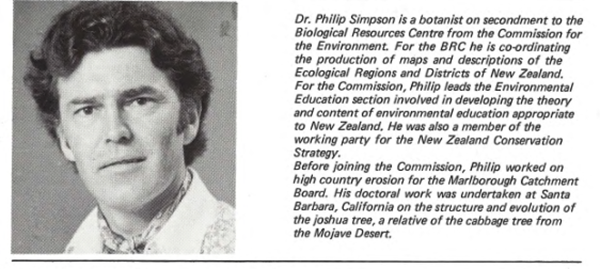
The biographical details above appeared in issue 13, April 1982 of The Landscape.