City Layers: A buried reservoir and urban contradictions
In common with all of its counterparts around the motu of Aotearoa, many of the landscape and urban design elements that make Whanganui a Tara Wellington what it is, are constantly seesawing between concealment and emergence, acceptance and debate.
Some planned-for elements like the Golden Mile streetscape revitalisation receive an indeterminate shelving, as happened this month, while other projects like the mammoth Omāroro reservoir now snuggled into the suburb of Mt Cook - also known as Puke-ahu - emerge slowly over time, until they enter into a type of feature that might be called 'best kept secrets'.
On the grey Sunday afternoon of 21 June, the local branch of Tuia Pito Ora New Zealand Institute of Landscape Architects ran a guided tour conducted by NZILA Fellow Steve Dunn of the Omāroro reservoir site, nestled betwixt the playing fields of the Prince of Wales Park.
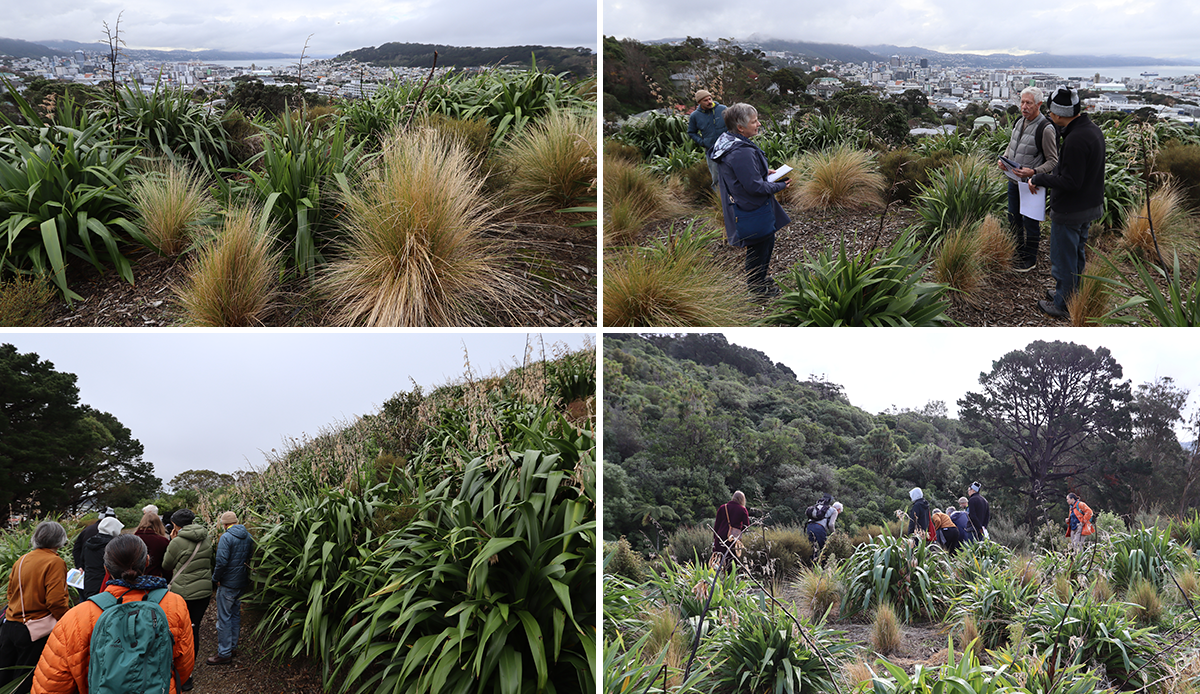
Photos by Stephen Olsen
Amongst others, Steve was joined by Cheryl Robilliard (retired landscape architect), Rong Qian (Hutt City), Eve McLachlan (Urban Edge Planning) and keen Te Herenga Waka Victoria University landscape architecture aficionados Vikki Chanse, Maria Rodgers, Angela Joe and Richie Green.
The area is one of the few buried reservoirs in the country and was officially re-opened for public access in February 2024, as little more, vegetation-wise, than a predominantly grassy knoll. At the time it was reported that this $70 million infrastructure build was delivered on time and within the amended budget, with the 35 million litre underground facility being put into service one year ahead of schedule in December 2022.
From a Boffa Miskell perspective Steve spoke about the integration of the reservoir within the Town Belt, with a focus on discussing the progress of the mass-scale restoration planting, maintenance, site options and surrounding natural waterways. Boffa Miskell's involvement went as far back as work done on habitat protection in 2020 by ecologists Stephen Fuller and Amanda Healy.
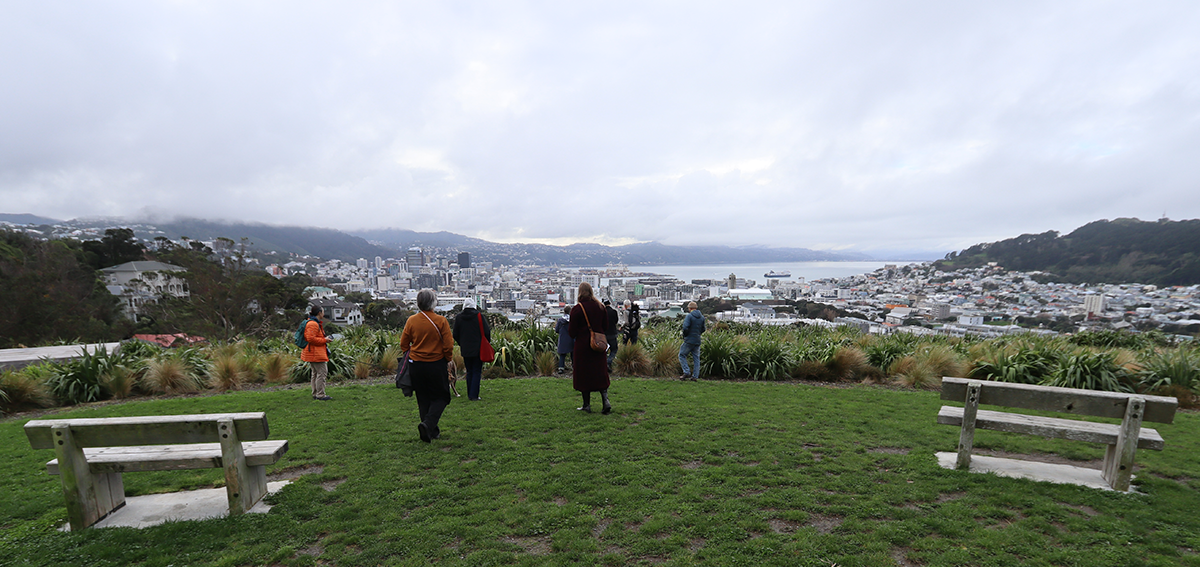
City locals who eyeballed this project from start-to-finish and who continue to include it on their Town Belt jaunts, have witnessed a transformation that delivers a one-of-a-kind lookout down to Te Aro and the harbour. It definitely belongs in a ‘best kept secret’ category and is well worth seeking out.
Alternative Takes on the Town Belt
Staying with the Town Belt of Wellington, Te Herenga Waka VUW senior lecturer Crystal Olin contributed a significant paper on its "beauty and contradiction" for a special issue of the highly regarded Journal of Urban Regeneration and Renewal earlier this year.
The paper situates the city's historically anomalous and deeply colonial Town Belt within wider debates, and offers a provocative critique. It makes the point that while the Town Belt provides "an enduring ring of public green space that has shaped the city’s urban form ... its presence can mask significant gaps in equitable, everyday access to green space within the compact urban area it encircles".
Crystal writes that "Wellingtonians are justifiably proud of their Town Belt and what it offers toward the public good. Unlike London or Seoul, Wellington’s Town Belt is not under large-scale pressure from greenfield development: its protections are strong, and there is little political appetite to release land for housing at its margins".
At the same time she challenges "the illusion that it provides sufficient green infrastructure within reach of the city’s increasingly diverse and growing population", adds a supposition that the city's inertia towards "greening its core is an unintended by-product of the Town Belt’s familiarity and its assumed or exaggerated accessibility" and concludes that rather than the Town Belt being revered as the city’s flagship green infrastructure achievement "success should be judged by the environmental health and human well-being outcomes enabled by green (and blue) space planning and provision [throughout the city]".
As well as stepping in and out of academia, Crystal, who arrived from the USA to Aotearoa New Zealand in 2012, has enjoyed a strong career as an urban design practitioner at both Dunedin and Wellington city councils, is teaching urban design and is a solid supporter of landscape architecture students. In recent years Crystal has been involved with the Australasian Cities Research Network (ACRN) and recently took up the role of ACRN Co-Chair. She was part of the team that delivered the highly successful 2023 State of Australasian Cities (SOAC) Conference held in Wellington and was a presenter at the 2025 International Conference on Urban Health (co-organised by the NZ Centre for Sustainable Cities and also held in Wellington)
Editor’s notes:
Two sets of guides to restoration planting are accessible on both the Wellington City Council website and the Greater Wellington Regional Council website.
LAA will be returning to the observations that Crystal Olin makes on urban green space, along with related on-the-ground projects. Meanwhile readers can download her piece for Journal of Urban Regeneration and Renewal at openaccess.wgtn.ac.nz
For a separate sampling of critical thinking about the ups-and-downs of city-making in Te Whanganui a Tara Wellington, we also recommend taking in the most recent City Talk event organised by the Wellington branch of Te Kāhui Whaihanga New Zealand institute of Architects.
This first City Talk for 2026 saw urban designer Gerald Blunt deliver a lecture titled A Contradictory City (available now to view on YouTube). The talk delved into arguments for why Wellington deserves to hold its Capital city status, as well as revealing hints of a forthcoming book.