Urban Vegetation & Urban Trees: How far have we come in 42 years?
On 26 June Landscape Architecture Aotearoa reproduced an article by Philip Simpson from NZILA Tuia Pito Ora’s original magazine The Landscape:, titled “Urban Vegetation” – is it real? (Issue 22, July 1984). Accelerating to 2026, Wellington-based NZILA member Amy Hobbs has offered this reflective response to Philip’s ‘Year of the Tree’ article.
by Amy Hobbs, Landscape Architect
Reading Philip Simpson’s article from July 1984 brought a striking sense of déjà vu to similar issues that we still face today. Over four decades later, as a landscape architect, I find myself grappling with the exact same philosophical and operational frictions.
We have made profound leaps in our ecological understanding and endorsement of strategies related to our urban settings, yet the core tension remains around treating the city as an ecosystem versus treating it as a collection of isolated assets; and being able to deliver on urban green infrastructure strategies effectively.
When I reflected on a few key points in the 1984 article (centred on Te Whanganaui a Tara Wellington) what really stood out for me is the innate connection that people have with trees, and that sometimes this is put on the back burner when we are tasked as humans with ‘just doing our job’ like in the case of the citizen vis-a-vis the contractor captured at the very beginning of Philip’s article:
"Last Friday a mature, fully flowering gum (in which tuis were feeding) was chopped back to the bare trunk and women in the street, who pleaded with the contractor, were left in tears."
This highlights a rift between the local citizen’s daily, experiential relationship with a tree and the contractor’s task-oriented execution.
We still see this clash play out today. To a resident, a street tree is a provider of shade, a seasonal marker, and a psychological anchor. To a utility contractor or a transport engineer working on underground services, that same tree can be viewed as a compliance risk or a physical barrier to infrastructure delivery.
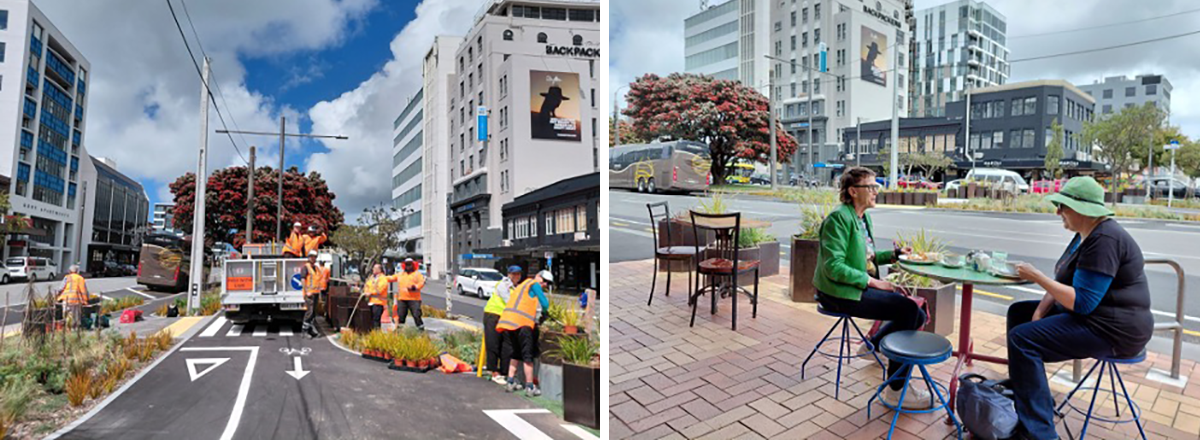
Greening Kent and Cambridge Terraces with Contractors and volunteers, while local residents enjoy food and beverages on Kent Terrace with the nearby mature kowhai and gardens seen in the background.
There is a shift that has been happening progressively since 1984.
A key example is the deliverables currently being delivered through Wellington City Council’s Green Network Plan. As landscape architects, we are trying to close this difference or gap by advocating for and proposing innovative modular underground systems (like structural soil cells) within streetscape projects that we are privileged to have an influence in.
We are progressively shifting the narrative so that trees are designed into the streetscape as essential ‘green infrastructure’ from day one, rather than treating them as decorative furniture to be dropped into a hostile environment at some later date.
The author in 1984 lamented that we understand sustainable resource management in wild spaces (like selective logging) but are "tardy in applying the concept of ecosystem to human environments."
Is this still the case? Yes and no.
We now explicitly talk about the "urban ecosystem," but our systems of funding and governance remain siloed. Complex human economic realities such as the urgent pressure for housing densification and the fiscal constraints of local government amongst other city priorities, still often push ecology to the periphery today.
The 1984 insight that "dogs and cabbages are part of ecosystems" is more relevant than ever. An urban ecosystem isn’t a pristine wilderness. It is a hybrid space where humans, domestic animals, introduced exotics, and indigenous flora and fauna must coexist.
As quoted from the 1984 article "Non-material needs of people such as the need to perceive beauty are just as important ecologically as material needs... they are a survival necessity for our culture in terms of an adequate quality of life."
This quote hits home. In an era where Te Aro (central Wellington city) is rapidly densifying and expanding its residential population, green spaces are no longer ‘nice to haves’ or cosmetic embellishments. They are public health infrastructure.
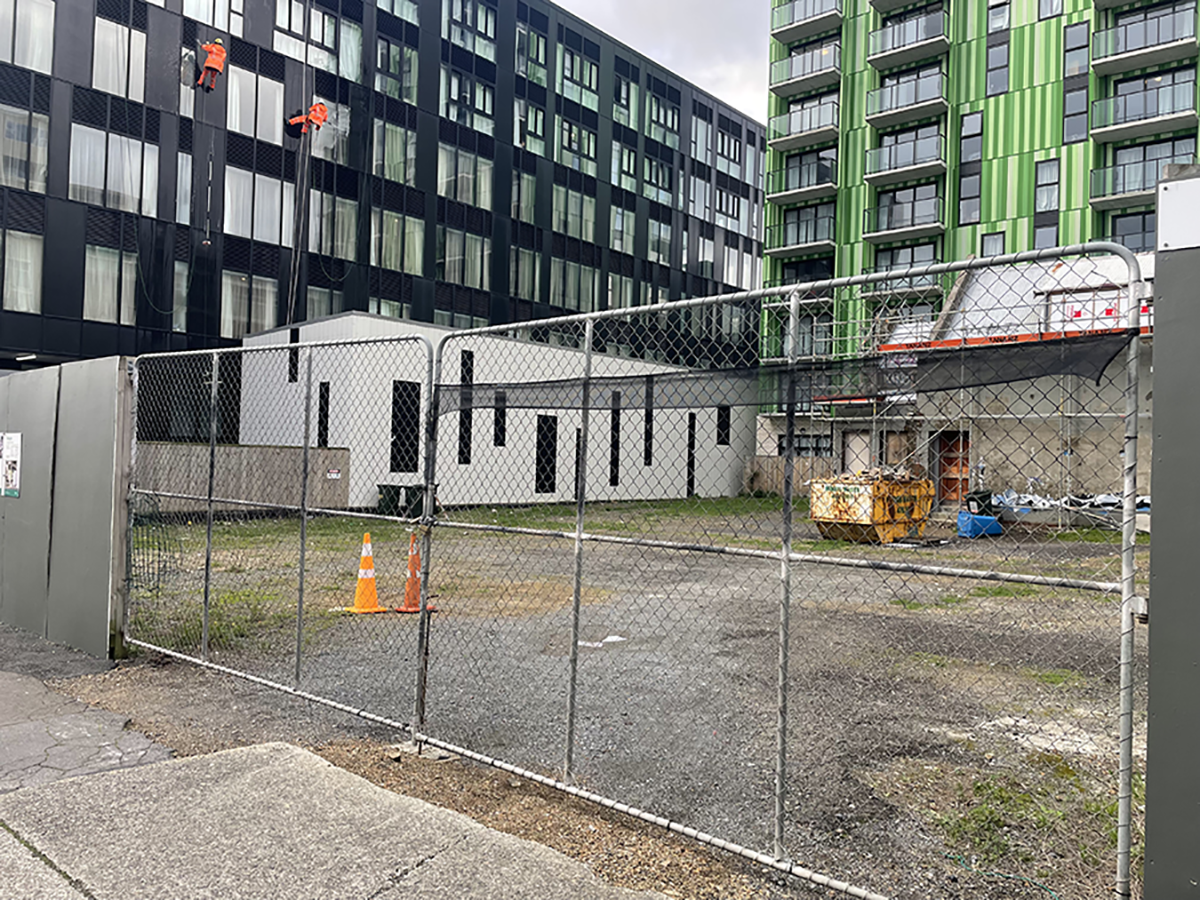
Wellington’s Central City Green Network Plan targets a doubling of the central city tree canopy (aiming for 4,000 trees) and delivering new urban oases like Frederick Street Park about to be constructed at the intersection of Taranaki and Frederick streets (seen above).
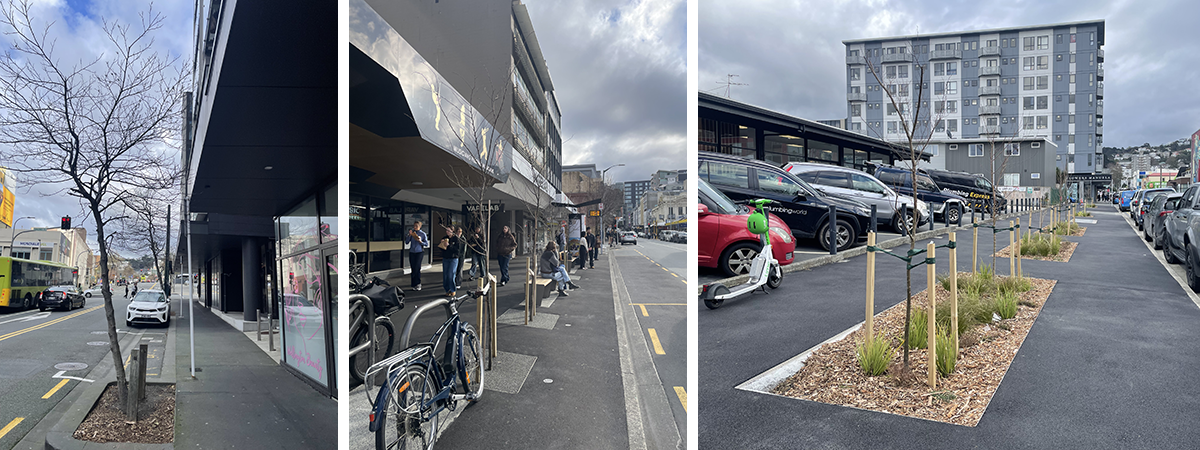
New tree pits have been constructed for the mature kowhai trees on Kent Terrace and Tui were seen flocking to their flowers last year. Ghuznee St has had some roading improvements made this year which included improving the tree pits and there was also tree work completed in Abel Smith Street. These are examples of the Green Network Plan in action within the city centre and of coordinating urban tree improvements with other urban and roading projects.
We are seeing some success in private and public partnerships such as the development at 1 Whitmore St, Farmers Lane planters, and the creation of the public park on Victoria Street between the Victoria St Precinct development and St Peter’s church on Willis Street, as well as the revitalised Denton Park and adjacent shared space on Lombard St.
On the outskirts of the city, we have even seen a few trees and plants pop up along sections of Te Ara Tupua (the ancient pathway) in environments that are arguably the city’s most challenging edge for nurturing trees and plants to full growth. For example between Petone (Piti-one) and Ngāuranga (Ngā-ūranga) and along Cobham Drive.
According to a 2023 report (Leveling the playing field - green spaces as vital urban infrastructure) prepared by the Parliamentary Commissioner for the Environment and spoken to by Commissioner Simon Upton at NZILA’s 2024 Firth NZILA Wānanga, urban green spaces must be treated as vital infrastructure every bit as important as pipes and roads, especially to mitigate the heat and extreme rain events of a changing climate.
Yet, despite robust strategic frameworks, decades of data reveal a steady decline in urban greenery per person across New Zealand. The report notes the following statistics:
Auckland: Between 1980 and 2016, green space per person fell by at least 30%.
Hamilton: Over the same period, green space per person dropped by at least 20%.
Greater Wellington: The overall proportion of urban green space remained the same
While Greater Wellington as a wider region performs incredibly well on paper due to its vast regional parks and iconic outer green belt/ Town Belt, zooming into the Wellington central city reveals a drastically different and much harsher reality.
The NZ Centre for Sustainable Cities reveals that the dense central city faces a severe green infrastructure deficit, with core areas like Te Aro reduced to a critical low of just 6m² of green space per capita. Despite targeted strategies like the city's 2022 Green Network Plan, execution remains trapped at a glacial pace by the complex realities of retrofitting trees into a paved, congested subterranean maze of underground utilities, and rapidly densifying urban core.
A poignant example of this bottleneck of taking our relevant strategies through to delivery is visible along Wellington’s waterfront quays.
Waterfront greening was championed over two decades ago in Jan Gehl’s landmark 2004 City to Waterfront study. Yet when hardy pohutukawa trees were selected and planted to establish a green corridor, it sparked intense debate within the local landscape community because the species is not strictly endemic to the Wellington region. The trees are however hardy to the specific urban environment, relatively low maintenance and do provide habitat and food supply to local fauna.
By the time Gehl Architects returned in 2021 to conduct a follow-up survey for Let’s Get Wellington Moving, the data still pointed to a severe central city greening deficit, proving that even when global urban design experts provide a clear blueprint, execution remains bogged down by localised friction and a failure to prioritise green elements as mandatory civic infrastructure.
As landscape architects contributing to the conversation of city ‘greening’, we aren't just advocating and planting for aesthetics, we are strengthening our urban ecosystems.
We propose solutions that mitigate the urban heat island effect, absorb and slow down stormwater, and prevent the psychological fatigue of a concrete and asphalt existence. Beauty is an ecological imperative for human retention in the city centre. We also have climate change to grapple with. If temperatures do increase by the predicted 3 to 4 degrees celsius by the end of the century, many popular species are predicted to not survive, therefore tree selection and placement is going to be crucial.
Echoing the 1984 article again, it rightly points out that true ecological necessity lies in linking features into a functioning system, rather than just accumulating a diverse but fragmented list of species. This instantly brings to mind the classic Wellington sight of a native Tūī feeding enthusiastically on a non native tree or plant species referenced in The Landscape article.
Nature does not care about strict design borders. Wildlife adapts. This brings us to the profound impact of Zealandia Te Māra a Tāne and the increased birdlife we can now experience in the centre of Pōneke, aided in tandem by the success of initiatives such as Predator Free Wellington.
The 1984 article poses the question “Could we have Tūī on Lambton Quay?” Absolutely! In fact, we already do. Alongside Kākā, Kererū, Kārearea and Piwakawaka making daring forays into our densest commercial corridors. The ‘Zealandia effect’ has flooded our city with birdlife, but it has exposed a glaring vulnerability, our urban landscapes are still too hostile to support them fully.
If a Kākā leaves the safety of the Town Belt or Zealandia to fly down to Lambton Quay, it needs structural stepping stones. It needs canopy cover to hide from predators, pocket parks to forage, and water sensitive urban design to drink from (more than just my mis-aligned gutters at home which they drink from regularly).
These ‘stepping stones’ are not a new concept and are being continually tested and explored through the work of landscape related / adjacent professionals and students at universities studying for their future careers in landscape architecture.
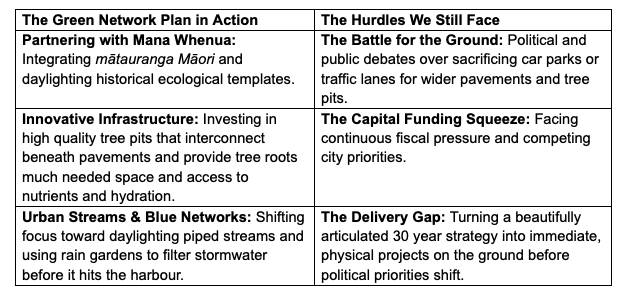
I have provided a succinct table of the hurdles we still face in relation to some of the actions identified in the Wellington Central City Green Network Plan with regard to where we are landing projects and where we are failing.
In Conclusion
In conclusion, do we deserve more trees and vegetation, carefully created to attract wildlife back to our cities and to improve our non-material survival needs?
The answer is that we do deserve them, but we have to actively design, fund, and defend them. The ecological goals we set today are entirely achievable and will significantly benefit our tamariki, mokopuna and generations to come.
More than four decades after the ‘Year of Urban Trees’, and with Gehl's 2021 follow-up survey still calling for urgent central city greening and with the research and strategies of Wellington’s Central City Green Network Plan available to us, we are left with a sobering paradox: Our strategies are robust, yet our city centre spaces remain stubbornly grey.
It forces us to ponder whether we truly value green infrastructure for its own merits, or if we still treat the living world as a luxury that is only permitted to exist when hitched to the back of a pipe or a roading project. We are also forced to ask why our grandest strategies remain trapped at a glacial pace in terms of delivery on the ground.
We are slowly considering cities as ecological landscapes in their own right, rather than fundamentally separate from nature, though we are still negotiating the endless gauntlet of bureaucracy to deliver on our urban tree and greening infrastructure strategies.
Like other critical infrastructure, we should also be treasuring the urban green assets we have grown by allocating adequate resources to look after them and replace them when they succumb to vandalism or death due to the tough urban environmental conditions they grow within.
We need to take our kaitiaki role seriously and take a long term, multi-generational view to greening rather than responding on a project-by-project basis. Climate change challenges and a focus on building resilient cities, has given urban greening greater urgency, but progress is still very slow, and like other critical infrastructure projects, too exposed to the winds of political change.
By treating the central city as a living, breathing continuum connecting our blue networks (streams/ awa/ wetlands) and green infrastructure, we can ensure that Pōneke remains a place where both humans and wildlife don't just survive, but genuinely thrive.
I think there is merit in the ‘Year for Urban Trees’ initiative that the 1984 article showcased. We need to take a lead from this initiative’s long-ago legacy to stimulate conversation and movement on these important city ecosystem issues.
There are many ways we can increase education about the benefits of urban trees mentioned in the 1984 article that are still relevant today, such as through schools, environmental and city groups, urban trails, walkways and around the Council table.
Written almost half a century ago, Philip Simpson’s article reflected on the awareness of seeing our urban and suburban vegetation as an ecological whole, seeing it as a true vegetation type in its own right and seeing people as wildlife. It emphasises that managing the urban ecosystem as a habitat will contribute to this awareness.
We just need to walk the streets and start reflecting on how far we have come since 1984 to help us imagine what our city could be in another 42 years.
Editor’s note: For some related reading see City Layers: A buried reservoir and urban contradictions If you have stories from your town or city of turning the tide towards more green spaces please contact laaotearoa@nzila.co.nz